Applied Trigonometric Mastery
The Unit Circle
Beyond Right Triangles
Your knowledge of SOH CAH TOA is perfect for finding side lengths in right triangles. But what about an angle of 120°, or a negative angle like -45°? Triangles can't accommodate these values. To handle any angle, we place trigonometry onto the coordinate plane using a tool called the unit circle.
The unit circle is a circle with a radius of 1, centered at the origin (0, 0) of the Cartesian plane.
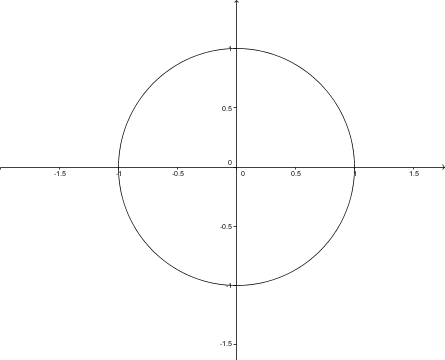
Every point (x, y) on the edge of this circle can be described by the angle, , formed by a line from the origin to that point and the positive x-axis. By convention, positive angles sweep counter-clockwise.
Coordinates Redefined
Here's the crucial shift: on the unit circle, the sine and cosine of an angle are defined by the coordinates of the point where the angle's terminal side intersects the circle.
This works perfectly with SOH CAH TOA. Imagine a right triangle inside the circle. The hypotenuse is always 1 (the radius). The side adjacent to is the x-coordinate, and the side opposite is the y-coordinate. So, , and .
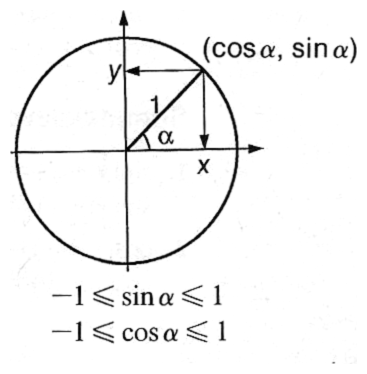
This direct link between coordinates and trig functions unlocks a powerful identity. The equation for any circle centered at the origin is . For the unit circle, , so we have . By substituting our new definitions for x and y, we get the fundamental Pythagorean Identity.
All Four Quadrants
The true power of the unit circle is that it extends trigonometry beyond the first quadrant. As the angle moves past 90°, the x and y coordinates become negative, which in turn makes their corresponding cosine and sine values negative.
| Quadrant | Angle Range | x (cosine) | y (sine) | tan = sin/cos |
|---|---|---|---|---|
| I | 0° to 90° | + | + | + |
| II | 90° to 180° | - | + | - |
| III | 180° to 270° | - | - | + |
| IV | 270° to 360° | + | - | - |
A common mnemonic to remember which functions are positive in which quadrant is the , starting from Quadrant IV and moving counter-clockwise: Cosine, All, Sine, Tangent. Of course, in Quadrant I, they are all positive.
To find the trig values for an angle greater than 90°, we use a —the acute angle that the terminal side of makes with the horizontal x-axis. This allows us to use the familiar values of our 30°, 45°, and 60° triangles and simply adjust the sign based on the quadrant.
For example, the angle 150° is in Quadrant II. Its terminal side makes a 30° angle with the negative x-axis, so its reference angle is 30°. In Quadrant II, sine (y) is positive and cosine (x) is negative. Therefore, , and .
Key Angle Coordinates
By applying the concept of reference angles, we can determine the exact coordinates for multiples of 30°, 45°, and 60° all around the unit circle. These specific angles and their corresponding coordinates are foundational and worth committing to memory.
Let's review these core concepts.
Now, check your understanding with a few questions.
On the unit circle, what do the x and y coordinates of the point where the angle's terminal side intersects the circle represent?
Which fundamental identity is a direct result of applying the unit circle's equation, ?
The unit circle is a bridge from the static world of right triangles to the dynamic, cyclical nature of waves, orbits, and vibrations that trigonometry describes so well.