Applied Thermodynamics for Engineers
First Law Applications
Energy in Motion
The First Law of Thermodynamics is a statement of energy conservation. In a closed system, where no mass can enter or leave, it's a straightforward accounting of heat, work, and internal energy changes. But most engineering applications, from jet engines to power plants, involve mass flowing through the system. To handle these, we need to expand our toolkit.
We start by defining a control volume—a specific region in space we want to analyze. Mass and energy can cross the boundary of a control volume. Think of it as drawing an imaginary box around a device, like a pump or a turbine, and then tracking everything that goes in and comes out.
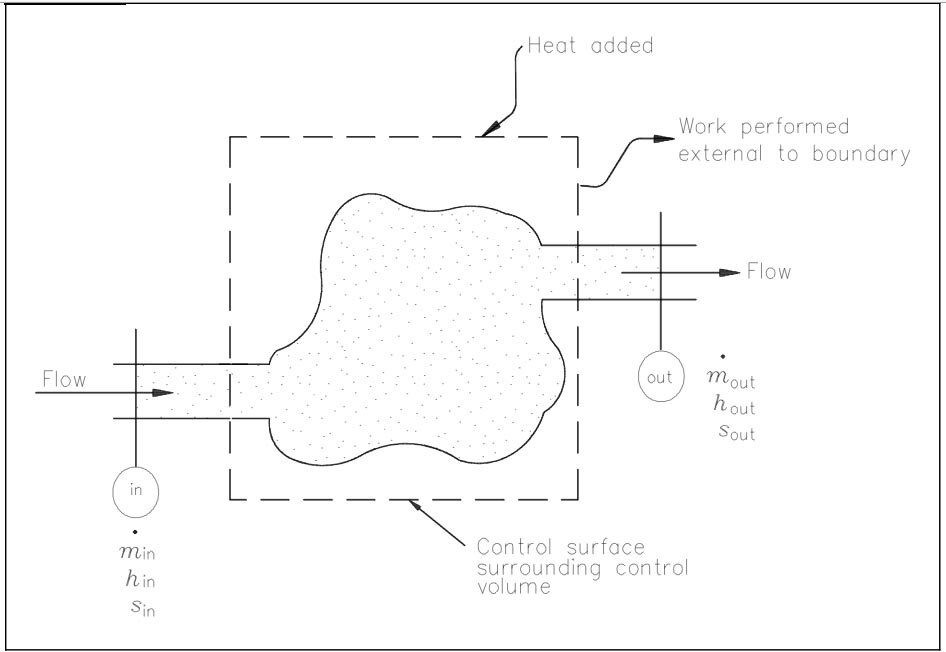
For a control volume, mass must be conserved. In a —where the conditions within the control volume don't change over time—the mass entering the system must equal the mass leaving it. This simple but powerful idea is the principle of conservation of mass.
Enthalpy and Flow Work
When mass enters a control volume, it brings its own energy with it—internal, kinetic, and potential. But it also requires work to be pushed into the system against the existing pressure. This is called flow work.
To simplify our energy balance, we combine internal energy () and flow work () into a single, convenient property called (). It represents the total energy content of a flowing fluid.
Using enthalpy, we can write the energy balance for a steady-flow system. The total energy entering the control volume must equal the total energy leaving it. This includes heat transfer, work, and the energy carried by the mass.
Analyzing Engineering Devices
The general energy equation looks complex, but for specific devices, we can simplify it by making reasonable assumptions. Many devices are well-insulated, have negligible changes in height, or involve very little work.
Nozzles and Diffusers
A nozzle is a device that increases the velocity of a fluid at the expense of its pressure. A diffuser does the opposite, increasing pressure by slowing the fluid down. They are commonly found in jet engines and rockets.
For these devices:
- Work is zero ().
- Heat transfer is usually negligible ().
- Potential energy change is negligible ().
The energy balance simplifies to a trade-off between enthalpy and kinetic energy.
Turbines and Compressors
A turbine extracts work from a high-pressure fluid, causing it to expand and cool. A compressor (or pump for liquids) does the opposite, using work to increase the pressure of a fluid.
For these devices:
- Heat transfer is often small compared to the work done ().
- Kinetic and potential energy changes are usually negligible.
The energy balance is primarily a relationship between work and the change in enthalpy.
Heat Exchangers
A heat exchanger is a device used to transfer heat between two moving fluids without letting them mix. Car radiators and power plant condensers are common examples.
If we take the entire heat exchanger as our control volume:
- No work is done ().
- The device is usually insulated, so heat transfer to the surroundings is zero.
The energy balance shows that the energy lost by the hot fluid is gained by the cold fluid.
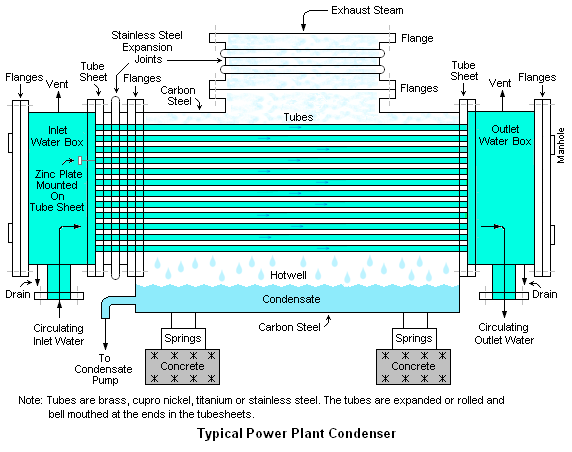
By applying these simplified energy balances, engineers can analyze complex systems and calculate the work, power, and heat transfer rates required to make them function. To get numerical answers, they use property tables to look up enthalpy values for substances like steam or refrigerants at given temperatures and pressures.
What is enthalpy ()?
A fluid passes through a well-insulated nozzle operating at steady state. What is the primary energy conversion that takes place?