Applied Quantum Computing Principles
Quantum Computing Models
The Gate Model
The most widely known approach to quantum computing is the gate model. It's conceptually similar to how classical computers work. A classical computer processes information by applying a sequence of logic gates, like AND, OR, and NOT, to bits.
In the same way, the gate model applies a sequence of quantum gates to qubits. These gates are unitary operations that manipulate the quantum states of qubits, leveraging superposition and entanglement to perform calculations. Each gate operation is a distinct, step-by-step transformation. The sequence of these gates forms a quantum circuit, which represents a complete algorithm.
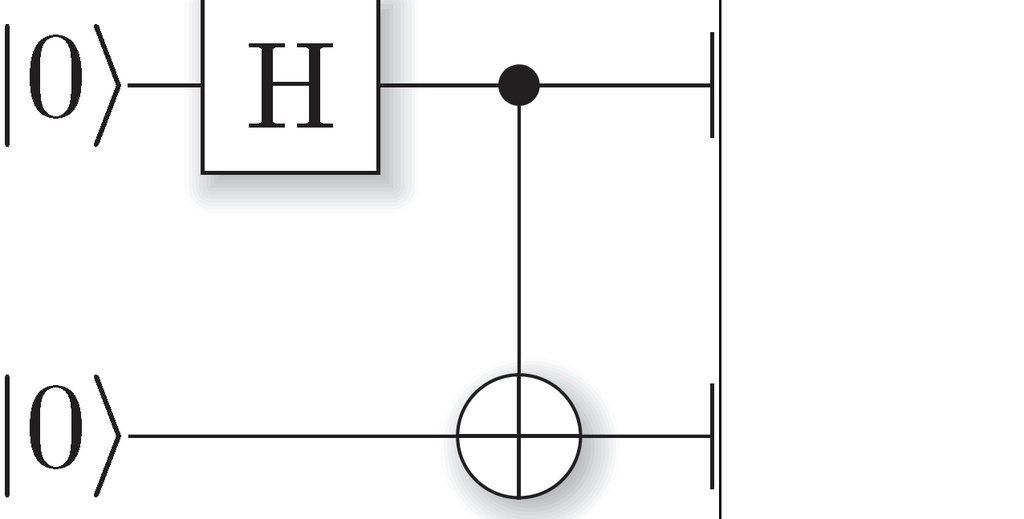
This circuit, for example, starts with two qubits in the state. A Hadamard gate puts the first qubit into a superposition of and . Then, a Controlled-NOT (CNOT) gate entangles the two qubits. The final state depends on the initial states and the precise sequence of these discrete gate operations.
Adiabatic Quantum Computing
Adiabatic quantum computing (AQC) takes a completely different path. Instead of running a pre-defined sequence of gates, AQC is more like gently guiding a quantum system toward a solution. It's based on the adiabatic theorem of quantum mechanics.
Adiabatic quantum computation (AQC) is an alternative to the better-known gate model of quantum computation.
The process begins with a quantum system prepared in the ground state (the lowest energy state) of a simple, well-understood Hamiltonian. A Hamiltonian is an operator that describes the total energy of the system.
Next, the system's Hamiltonian is slowly and continuously transformed into a final, more complex Hamiltonian. The ground state of this final Hamiltonian is designed to encode the solution to the problem you want to solve. According to the adiabatic theorem, if this transformation is done slowly enough, the system will remain in its ground state throughout the entire process. At the end, measuring the system's state reveals the solution.
Think of it like carrying a full cup of coffee across a room. If you move slowly and smoothly (adiabatically), the coffee doesn't spill. The system (the coffee) stays in its lowest energy state (settled in the cup).
Topological Quantum Computing
Topological quantum computing is an approach designed to tackle one of the biggest challenges in the field: decoherence. Qubits are incredibly fragile and easily disturbed by their environment, which introduces errors into the computation.
This model uses quasiparticles called anyons. The defining feature of anyons is that their quantum states are determined by their topology—specifically, how their world lines braid around each other in spacetime. A world line is the path an object traces through 4D spacetime.
In this model, information is stored in the topological properties of the system, which are global and not affected by small, local disturbances. A quantum gate operation is performed by braiding the world lines of these anyons. Since the outcome of the computation depends only on the topology of the braids, not their exact paths, the computation is inherently robust against local noise.
This makes topological quantum computers theoretically much more fault-tolerant than other models.
Comparing the Models
Each model of quantum computation has distinct strengths and is suited for different kinds of problems.
| Model | Approach | Primary Strength | Main Challenge |
|---|---|---|---|
| Gate Model | Discrete sequence of gate operations | Universal; can implement any quantum algorithm | Highly sensitive to noise and decoherence |
| Adiabatic | Continuous evolution of a system's ground state | Well-suited for optimization problems | Requirement for slow evolution can be time-consuming |
| Topological | Braiding of anyon world lines | Extremely robust against local errors | Physically realizing and manipulating anyons is difficult |
The gate model is the most developed and is considered a universal model, meaning it can theoretically solve any problem a quantum computer is capable of solving. Adiabatic quantum computers, and a related model called quantum annealing, are less general but show promise for specific optimization tasks.
Topological quantum computing remains more theoretical but offers a compelling solution to the problem of quantum errors. The choice of model depends on the specific problem at hand and the current state of hardware technology. Researchers are actively exploring all three avenues, as each provides unique insights into the power of quantum computation.
How does the gate model of quantum computing process information?
What is the primary advantage of topological quantum computing?