Applied Principles of Pharmacology
Advanced Receptor Dynamics
Beyond Binding
A drug binding to a receptor is just the first step. The real question is, what happens next? Two key properties govern this interaction: affinity and intrinsic activity. Think of them as separate but related concepts.
Affinity is the measure of how tightly a drug binds to a receptor. A drug with high affinity will bind strongly and stay bound, even at low concentrations. It's a measure of attraction.
Intrinsic activity, on the other hand, describes the ability of a drug to activate the receptor and produce a biological response once it's bound. It measures the drug's effectiveness as a messenger.
A drug can have high affinity but zero intrinsic activity. It binds tightly but does nothing, effectively just blocking the receptor from other molecules. This type of drug is known as an antagonist.
A Spectrum of Action
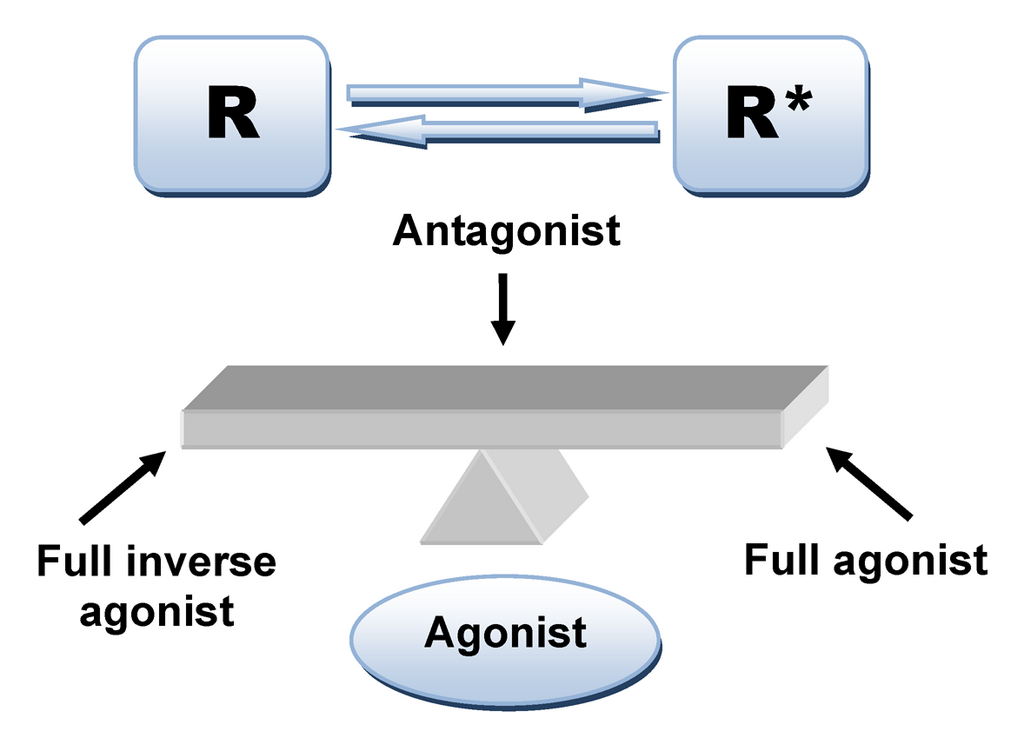
Intrinsic activity isn't an all-or-nothing property. Drugs exist on a spectrum, defined by how they modulate a receptor's function.
-
Full Agonists: These drugs have high intrinsic activity. They bind to and activate receptors to their maximum capacity, producing the strongest possible biological response.
-
Partial Agonists: These have intermediate intrinsic activity. Even if they occupy every single available receptor, they cannot produce a maximal response. Their effect is always submaximal compared to a full agonist. This can be useful therapeutically; for example, buprenorphine is a partial agonist at opioid receptors, providing pain relief with a lower risk of respiratory depression than full agonists like morphine.
-
Inverse Agonists: This is where things get interesting. Some receptors have a baseline level of activity even without any agonist bound, a state known as and its presence forms the two-state model of receptor activation. An inverse agonist binds to these receptors and stabilizes them in an inactive state, reducing this baseline activity. It doesn't just block a signal; it actively dials it down below its normal resting state.
From Signal to Response
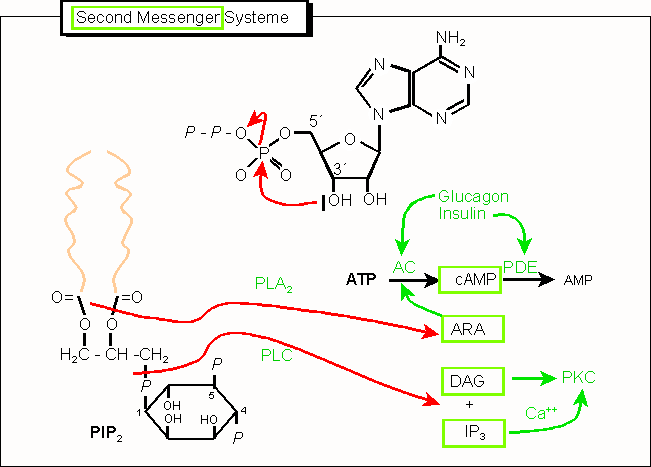
When an agonist binds and activates a receptor, it kicks off a chain reaction inside the cell called signal transduction. The initial signal, the drug binding, is amplified into a much larger cellular response. One of the most common and important mechanisms involves (GPCRs).
When a ligand binds to a GPCR, the receptor changes shape. This conformational change allows it to activate a G-protein on the inner surface of the cell membrane. The activated G-protein then interacts with other enzymes or channels.
A common target is the enzyme adenylyl cyclase. When activated, it converts ATP into cyclic AMP (cAMP). This [{
Quantifying the Effect
We can visualize and quantify a drug's effect using a dose-response curve, which plots the magnitude of the response against the drug concentration. From this curve, we can determine two critical parameters: efficacy and potency.
Efficacy () is the maximum response a drug can produce. It's represented by the plateau of the dose-response curve. A full agonist has high efficacy, while a partial agonist has lower efficacy.
Potency () is the concentration of a drug required to produce 50% of its maximal effect. A lower value means the drug is more potent; a smaller amount is needed to achieve the same half-maximal effect. Potency is about concentration, while efficacy is about the maximum possible effect.
By analyzing these curves, we can compare drugs directly. A drug shifted to the left is more potent. A drug with a lower plateau is less efficacious. This quantitative approach is fundamental to pharmacology, allowing scientists to predict how a drug will behave in a biological system and to design medications with precisely tuned effects.
Which of the following best describes a drug's intrinsic activity?
A new drug is developed that binds to a receptor but only produces a submaximal response, even when all receptors are occupied. This drug is best classified as a(n):