Applied Nuclear Engineering Concepts
Advanced Reactor Designs
Smaller, Smarter Reactors
Traditional nuclear power plants are massive, custom-built projects. They require huge upfront investments and long construction times. Small Modular Reactors, or SMRs, offer a different approach. As the name suggests, they are much smaller than conventional reactors, typically producing less than 300 megawatts of electricity (MWe).
Small modular reactors offer a lower initial capital investment, greater scalability, and siting flexibility for locations unable to accommodate more traditional larger reactors.
The key innovation is modularity. SMRs are designed to be manufactured in a factory and shipped to a site for assembly. This standardization drastically reduces construction costs and timelines. Instead of building one giant 1,000 MWe plant, a utility could install several smaller SMR modules over time, scaling up power generation as demand grows.
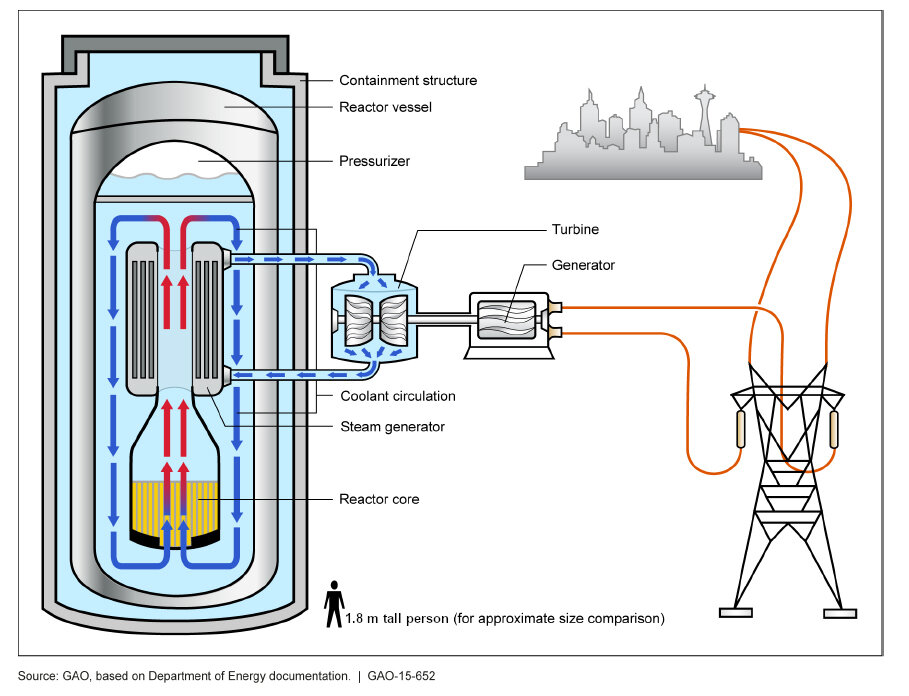
SMRs also bring significant safety enhancements. Their smaller core size means there is less radioactive material to manage. Many designs rely on passive safety systems, which use natural forces like gravity, convection, and pressure differentials to cool the reactor and shut it down in an emergency, without needing external power or human intervention. For example, some designs place the reactor vessel in a large pool of water that can absorb heat for days or weeks without any active measures.
This flexibility opens up new applications beyond the traditional power grid. SMRs could power industrial processes that require high heat, run desalination plants to produce fresh water, or generate hydrogen for clean fuel.
The Next Generation
While SMRs represent a new way of building reactors, Generation IV designs represent a fundamental shift in reactor technology itself. The Generation IV International Forum selected six promising reactor technologies for further research and development. These designs aim to improve on current reactors in four key areas: sustainability, economics, safety and reliability, and proliferation resistance.
| Reactor Type | Coolant | Temperature (°C) | Fuel Cycle |
|---|---|---|---|
| Gas-Cooled Fast Reactor (GFR) | Helium | 850 | Closed |
| Lead-Cooled Fast Reactor (LFR) | Lead | 550 - 800 | Closed |
| Molten Salt Reactor (MSR) | Fluoride Salts | 700 - 800 | Closed |
| Sodium-Cooled Fast Reactor (SFR) | Sodium | 550 | Closed |
| Supercritical Water Reactor | Water | 510 - 625 | Open/Closed |
| Very High-Temp Reactor (VHTR) | Helium | 900 - 1000 | Open |
Let's look at a couple of these designs more closely.
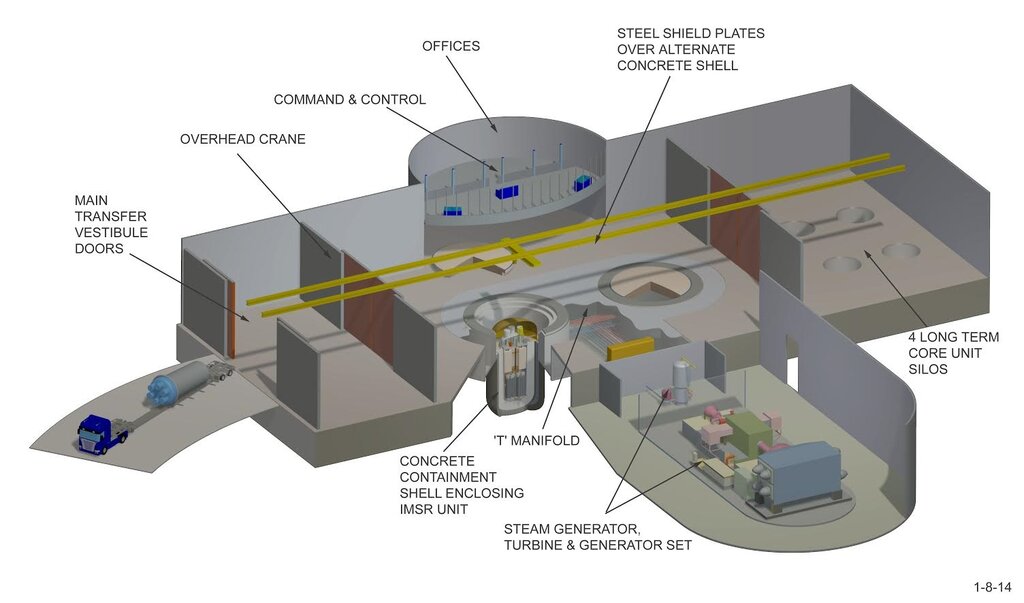
Molten Salt Reactors (MSRs) are unique because their fuel is dissolved directly into the coolant, a high-temperature molten fluoride or chloride salt. This liquid fuel mixture is circulated through the core and heat exchangers. This design has inherent safety features; if the reactor overheats, a frozen salt plug melts, allowing the fuel salt to drain into a passively cooled tank where the nuclear reaction stops. MSRs can also be designed to consume existing nuclear waste, reducing its long-term radioactivity.
Sodium-Cooled Fast Reactors (SFRs) use liquid sodium as a coolant instead of water. Sodium has excellent heat transfer properties and allows the reactor to operate at low pressure, even at very high temperatures. This enhances efficiency and safety, reducing stress on the reactor vessel. SFRs are 'fast' reactors, meaning they use high-energy (fast) neutrons to sustain the fission chain reaction. This allows them to burn a wider range of fuels, including depleted uranium and actinides from spent fuel from conventional reactors, effectively closing the fuel cycle.
Challenges and Trade-offs
These advanced designs are not without challenges. New materials are needed that can withstand the higher temperatures, corrosive coolants, and intense radiation environments inside these reactors. Developing and qualifying new fuel types is a complex and expensive process. Furthermore, the existing regulatory frameworks, largely designed for traditional light-water reactors, must be adapted to certify these novel technologies.
While advanced reactors promise a safer, more sustainable future for nuclear energy, turning these concepts into commercially viable power plants will require significant investment and continued innovation.
Ready to test your knowledge on these advanced reactor designs?
What is the primary advantage of the "modular" design of Small Modular Reactors (SMRs) compared to traditional nuclear power plants?
How do Molten Salt Reactors (MSRs) handle an overheating emergency, based on the inherent safety feature described?