Applied Mechanical Systems and Design Engineering
Structural Statics Analysis
Deconstructing Structures
We've seen how forces and moments act on single rigid bodies. But most real-world structures, from bridges to cranes, are complex assemblies of many interconnected parts. To ensure these structures are safe and stable, engineers must understand not just the external forces acting on the whole system, but also the internal forces that each component exerts on the others.
This is the core of structural analysis. We mentally disassemble a structure into its constituent parts to see how loads are transferred through the system. We'll start with one of the most common structural forms: the truss.
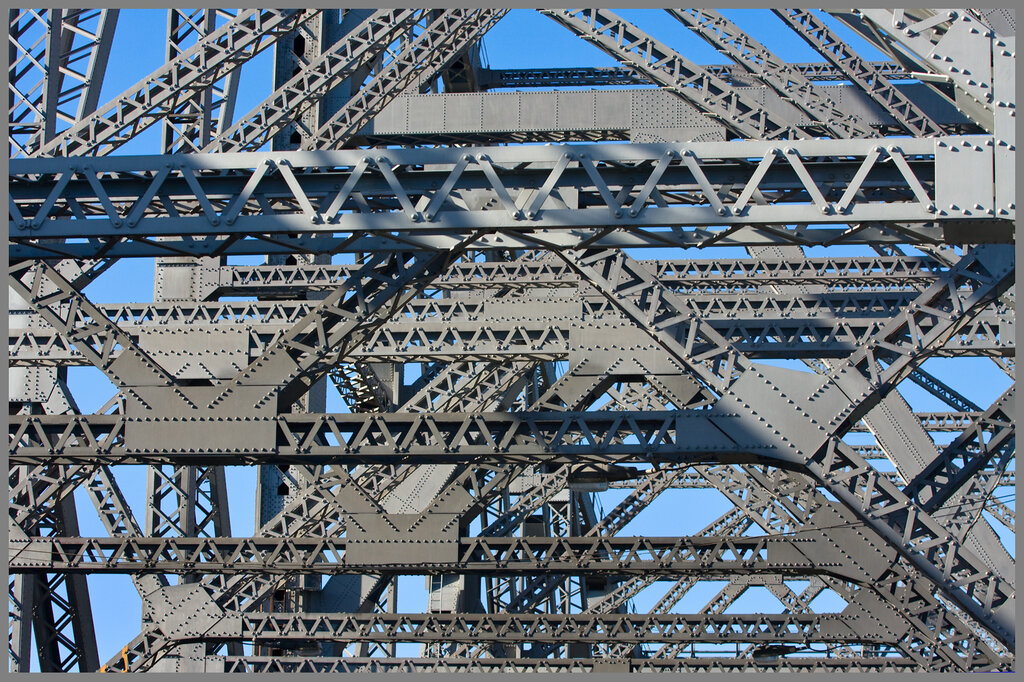
A truss is a structure composed of slender members joined together at their endpoints. For analysis, we make two key assumptions:
- All joints are treated as frictionless pins, meaning members are free to rotate.
- All loads are applied only at the joints.
These assumptions mean that each member of an ideal truss acts as a simple —it is only subjected to either tension (being pulled apart) or compression (being pushed together) along its axis. There's no bending involved.
Analyzing Trusses
To find the tension or compression in each member, we have two primary techniques: the Method of Joints and the Method of Sections. The one you choose often depends on whether you need to know the forces in every member or just a few specific ones.
The Method of Joints involves analyzing the equilibrium of each pin, or joint, one by one. Since each pin is a point, we only have two equilibrium equations to work with: the sum of horizontal forces is zero (), and the sum of vertical forces is zero ().
You typically start at a joint where at least one force is known and there are no more than two unknown member forces. You solve for the unknowns, and they become knowns for the next joint you analyze. By moving from joint to joint, you can solve for the forces in the entire structure.
What if you only need the force in one specific member in the middle of a large bridge? The Method of Joints would be tedious. This is where the Method of Sections shines.
The Method of Sections involves cutting the truss into two pieces through the members you're interested in. You then analyze the equilibrium of one of the two resulting sections. Since the section is a rigid body, you can use all three equilibrium equations: , , and the sum of moments .
By carefully choosing where to take our moment sum, we can often solve for a desired member force with a single equation. For example, summing moments about a point where two unknown forces intersect will eliminate them from the equation, leaving only the force you want to find.
Internal Forces in Beams
Trusses are a special case. Most structural members in frames and machines are not simple two-force members. Think of a diving board or a floor joist. These are beams, and they are designed to resist bending.
When we make an imaginary cut through a beam, we expose three types of internal forces that keep the section in equilibrium:
| Internal Force | Symbol | Description |
|---|---|---|
| Axial Force | N | A force acting along the axis of the beam (tension or compression). |
| Shear Force | V | A force acting perpendicular to the axis, tending to slice the beam. |
| Bending Moment | M | A couple that resists the bending effect of the external loads. |
These internal forces are not constant; they vary along the length of the beam. To visualize how they change, we create (SFD and BMD). These diagrams are essentially graphs that plot the value of the shear force and bending moment at every point along the beam's length.
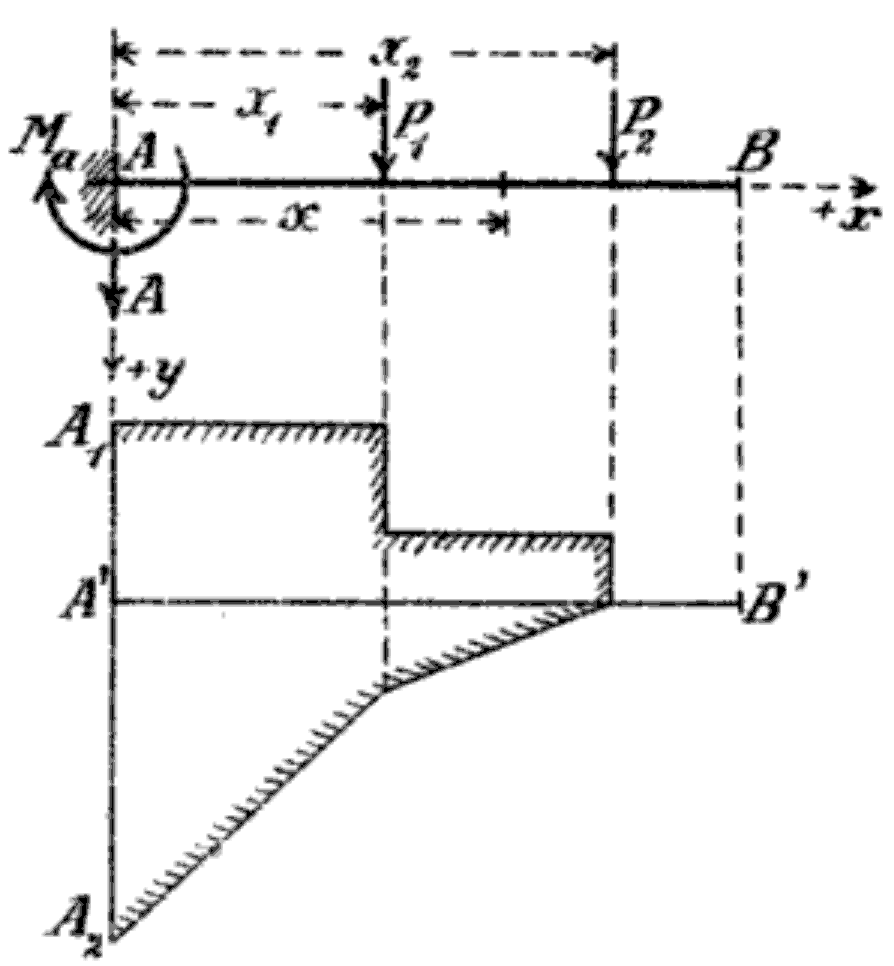
There are important relationships between the load, shear, and moment:
- The slope of the shear diagram at any point is equal to the negative of the distributed load intensity at that point ().
- The slope of the moment diagram at any point is equal to the shear force at that point ().
Understanding these calculus-based relationships allows us to quickly sketch the diagrams and identify critical points of maximum shear and bending moment, which is where the beam is most likely to fail.
When Statics Isn't Enough
So far, we've dealt with structures that are statically determinate. This means we can find all the unknown support reactions and internal forces using only the equations of equilibrium.
A simple way to check for determinacy in a 2D truss is the formula , where m is the number of members and j is the number of joints. If , the truss has redundant members and is considered statically indeterminate.
In a [{
}] structure, there are more unknown forces than there are available equilibrium equations. The principles of statics alone are not sufficient to solve the problem.
To solve these systems, we need additional equations that come from the geometry of the structure's deformation—how the members stretch, compress, or bend. This moves us beyond rigid body mechanics and into the realm of deformable bodies.
Our analysis also expands when we consider three-dimensional space. For a 3D rigid body, we have six equilibrium equations at our disposal:
- Sum of forces in each direction is zero: , ,
- Sum of moments about each axis is zero: , ,
While the principles are the same, the vector math becomes more complex, often requiring cross products to calculate moments.
Which of the following is a key assumption made when analyzing an ideal truss?
An engineer needs to determine the force in a single member located in the middle of a large bridge truss. Which analysis method would be most efficient?
Analyzing static structures is a process of systematic deconstruction. By isolating parts of a system and applying the fundamental laws of equilibrium, we can determine the hidden forces that hold everything together.