Applied Mathematical Reasoning and Problem Solving
Quadratic Function Applications
Models of the Real World
The parabolas drawn by quadratic functions aren't just abstract curves on a graph. They describe the arc of a basketball shot, the path of a rocket, and even the profit curve for a business. The key features of the parabola—its highest or lowest point (the vertex) and where it crosses the x-axis (the roots)—represent critical moments in these real-world scenarios.
The vertex tells you the maximum or minimum value, like the peak height of a thrown ball. The roots mark when the value is zero, like when the ball lands back on the ground.
By translating a situation into a quadratic equation, we can pinpoint these important values and make predictions. The standard form, , serves as our blueprint, but understanding how to work with it is what unlocks its power.
The Arc of a Projectile
One of the most common applications of quadratics is modeling projectile motion. When you throw an object, its height over time can be described by a quadratic function. Gravity pulls it down in a parabolic arc.
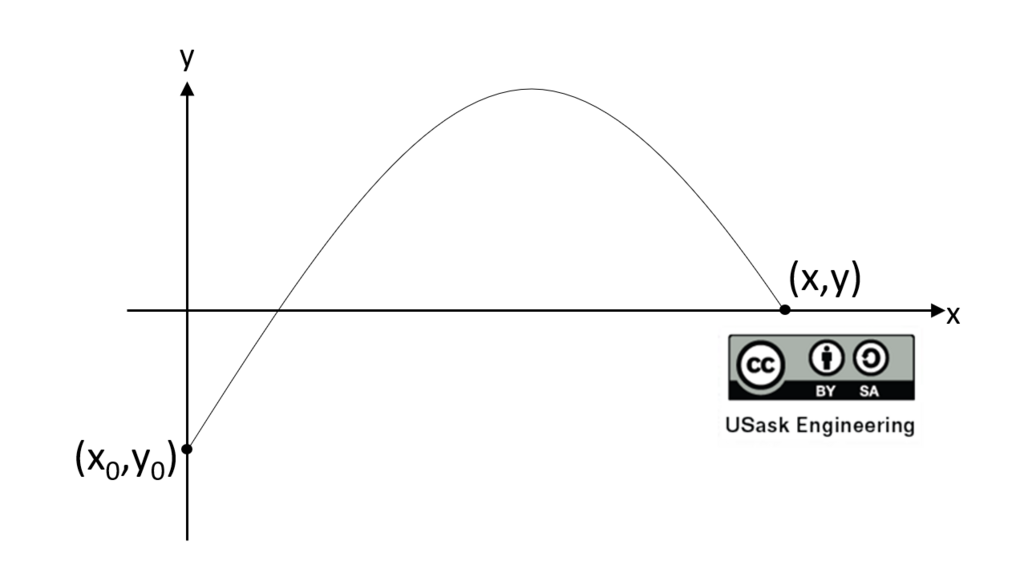
The general equation for an object's height, , at a given time, , is:
Let’s say a flare is launched from a boat with an initial velocity of 80 feet per second. The launching point is 4 feet above the water. The equation modeling its height is:
Here, the term represents half the acceleration due to gravity in feet per second squared.
When does the flare reach its maximum height, and what is that height? This question is just asking for the vertex of the parabola.
The x-coordinate (in this case, the t-coordinate) of the vertex gives us the time. We find it with the formula .
To find that maximum height, we plug this time back into our height function.
What if the flare was launched from a platform 10 feet higher? The initial height, , would change from 4 to 14. This results in the equation . This is a vertical shift of the entire parabola 10 units up, meaning the flare starts higher and will reach a higher peak.
Optimizing for the Best Result
Quadratics are also essential for optimization problems, like finding the price that will generate the most revenue for a product. Revenue is calculated as Price × Quantity Sold. Often, as you increase the price, the quantity sold goes down. This relationship can create a quadratic revenue function.
A common application of quadratics is optimization, which typically involves finding the vertex of a parabola since it’s the highest or lowest amount.
Imagine a theater that sells 500 tickets per show at a price of $20 each. The manager estimates that for every $1 increase in price, they will sell 20 fewer tickets. What price maximizes revenue?
First, let's define our variables. Let be the number of $1 price increases.
The new price will be . The number of tickets sold will be .
Revenue, , is the product of these two expressions.
Since the value (-20) is negative, this parabola opens downward, and its vertex represents the maximum revenue. We find the number of price increases, , that gives us this maximum using the vertex formula .
The optimal price is . At this price, the maximum revenue would be:
.
Choosing Your Method
Once you have a quadratic model, you need to solve for the variable. Let's return to our flare example: when does it hit the water? We need to find the time when the height is 0.
We have several tools at our disposal: factoring, completing the square, or the quadratic formula. The best method depends on the equation.
| Method | When to Use | Example |
|---|---|---|
| Factoring | Quickest method when the equation has simple, integer roots. | factors to . |
| Completing the Square | Useful when and is an even number. Also helps convert to vertex form. | . |
| Quadratic Formula | Works for every quadratic equation. It's the most reliable method, especially with messy coefficients. | Our flare equation: . |
For the flare equation, the numbers aren't simple. Factoring would be difficult. Let's use the quadratic formula to solve for .
Calculating the two roots gives us:
Since time cannot be negative in this context, the flare hits the water after approximately 5.05 seconds. Choosing the right method saved us from a frustrating factoring attempt and gave us a precise answer.
A flare is launched from a boat. Its height is modeled by the function , where is the height in feet and is the time in seconds. How long does it take for the flare to reach its maximum height?
In the context of an object's flight path, such as a thrown ball, the roots (or x-intercepts) of the quadratic equation represent the moments when the object's height is zero.
Understanding how to apply quadratic functions allows you to model and solve a wide range of problems involving motion, optimization, and design.