Applied Machine Learning Systems
Advanced Supervised Learning
Beyond a Single Model
You know how a single decision tree works. It asks a series of questions to arrive at a prediction. But a single tree, like a single expert, can have blind spots. It might learn the training data too well, a problem called overfitting, and fail to generalize to new, unseen data. Or it might be too simple and miss important patterns, leading to underfitting.
Ensemble methods solve this by combining the predictions of multiple models, or learners, into one. Think of it as forming a committee of experts instead of relying on just one. The collective judgment is often more accurate and reliable than any individual member's. The two most common strategies for building these committees are bagging and boosting.
Bagging and Random Forests
Bagging, short for , builds multiple independent models in parallel. It works by creating several random subsets of the original training data. For each subset, it trains a separate model. To make a final prediction, the results from all models are averaged (for regression) or put to a vote (for classification).
This process is incredibly effective at reducing variance. High variance means a model is overly sensitive to the specific data it was trained on. By training on different data subsets, each model develops a slightly different “perspective.” When their predictions are combined, the individual errors tend to cancel each other out, leading to a more stable and reliable outcome.
The most famous algorithm based on bagging is the Random Forest. It builds a “forest” of many decision trees. Not only does it use bootstrap samples for each tree, but it also adds another layer of randomness: when splitting a node, it considers only a random subset of features. This decorrelates the trees, preventing them from all latching onto the same, most predictive features. The result is a diverse forest where each tree contributes a unique perspective.
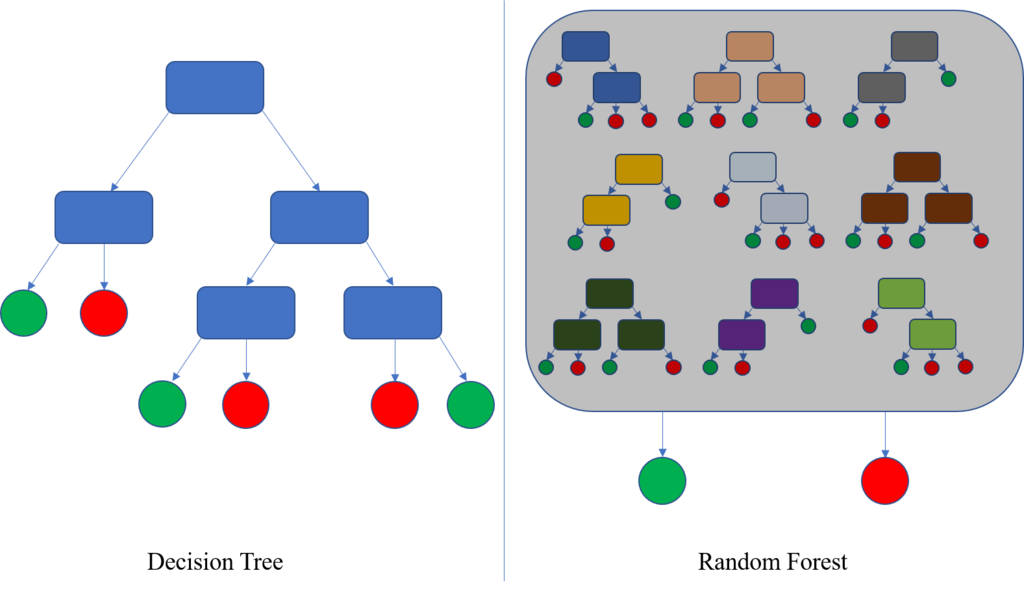
Random Forests are robust, handle outliers well, and are less prone to overfitting than a single decision tree. They are also relatively easy to tune, making them a great starting point for many tabular data problems.
Boosting and Gradient Boosting
Boosting takes a different approach. Instead of building models in parallel, it builds them sequentially. Each new model tries to correct the errors made by the previous one. It's like a team where each member focuses on the mistakes of the person before them, progressively refining the final result.
This method is excellent at reducing bias. High bias means a model is too simple and fails to capture the underlying patterns in the data. By focusing on the residuals—the difference between the actual values and the predicted values—each new learner adds a piece of the puzzle that the earlier models missed.
Gradient Boosting Machines (GBMs) are a powerful family of boosting algorithms. They use a technique called to minimize the errors of the sequential models. Each new tree is trained to predict the negative gradient of the loss function, which essentially points in the direction of the steepest reduction in error.
Because they are so focused on correcting mistakes, GBMs can achieve very high accuracy. However, this also makes them more susceptible to overfitting if not carefully controlled. You need to manage the learning rate, tree depth, and number of trees to find the right balance. This process is called regularization.
The GBM Champions
Several GBM implementations have become dominant in machine learning, especially for structured or tabular data. Each has its own strengths.
| Algorithm | Key Feature | Best For | Trade-off |
|---|---|---|---|
| XGBoost | Regularization & Speed | General-purpose, high accuracy | Slower than LightGBM, more parameters to tune. |
| LightGBM | Leaf-wise growth | Very large datasets, speed is critical | Can overfit on small datasets if not tuned. |
| CatBoost | Built-in categorical handling | Datasets with many categorical features | Can be slower than LightGBM on purely numerical data. |
(eXtreme Gradient Boosting) was a game-changer. It optimized the standard GBM algorithm for performance and accuracy, adding regularization techniques directly into the model's objective function to control overfitting. It also includes clever computational tricks like parallelized tree building and cache-aware access to make it fast.
(Light Gradient Boosting Machine) focuses on speed. While XGBoost grows trees level-by-level, LightGBM grows them leaf-by-leaf. It chooses the leaf that will yield the largest reduction in error and splits it. This approach converges much faster, making it ideal for very large datasets, though it can be prone to overfitting on smaller ones.
CatBoost (Categorical Boosting) excels at handling categorical features. Traditionally, you have to convert categories like 'city' or 'product type' into numbers using methods like one-hot encoding. CatBoost has a sophisticated built-in mechanism to do this automatically and effectively, saving you a preprocessing step and often improving accuracy.
XGBoost, with its intricate optimization and adaptive design, frequently surpasses Random Forest in these practical arenas.
Choosing the right algorithm depends on your specific needs. Are you working with a massive dataset where training time is a concern? LightGBM might be your best bet. Is your data full of categorical variables? Give CatBoost a try. For general-purpose tasks where accuracy is paramount, XGBoost remains a powerful and reliable choice. And if you need a model that's robust and easy to set up, a Random Forest is an excellent place to start.
What is the primary motivation for using an ensemble method like a Random Forest or Gradient Boosting Machine instead of a single decision tree?
What is the key difference between how bagging and boosting build their ensemble of models?
Ensemble methods provide a powerful toolkit for tackling complex supervised learning problems. By understanding the trade-offs between variance and bias, and between different algorithms like Random Forests and GBMs, you can select the best approach for your data and build highly accurate predictive models.