Applied Forensic Science Foundations
Advanced DNA Profiling
Amplifying the Evidence
You already know how Polymerase Chain Reaction (PCR) can copy a specific segment of DNA. But a crime scene sample might require us to look at over 20 different DNA regions to build a reliable profile. Running 20 separate PCR tests is slow and inefficient. The solution is multiplex PCR, a technique that amplifies many target sequences in a single reaction tube.
This isn't as simple as just throwing 20 sets of primers into the mix. Each primer pair must be designed to work at the same temperature and not interfere with one another. They also need to produce amplified fragments, called amplicons, of different lengths so they can be distinguished later. Optimizing this chemical cocktail is a delicate balancing act, ensuring that all target regions are amplified evenly and accurately.
Separating the Strands
After amplifying the DNA, we need to measure the results. This is done using a technique called capillary electrophoresis (CE). Instead of a flat gel, CE uses a very thin, long glass tube filled with a polymer matrix. The amplified DNA fragments, which have been tagged with fluorescent dyes, are injected into one end of the capillary.
An electric current is applied, pulling the negatively charged DNA fragments through the tube. Shorter fragments navigate the polymer matrix more quickly than longer ones. Near the end of the capillary, a laser excites the fluorescent tags, and a detector records the specific color and time of each fragment as it passes by. This data is then translated by software into a graph called an electropherogram, which shows a series of peaks representing the different DNA fragments.
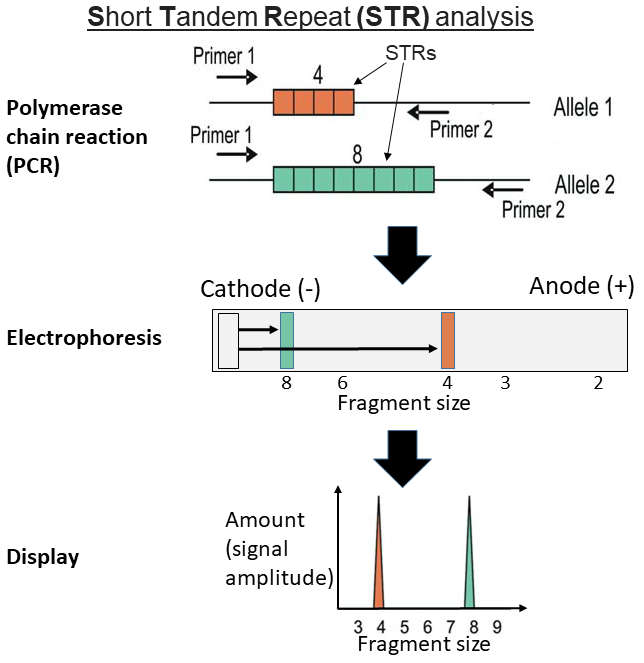
The specific locations we analyze are called Short Tandem Repeats (STRs). These are sections of non-coding DNA where a short sequence of base pairs, like GATA, is repeated over and over. The number of repeats at any given STR locus varies greatly between individuals. By analyzing around 20 different STR loci, forensic scientists can generate a genetic profile that is statistically unique.
The Challenge of Mixed Samples
In a controlled lab setting, DNA analysis is straightforward. But crime scene evidence is rarely so simple. A sample might contain DNA from two, three, or even more individuals, creating a complex mixture. Interpreting these mixed profiles is one of the greatest challenges in forensic genetics. Peaks on the electropherogram from different contributors can overlap (a phenomenon called allele stacking), and small technical artifacts called stutter peaks can complicate the view.
When a sample is a mixture of male and female DNA, analysts can focus specifically on Y-STRs, which are passed down only on the Y chromosome. For highly degraded samples where nuclear DNA is gone, they can turn to mitochondrial DNA (mtDNA), which is more abundant and robust.
To untangle these mixtures, analysts now rely on probabilistic genotyping software (PGS). Instead of making a simple binary judgment (match or no match), PGS uses complex statistical algorithms to assess the probability of the evidence, given different scenarios. For example, it might calculate the likelihood of observing the mixed DNA profile if the suspect is a contributor versus the likelihood of observing it if they are not.
The result is often expressed as a (LR). An LR of 1,000 means it's 1,000 times more likely that the suspect contributed to the DNA mixture than a random, unrelated person. This provides a statistical weight to the evidence, offering a more nuanced and objective measure for the court.
The Next Generation
Capillary electrophoresis is the workhorse of forensic labs, but a more powerful technology is on the rise: Next-Generation Sequencing (NGS). While CE only measures the length of an STR, NGS reads the actual sequence of every base pair within it. This provides a much higher-resolution view of the DNA.
Why does this matter? Sometimes two different people have STRs that are the same length but have small variations in the internal sequence. CE would see them as identical, but NGS can tell them apart. This added detail is invaluable for distinguishing contributors in a complex mixture, analyzing degraded DNA, and tracing familial relationships.
The trade-off is that NGS workflows are currently more complex, time-consuming, and expensive than traditional CE-based methods. As the technology matures and costs decrease, NGS is expected to become the new standard. Regardless of the platform, the core principles of the scientific method—objective analysis, validation, and preventing interpretation bias—remain essential to ensure that the data is interpreted correctly and responsibly.
Ready to test your knowledge of these advanced techniques?
What is the primary advantage of using multiplex PCR in forensic DNA analysis?
In capillary electrophoresis, how are amplified DNA fragments (amplicons) separated?
These powerful tools give forensic scientists an unprecedented ability to analyze biological evidence. By understanding how they work, we can better appreciate both their potential and their limitations.