Applied Environmental Economics
Environmental Market Failures
When Markets Miss the Mark
In a perfect market, the price you pay for a product reflects the cost of making it. The supply curve, which represents the private costs to producers, meets the demand curve, which reflects private benefits to consumers. The result is an efficient equilibrium. But the real world is messy. The production and consumption of goods often create side effects that impact people who aren't part of the transaction. These are called externalities.
Externalities sit at the heart of one of microeconomics' most important questions: when do markets fail to produce efficient outcomes?
Think of a factory that produces steel. Its private costs include labour, raw materials, and electricity. These determine its supply curve (also known as the Marginal Private Cost, or MPC curve). But what about the pollution it emits? The local community bears the cost of this pollution through health problems and environmental damage. This external cost, when added to the factory's private cost, gives us the Marginal Social Cost (MSC). For a negative externality like pollution, the MSC is higher than the MPC.
Because the market only considers private costs, it produces at quantity Qm, where supply (MPC) equals demand. But the socially optimal quantity is Q*, where the full social cost (MSC) equals demand. The market, left to its own devices, overproduces the good and underprices the pollution. The result is a deadweight loss to society.
Externalities can also be positive. A beekeeper's bees pollinate a nearby apple orchard, boosting the farmer's crop. The farmer receives a benefit they didn't pay for. In this case, the Marginal Social Benefit (MSB) is higher than the Marginal Private Benefit (MPB). The market, by itself, will produce too few bees and beehives because the beekeeper isn't compensated for the external benefit they provide.
Unownable Resources
Many environmental problems stem from resources that nobody owns. You can't buy a patch of the ozone layer or a share of clean air. These are —they are non-excludable (you can't stop anyone from using them) and non-rivalrous (one person's use doesn't diminish another's).
Markets struggle to provide public goods because of the free-rider problem. Why pay to reduce pollution when you can benefit from others' efforts for free? As a result, these goods are undersupplied by the market.
A related, but distinct, category is common-pool resources. These are non-excludable but rivalrous. Think of fish in the ocean. No one can be stopped from fishing in international waters, but every fish one person catches is one less for everyone else. This leads to a classic problem known as the —a term popularised by ecologist Garrett Hardin in 1968.
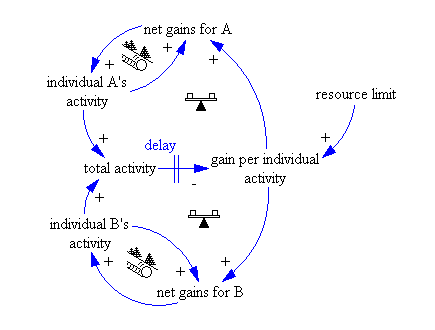
In this scenario, each individual acting in their own rational self-interest depletes the shared resource, leading to a worse outcome for the entire group. Global fish stocks, fresh water aquifers, and even the atmosphere as a carbon sink are all modern examples of common-pool resources at risk of this tragedy.
A Path to Solutions
So if markets fail, what can be done? One influential idea is the Coase Theorem, which suggests that if property rights are well-defined and transaction costs are low, private parties can bargain to solve externality problems on their own, without government intervention.
Imagine the factory and the town. If the town has a clear legal right to clean air, it can demand payment from the factory to allow it to pollute. If the factory has the right to pollute, the town can pay the factory to reduce its emissions.
In either case, the bargaining should lead to a socially efficient level of pollution. The problem is that in the real world, the conditions of the Coase Theorem rarely hold. Transaction costs are often high, especially with many parties involved (like millions of people affected by air pollution). And for many environmental goods, property rights are impossible to assign. Who owns the Atlantic Ocean?
Because of these limitations, identifying market failures is the first step toward designing effective environmental policies. These policies, from taxes on pollution to cap-and-trade systems, are all attempts to correct the prices and incentives that the free market gets wrong.
In economics, what is an 'externality'?
A factory that pollutes the air represents a negative externality. In this case, the market, if left alone, will: