Applied Engineering Mechanics and Structural Analysis
Complex Truss Analysis
First, Check for Stability
Before analysing any truss, you must first confirm it's statically determinate. This means you can solve it using only the equations of static equilibrium. An unstable truss will collapse under load, and a statically indeterminate truss has too many unknown forces for basic equilibrium equations alone.
We use a simple formula to check this. Let be the number of members, be the number of joints, and be the number of support reactions.
If , the truss is statically indeterminate, meaning it's rigid but has redundant members. If , the truss is unstable and will collapse. This check doesn't guarantee stability — poor geometry can still cause issues — but it's a necessary first step.
Always begin your analysis by calculating the external support reactions for the entire truss. Treat the whole structure as a single rigid body and apply the equilibrium equations: , , and .
The Method of Joints
The Method of Joints is a systematic process where you analyse the equilibrium at every single joint. It's thorough and ideal when you need to find the force in every member of the truss. You work from joint to joint, using the forces you've found to solve for new ones.
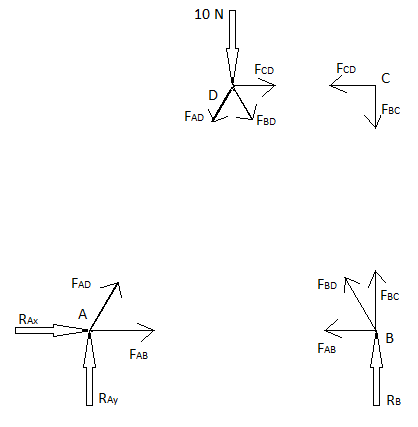
At each joint, you draw a free-body diagram (FBD) showing all member forces acting on the pin. Since each pin is in equilibrium, the sum of forces in the x and y directions must be zero.
When using the Method of Joints, always start analysis from joints with the least number of unknowns for simplified calculations.
A good habit is to assume all unknown member forces are in tension (pulling away from the joint). When you solve the equations, a positive result means your assumption was correct (tension), while a negative result means the force is actually in compression (pushing into the joint).
This leads to two equations per joint, which you can use to solve for, at most, two unknown forces.
Before you start solving, look for zero-force members. These are members that carry no load under a specific loading condition. Identifying them simplifies the analysis by reducing the number of calculations.
There are two main rules for spotting them by inspection:
- If a joint connects only two non-collinear members and has no external load or support reaction, both members are zero-force members.
- If a joint connects three members, two of which are collinear, and there is no external load or support reaction, the third member is a zero-force member.
The Method of Sections
What if you don't need to know the force in every member? If you're interested in the force in just one or two specific members deep inside a large truss, the Method of Joints is inefficient. That's where the Method of Sections comes in.
This method involves making an imaginary 'cut' through the truss, dividing it into two separate sections. You then analyse the equilibrium of one of these sections as a rigid body. The cut should pass through the members whose forces you want to find, but no more than three of them, as you typically only have three useful equilibrium equations.
The Method of Sections allows you to directly calculate the force in a specific member without first having to find the forces in all the other members.
After making your cut, you analyse one of the two resulting sections. The internal forces of the cut members now become external forces acting on your chosen section. You can then apply the three equations of static equilibrium to the entire section.
The key to this method is the strategic use of the moment equation, . By summing moments about a point where two of the three unknown forces intersect, you can eliminate them from the equation, allowing you to solve directly for the third unknown force. This is a powerful shortcut.
Which Method to Use?
Choosing the right method depends on what you need to find.
| Method | Best For | Pros | Cons |
|---|---|---|---|
| Method of Joints | Finding the forces in all members. | Systematic; provides a complete analysis of the truss. | Can be very time-consuming for large trusses. |
| Method of Sections | Finding the forces in a few specific members. | Fast and direct for targeted analysis. | Doesn't provide forces for the whole structure. |
In many complex problems, a combination of both methods is the most effective approach. You might use the Method of Sections to find a force in the middle of a truss, then switch to the Method of Joints to work your way toward an adjacent member.
Ready to test your understanding of these analysis techniques?
A truss is analysed using the formula , where 'm' is members, 'r' is reactions, and 'j' is joints. If the result is , what does this indicate about the truss?
When using the Method of Joints, what is the standard convention to assume for unknown member forces?
Mastering these methods allows engineers to analyse and design complex structures, ensuring they can safely withstand the forces they're designed to carry.