Applied Electrical Engineering and Circuit Analysis
Circuit Analysis Laws
The Rules of the Road
When you move beyond simple circuits with one battery and one resistor, you need a more systematic way to figure out what's happening. Ohm's Law is still essential, but it's not enough on its own. Two principles, developed by Gustav Kirchhoff in the 1840s, provide the foundation for analysing any complex resistive network. They are less like new laws of physics and more like rules of accounting for charge and energy in a circuit.
Kirchhoff's Laws are the cornerstone of electrical circuit analysis, providing the mathematical foundation for understanding how current flows and voltage distributes in any electrical network.
Kirchhoff's Current Law
Kirchhoff's Current Law, or KCL, deals with how current behaves at a node, which is any point where two or more circuit elements connect. The law is incredibly intuitive: the total amount of current flowing into a node must equal the total amount of current flowing out of it. Charge can't just appear or disappear at a junction. It has to go somewhere.
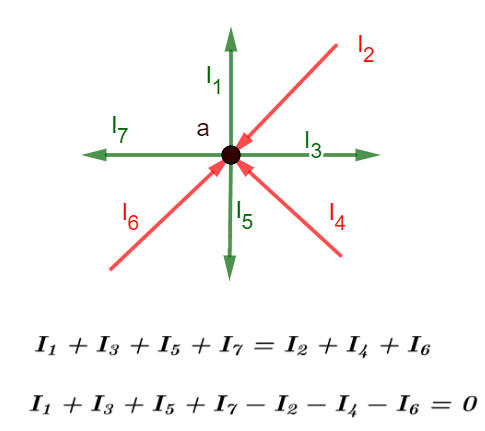
We can state this mathematically. The convention is to treat currents entering a node as positive and currents leaving as negative. With that in mind, KCL says that the algebraic sum of all currents at a node is zero.
For the image above, KCL would be expressed as: .
Kirchhoff's Voltage Law
Kirchhoff's Voltage Law, or KVL, deals with energy conservation around any closed loop in a circuit. It states that the sum of all voltage drops and voltage rises around any closed path must equal zero. Think of it like hiking. If you start at a certain elevation, walk a path that goes up and down some hills, and return to your exact starting point, your net change in elevation is zero. Voltage works the same way in a closed loop.
Voltage sources (like batteries) add energy to the circuit, creating a voltage rise. Components like resistors dissipate energy, creating a voltage drop. According to KVL, if you trace any closed path, all the rises must be balanced by all the drops.

To apply KVL systematically, we need a sign convention. When tracing a loop, if you move through a resistor in the same direction as the assumed current, it's a voltage drop (negative). If you go against the current, it's a rise (positive). For a voltage source, moving from the negative to the positive terminal is a rise (positive), and from positive to negative is a drop (negative). This is part of the passive sign convention that is standard in circuit analysis.
For the circuit in the image above, if we trace the loop clockwise starting from the bottom of the voltage source, the KVL equation would be: .
Systematic Analysis
Kirchhoff's laws give us the tools to analyse any circuit, no matter how complex. We use them in two main systematic methods: Nodal Analysis and Mesh Analysis.
Nodal Analysis
noun
A method of circuit analysis that uses Kirchhoff's Current Law (KCL) to find the voltage potentials at each node in a circuit relative to a reference node.
Nodal analysis is all about applying KCL. The steps are straightforward:
- Identify all the nodes in the circuit.
- Choose one node to be the reference node (or ground), which has a defined voltage of 0V.
- For the remaining nodes, assign a variable for the unknown voltage (e.g., , ).
- Write a KCL equation for each of these non-reference nodes. Use Ohm's Law () to express the currents in terms of the unknown node voltages.
- Solve the resulting system of equations to find the voltages.
For the circuit above, we have two non-reference nodes, 'a' and 'b'. We can write two KCL equations.
At Node a: The current from the voltage source enters, while currents through R1 and R2 leave. The current from the source is , but since it's an ideal source, we set . This simplifies the problem, but in a more general case, you would write: .
At Node b: Current through R1 enters, while current through R3 leaves and the current from I1 also leaves (since it flows into the node from ground, it's considered leaving from the perspective of the node's equation). So: .
Mesh Analysis
noun
A method that uses Kirchhoff's Voltage Law (KVL) to find the currents circulating in the loops, or meshes, of a planar circuit.
Mesh analysis is the counterpart to nodal analysis, but it uses KVL. It's suitable for circuits that are planar (can be drawn on a flat surface with no crossing wires).
- Identify all the meshes (the innermost loops).
- Assign a mesh current variable to each mesh, typically assuming a clockwise direction for consistency (e.g., , ).
- Write a KVL equation for each mesh. Use Ohm's Law to express voltages in terms of the unknown mesh currents.
- For elements shared between two meshes, the actual current is the sum or difference of the mesh currents.
- Solve the system of KVL equations.
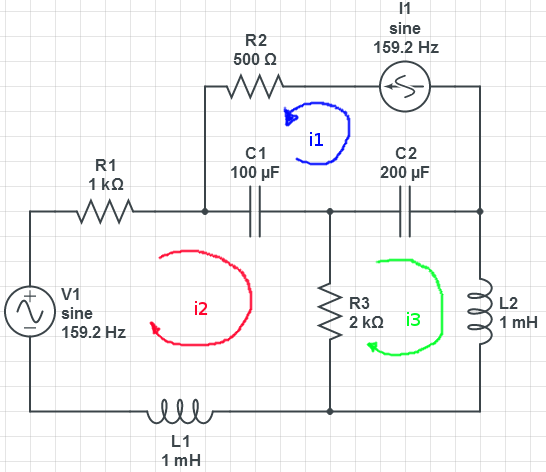
For the blue mesh (i1) in the circuit above, the KVL equation would sum the voltage drops across R1, C1, and L1, accounting for the voltage source V1 and the shared components with mesh i2.
Notice how for the shared resistor R1, the net current is the difference between the two mesh currents flowing through it. A similar equation would be written for the red and green meshes, creating a system of three equations to solve for , , and .
These systematic methods are powerful. However, it's important to remember that they are based on an ideal model. In the real world, every wire has a small amount of resistance, and every connection point (contact) has resistance. For most circuits, this is negligible. But in high-precision or high-power applications, these seemingly tiny resistances can cause unexpected voltage drops and performance issues, reminding us of the gap between a perfect diagram and a physical circuit.
Ready to test your understanding? Let's see how well you've grasped these fundamental laws of circuit analysis.
Kirchhoff's Current Law (KCL) is a direct consequence of which fundamental principle?
According to Kirchhoff's Voltage Law (KVL), the algebraic sum of all voltages around any closed loop in a circuit must be zero.
Mastering KCL and KVL unlocks the ability to analyse virtually any electrical network you might encounter, forming the backbone of all circuit theory.