Applied Coding Principles
Data Structures and Algorithms
Organizing Your Data
How you organize information is just as important as the information itself. Think about a library. If all the books were thrown in a giant pile, finding a specific one would be a nightmare. Libraries use systems like the Dewey Decimal System to organize books, making them easy to find. In programming, we use data structures to organize data in a similar way.
Two of the most fundamental data structures are arrays and linked lists. They both store collections of items, but they do it in very different ways.
An array is like a row of numbered mailboxes. Each box holds one item, and you can go directly to any mailbox if you know its number (its index). This makes accessing any item super fast. The downside is that the row of mailboxes is a fixed size. If you need more boxes, you have to build a whole new, bigger row.
A linked list, on the other hand, is like a scavenger hunt. Each item in the list holds a piece of data and a clue that points to the location of the next item. To find the fifth item, you have to start at the beginning and follow the clues four times. This makes access slower, but it's very flexible. Adding or removing an item is as simple as changing one of the clues.
| Operation | Array | Linked List |
|---|---|---|
| Accessing an item (by position) | Fast | Slow |
| Adding an item (at the end) | Fast (if there's space) | Fast |
| Adding an item (in the middle) | Slow | Fast |
| Removing an item | Slow | Fast |
Rules for Access
Sometimes, we want to enforce specific rules about how data can be added or removed. This is where abstract data types like stacks and queues come in. They aren't new structures themselves, but rather sets of rules that can be applied to structures like arrays or linked lists.
Stack
noun
A data structure that follows a Last-In, First-Out (LIFO) principle. The last element added is the first one to be removed.
With a stack, you can only add a new item to the top (called a push) and remove the item that's currently on top (called a pop). You can't reach into the middle of the stack.
Queue
noun
A data structure that follows a First-In, First-Out (FIFO) principle. The first element added is the first one to be removed.
A queue works just like a line at the grocery store. New items are added to the back (enqueue), and items are removed from the front (dequeue).
Complex Relationships
Arrays, lists, stacks, and queues are all linear data structures, meaning the items are stored in a sequence. But what if our data has more complex, hierarchical relationships? For that, we use trees and graphs.
A tree is a structure that simulates a hierarchy. Think of a family tree or a company's organizational chart. It starts with a single root node at the top. Each node can have several child nodes, but each child has only one parent. Nodes at the very bottom are called leaves.
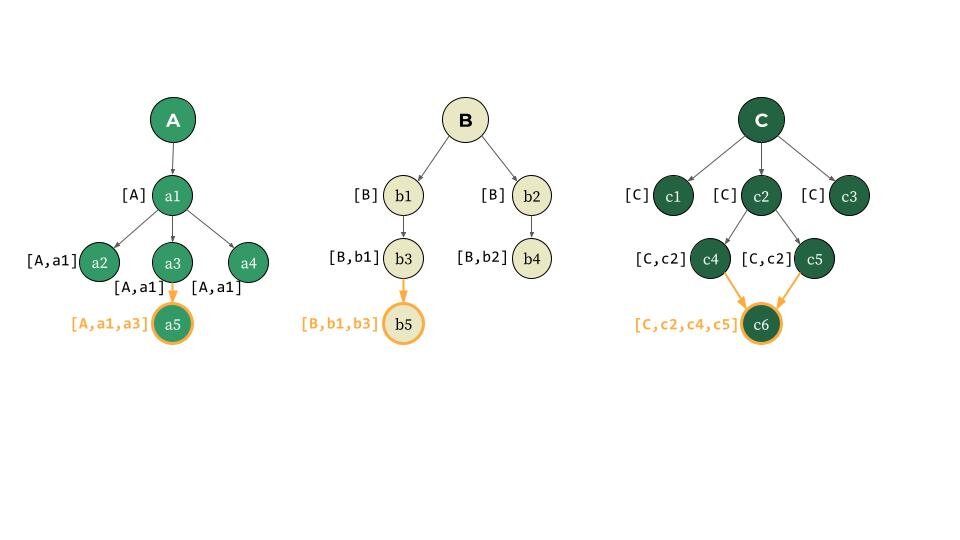
A graph is even more flexible. It's a collection of nodes (or vertices) connected by links (or edges). A graph is like a generalization of a tree where there are no rules about parents and children. Any node can be connected to any other node. Social networks, where people are nodes and friendships are edges, are a perfect example of a graph. The internet itself is a giant graph of web pages connected by links.
Finding and Sorting
Once our data is organized, we need efficient methods, or algorithms, to work with it. Two of the most common tasks are searching for an item and sorting the entire collection.
The most basic searching algorithm is a linear search. You just start at the beginning and check every single item until you find what you're looking for. It's simple, but it can be very slow if you have a lot of data.
If your data is sorted, you can use a much faster method called a binary search. Imagine looking for a word in a dictionary. You don't start at 'A' and read every word. Instead, you open it to the middle. If your word comes alphabetically before the words on that page, you know it's in the first half. If it comes after, it's in the second half. You repeat this process, cutting the search area in half each time, until you find your word.
This "divide and conquer" strategy makes binary search incredibly efficient.
function binary_search(list, target):
  low = 0
  high = length of list - 1

  while low <= high:
    mid = (low + high) / 2
    guess = list[mid]

    if guess == target:
      return mid  // Found it!
    if guess > target:
      high = mid - 1 // Guess was too high
    else:
      low = mid + 1  // Guess was too low

  return null // Target not in list
Of course, for binary search to work, the data must first be sorted. There are many different sorting algorithms, each with its own strengths and weaknesses. Some, like Bubble Sort, are simple to understand but slow. Others, like Merge Sort and Quick Sort, are more complex but much faster for large datasets.
Understanding these fundamental structures and algorithms is the key to writing code that is not just correct, but also efficient and scalable.
Ready to check your understanding?
Which data structure operates on a 'Last-In, First-Out' (LIFO) principle, similar to a stack of plates?
For a binary search algorithm to work correctly and efficiently, the data collection must be __________.
These concepts are the building blocks programmers use to solve complex problems, from searching a database to recommending a new song.