Applied Chemical Principles and Dynamics
Molecular Orbital Theory
Beyond Dots and Sticks
You've mastered Lewis structures and used VSEPR theory to predict molecular shapes. These models are powerful, but they treat electrons as neat pairs shared between two specific atoms. This works well for many simple molecules, but it starts to break down when we encounter more complex bonding scenarios, like resonance, or surprising magnetic properties.
To get a deeper understanding, we need to refine our view of how atomic orbitals interact. When atoms form a molecule, their individual orbitals don't just stay as they are. They mix and morph into new shapes, a process called hybridization. This idea is the cornerstone of Valence Bond Theory, which serves as a great bridge to the more powerful Molecular Orbital Theory.
Hybrid Orbitals
Imagine a carbon atom. Its electron configuration is $1s^22s^22p^2$. To form four bonds, like in methane (CH₄), it seems like it should use its two p-orbital electrons and maybe one s-orbital electron. But that doesn't explain why all four C-H bonds in methane are identical in length and strength, and why they arrange themselves in a perfect tetrahedron.
The solution is hybridization. The carbon atom's one 2s and three 2p orbitals mathematically combine to form four new, identical hybrid orbitals called sp³ orbitals Each sp³ orbital has 25% s-character and 75% p-character, resulting in a shape that's great for overlapping with other atoms' orbitals to form strong bonds.
This head-on overlap of orbitals, whether they are s, p, or hybrid orbitals, forms a sigma (σ) bond. Sigma bonds are strong and are the first type of bond to form between any two atoms. They have their electron density concentrated directly along the axis connecting the two nuclei.
Other types of hybridization explain other geometries. For example, in ethene (C₂H₄), each carbon is sp² hybridized (one s, two p's) leading to a trigonal planar geometry. The leftover p-orbital on each carbon atom overlaps side-to-side, forming a weaker pi (π) bond. This combination of one sigma and one pi bond creates the double bond.
The Full Picture with MO Theory
Valence Bond theory, with its hybrid orbitals and localized bonds, is a fantastic mental model. However, it's not the complete story. A more comprehensive model is Molecular Orbital (MO) Theory. MO theory takes a different approach: it assumes that when atoms combine, their atomic orbitals are completely replaced by molecular orbitals that are delocalized, or spread out, over the entire molecule.
Unlike valence bond theory, which uses hybrid orbitals that are assigned to one specific atom, MO theory uses the combination of atomic orbitals to yield molecular orbitals that are delocalized over the entire molecule rather than being localized on its constituent atoms.
When two atomic orbitals combine, they create two molecular orbitals. One is the bonding molecular orbital, which results from the constructive interference of the atomic orbital wave functions. It's lower in energy than the original atomic orbitals and concentrates electron density between the nuclei, pulling them together.
The other is the antibonding molecular orbital, which results from destructive interference. It's higher in energy and has a node (a region of zero electron density) between the nuclei. Placing electrons in an antibonding orbital actually weakens the bond.
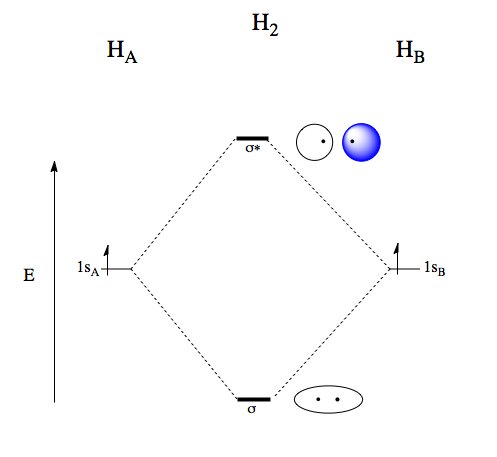
We can quantify the strength of a bond using this model by calculating its bond order.
For H₂, there are 2 electrons in the bonding orbital and 0 in the antibonding orbital. The bond order is ½(2 - 0) = 1. This matches our understanding of H₂ having a single covalent bond.
A Tale of Two Theories
So why do we need two different theories? Because each has its strengths. VSEPR and Valence Bond theory are fantastic for quickly predicting the 3D shape and geometry of most molecules. They are intuitive and visual.
MO theory, however, is more powerful and accurate. It can explain phenomena that VB theory cannot. The classic example is the oxygen molecule, O₂. Lewis structure shows a double bond (O=O), and predicts all electrons are paired. This would suggest O₂ is diamagnetic meaning it should be weakly repelled by a magnetic field. But experiments show that liquid oxygen is strongly attracted to magnets; it is paramagnetic
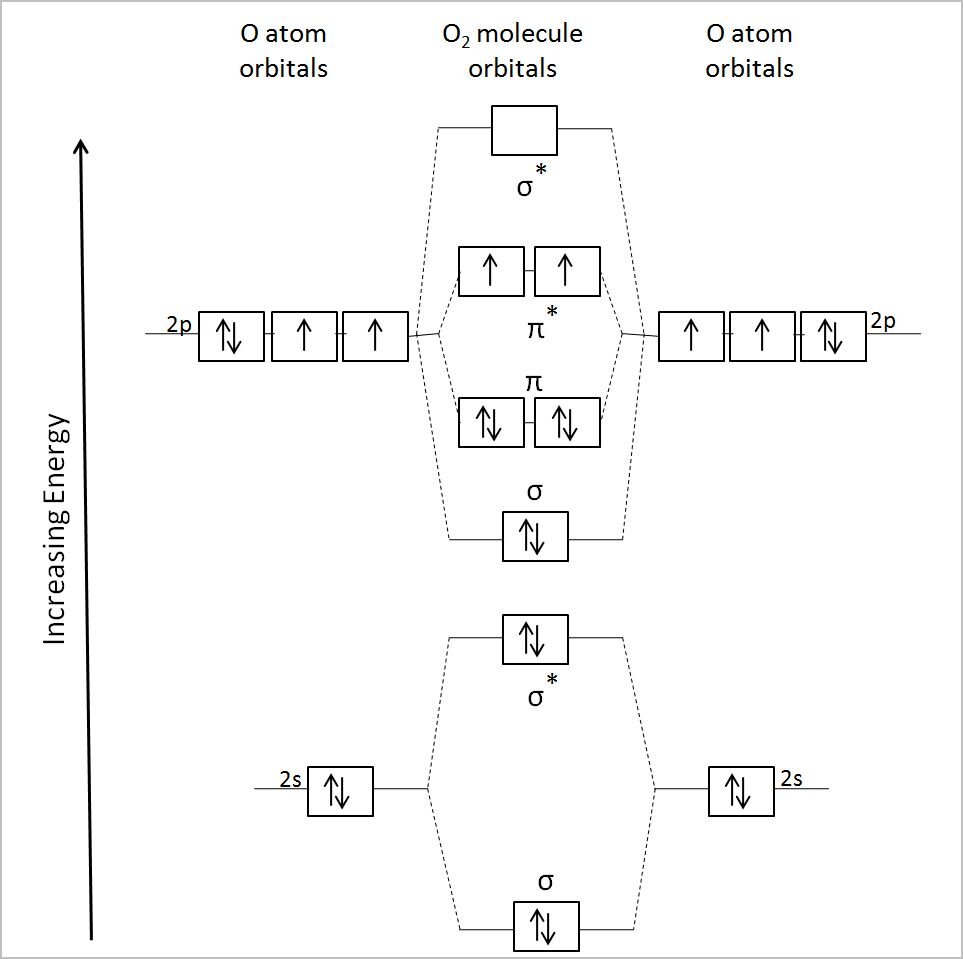
MO theory solves the mystery. When you construct the molecular orbital diagram for O₂, you find that the two highest-energy electrons are unpaired, each occupying a separate π* antibonding orbital. These unpaired electrons give O₂ its paramagnetic properties. This was a major predictive triumph for MO theory.
So which theory should you use? For everyday predictions of molecular shape, VSEPR is your quick and reliable tool. When you need to explain properties like magnetism, bond energies, or electronic spectra, MO theory provides the more fundamental and accurate picture.
Ready to test your understanding of these advanced bonding concepts? Let's see how well you can apply these theories.
According to Valence Bond Theory, what is the hybridization of the carbon atom in methane (), which allows it to form four identical single bonds?
A double bond, such as the one found between the carbon atoms in ethene (), is always composed of which combination of bonds?
Understanding how atomic orbitals combine to form molecules is key to predicting how materials will behave. It bridges the gap between the properties of individual atoms and the complex world of chemistry and material science.