Applied Chemical Foundations
Chemical Reaction Equations
Chemical Recipes
A chemical reaction is like a recipe. You start with ingredients and end up with a finished dish. In chemistry, we call the starting ingredients reactants and the final dish products. To communicate these recipes clearly, we use chemical equations.
The basic format is simple: reactants on the left, products on the right, separated by an arrow that shows the direction of the change. For example, the reaction of hydrogen gas with oxygen gas to form water looks like this:
But there's a problem with this recipe. It violates a fundamental rule of the universe: the Law of Conservation of Mass. This law, championed by French chemist , states that matter cannot be created or destroyed in a chemical reaction. Atoms are just rearranged.
If we count the atoms in our water recipe, we have 2 hydrogen atoms and 2 oxygen atoms on the left, but only 2 hydrogen and 1 oxygen on the right. An oxygen atom has vanished. This is impossible.
Balancing the Books
To fix our equation, we need to balance it. This means making sure the number of atoms of each element is the same on both sides. We do this by adding coefficients, which are numbers placed in front of the chemical formulas.
coefficient
noun
A number placed in front of a chemical formula in an equation. It indicates how many molecules or moles of that substance are involved in the reaction.
It’s crucial not to confuse coefficients with subscripts. A subscript is the small number within a formula (like the '2' in H₂O) that tells you how many atoms of an element are in one molecule. Changing the subscript changes the substance itself. For example, H₂O is water, but H₂O₂ is hydrogen peroxide, a completely different chemical.
To balance the water equation, we can't change the formulas, but we can change the coefficients. Let's try adding a coefficient of 2 in front of the H₂. That gives us 4 hydrogens on the left. Then we add a 2 in front of H₂O, which gives us 4 hydrogens and 2 oxygens on the right. Now the equation is balanced.
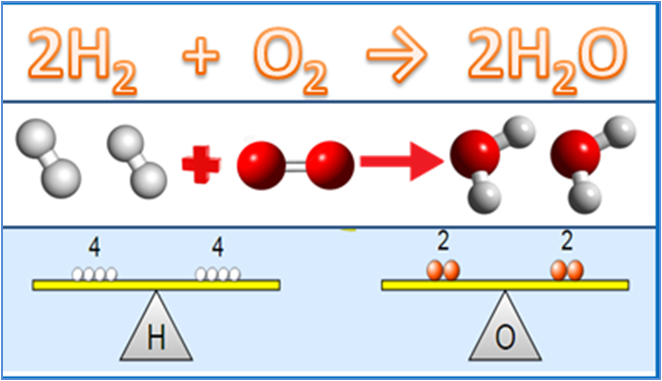
Balancing equations is a process of trial and error. Start with the most complex molecule and leave single elements for last. The goal is to find the smallest whole-number coefficients that make the atom counts match. This entire process is the foundation of —the calculation of reactants and products in chemical reactions.
Adding More Detail
We can make our equations even more descriptive by adding state symbols. These tell us the physical state of each substance in the reaction.
| Symbol | State | Example |
|---|---|---|
| (s) | Solid | - Solid Sodium |
| (l) | Liquid | - Liquid Water |
| (g) | Gas | - Oxygen Gas |
| (aq) | Aqueous | - Salt dissolved in water |
The aqueous (aq) symbol is particularly important because many reactions happen in water. It means the substance is dissolved to form a solution. Our fully described water formation equation would look like this:
This single line of symbols tells a complete story: what reacted, what was produced, in what proportions, and in what physical state. It's the universal language of chemistry.
Ready to practice balancing the books yourself? This quiz will test your understanding of the concepts we've just covered.
In a chemical equation, what are the starting ingredients called?
The principle that matter cannot be created or destroyed in a chemical reaction is known as the Law of Conservation of Mass.
Mastering chemical equations is the key to unlocking the quantitative side of chemistry, allowing you to move from simply observing reactions to predicting their outcomes.