Applied Calculus Insights
Limits and Continuity
What is a Limit?
In calculus, a limit describes the value a function approaches as its input gets closer and closer to a specific number. It’s not about what happens at the number, but what happens in its immediate neighborhood. Think of it like walking towards a wall. A limit describes the spot on the wall you're heading towards, even if there's a tiny hole right at that spot preventing you from ever touching it. The destination is clear, regardless of what's at the final point.
A limit is the value that a function approaches as the input approaches some value.
We use a specific notation to talk about limits. If we want to describe the limit of a function as approaches a value , we write it like this:
The limit exists only if the function approaches the same value from both the left side (numbers smaller than ) and the right side (numbers larger than ).
Finding Limits
Calculating limits can be straightforward or require a bit of algebraic manipulation. Here are the most common techniques.
Direct Substitution The simplest method is to just plug the value into the function. If you get a real number, that's your limit. This works for many simple functions, like polynomials.
For example, to find the limit of as approaches 2:
Things get interesting when direct substitution gives you an indeterminate form, most commonly . This doesn't mean the limit is zero or undefined; it just means we need to do more work.
Factoring and Canceling If you have a rational function (a fraction of polynomials) that results in , try factoring the numerator and denominator. You can often cancel a common factor that's causing the issue.
Let's find the limit of as approaches 2. Direct substitution gives .
This tells us that as gets very close to 2, the function's value gets very close to 4, even though the function is undefined right at .
Continuity
Continuity is a direct application of limits. A function is continuous at a point if there are no interruptions, jumps, holes, or gaps in its graph. You can draw it without lifting your pen from the paper.
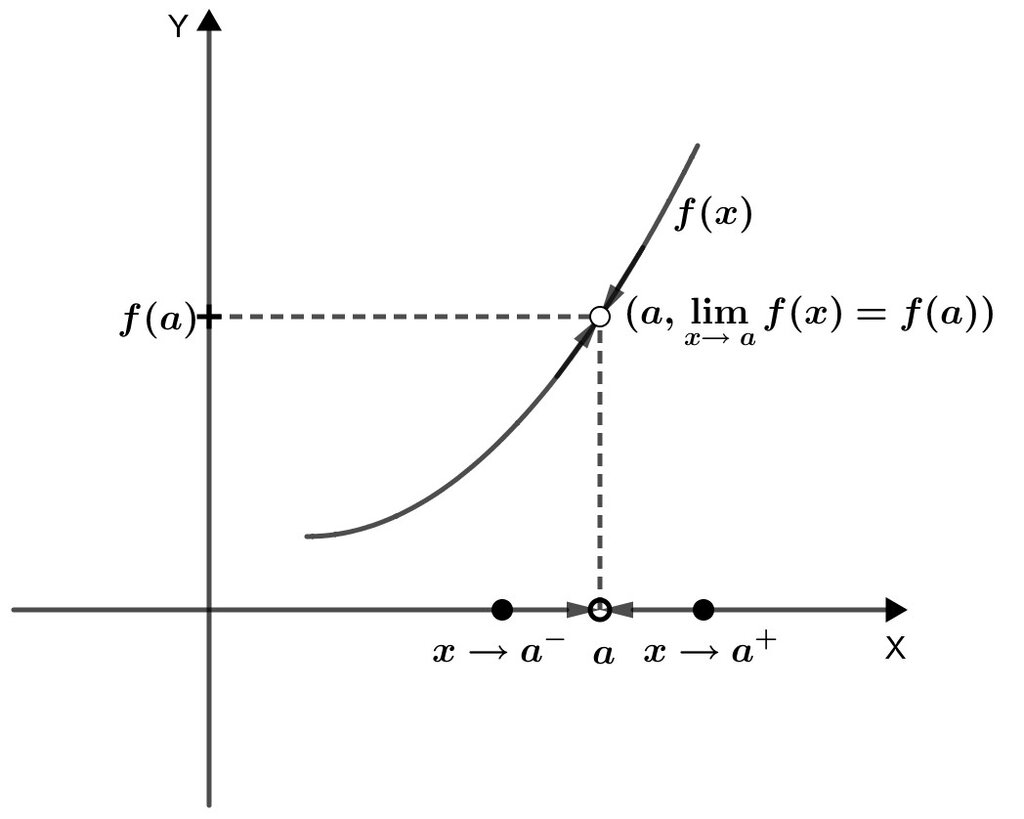
For a function to be continuous at a point , three conditions must be met:
| Condition | Meaning |
|---|---|
| 1. is defined. | The point must actually exist on the graph. |
| 2. exists. | The function must approach the same value from both sides. |
| 3. . | The limit must equal the function's value at that point. |
If any of these fail, the function is discontinuous at . Continuity is a foundational assumption for many theorems in calculus. It ensures that functions behave predictably, which is crucial when analyzing rates of change or calculating areas under curves.
Infinite Limits and The Squeeze Theorem
Limits also help us understand a function's behavior at the extremes. We can look at what happens as grows infinitely large (approaches ) or infinitely small (approaches ). This is key to identifying horizontal asymptotes, the values a function levels out to.
Sometimes, a function's output grows without bound as approaches a certain number. This is a limit that equals infinity and indicates a vertical asymptote.
Finally, we have a clever tool for finding tricky limits called the Squeeze Theorem (or Sandwich Theorem). If a function is "squeezed" between two other functions that both approach the same limit at a certain point, then the function in the middle must also approach that same limit.
If for all near , and , then .
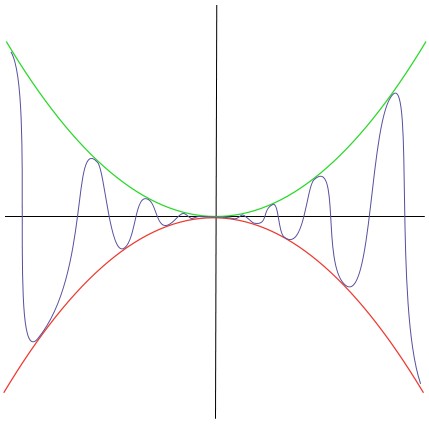
This theorem is especially useful for limits involving trigonometric functions, like the important limit , which equals 1. Proving this limit relies on squeezing the function between two simpler geometric expressions.
Time to test your understanding of these foundational concepts.
What does the limit of a function as x approaches c, written as , describe?
Evaluate the following limit:
Limits form the bedrock of calculus, defining how functions behave at a microscopic level and paving the way for the study of change.