Applied Behavioral Economics and Choice Architecture
Advanced Prospect Theory
The Next Step in Prospect Theory
Prospect Theory describes how people choose between probabilistic alternatives involving risk. But the original model was designed for simple gambles, like a coin flip. Real-world decisions are far messier, involving many possible outcomes with varying probabilities. This is where (CPT) comes in.
CPT models decision-making in two stages. First is the "editing" phase, where a person simplifies the available options into a more manageable form. They might round probabilities, discard extremely unlikely outcomes, or frame outcomes relative to a reference point.
Second is the "evaluation" phase. Here, the edited prospects are evaluated using two core functions: a value function (like the one in original Prospect Theory) and a probability weighting function, which is where things get really interesting.
How We Weigh the Odds
Expected Utility Theory assumes we treat probability linearly. A 20% chance of something happening is perceived as exactly twice as likely as a 10% chance. CPT shows this isn't true. We systematically distort probabilities in our minds. The captures this distortion.
Generally, we overweight very small probabilities and underweight moderate and high probabilities. This gives the function an inverse S-shape. The jump from a 0% chance to a 1% chance feels huge—it’s the difference between impossible and possible. But the jump from a 50% chance to a 51% chance feels negligible.
This function has a different shape for gains than for losses, reflecting our different attitudes toward risk in each domain. Research shows these weighting functions can vary across demographic groups and cultures, influencing everything from insurance markets to public policy decisions.
A Shifting Viewpoint
A key challenge for both Expected Utility Theory and basic Prospect Theory is that they assume a stable reference point. But our reference point for what counts as a gain or a loss is fluid; it's shaped by recent experiences. This is called —our frame of reference is determined from within the situation, not outside of it.
One powerful example of this is "Gain Overhang." An investor who has recently experienced significant gains on a stock may update their reference point. The new, higher price becomes the baseline. Instead of feeling wealthy, they feel protective of their paper profits and become more risk-averse, fearing a drop back to the original price.
This is also known as the "house money effect." Gamblers are often more willing to take big risks with money they've recently won, because they don't yet psychologically categorize it as their own. It's still the casino's money, making a loss feel less painful.
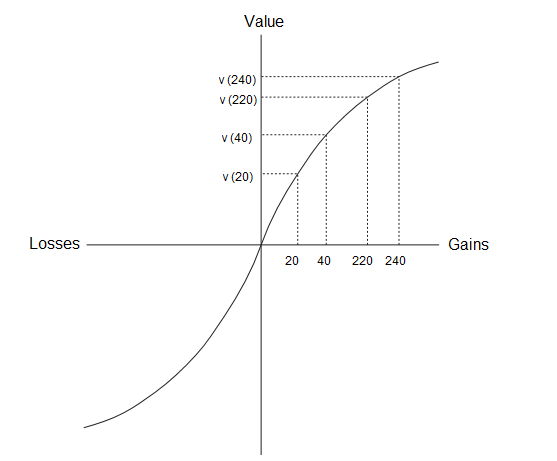
Conversely, after a series of losses, an investor's reference point may shift downwards. To get back to their original breakeven point, they might take on excessive risk, a behaviour known as "disposition effect"—holding onto losing investments for too long in the hope they will recover. This is driven by diminishing sensitivity in the loss domain: each additional dollar lost hurts less than the one before it, encouraging risk-seeking behaviour to erase the loss.
When to Use Which Theory
So, when should we use CPT over the more traditional Expected Utility Theory (EUT)?
| Scenario | Best Model | Why |
|---|---|---|
| Long-Term Financial Planning | EUT | Assumes rationality and focuses on final wealth, which is more appropriate for strategic, long-horizon decisions. |
| Short-Term Market Anomalies | CPT | Explains behaviours like momentum and disposition effect by focusing on gains and losses relative to a recent reference point. |
| Insurance and Lotteries | CPT | The probability weighting function perfectly models why people overpay for covering small-probability risks or chasing small-probability jackpots. |
| Corporate Finance | EUT | Decisions about major capital investments are typically made with rigorous analysis that aims for rational, value-maximising outcomes. |
| Individual Investor Behaviour | CPT | Captures the emotional and psychological biases that heavily influence retail trading decisions. |
EUT describes how a perfectly rational agent should behave to maximise wealth. It’s a normative model. CPT is a descriptive model—it describes how people actually behave, with all our biases and mental shortcuts. While EUT fails to explain many real-world market behaviours, CPT provides a powerful framework for understanding the psychology that drives asset prices away from their fundamental values.
Time to test your understanding of these advanced concepts.
Which of the following best describes the key advancement of Cumulative Prospect Theory (CPT) over the original Prospect Theory?
According to the probability weighting function in CPT, which of these changes in the probability of winning a prize would feel most psychologically significant?
Understanding these nuances helps bridge the gap between idealized economic models and the often-unpredictable reality of human decision-making in financial markets.