Applied Artificial Intelligence Systems
Learning Paradigms and Trade-offs
The Art of Generalization
The ultimate goal of a machine learning model isn't to be right about the data it trained on. That's like a student who memorizes the answers to a practice exam but can't solve new problems. The real test is how well a model performs on unseen data, a quality known as generalization. A model that generalizes well has learned the underlying patterns, not just the noise.
Achieving good generalization requires balancing two competing sources of error: bias and variance. Think of bias as a model's stubbornness. A high-bias model makes strong assumptions about the data. For example, assuming a complex, wavy relationship between data points is a straight line. It's simple and fast, but it will be wrong a lot. This is called underfitting.
Variance is the opposite. It's a model's sensitivity to the training data. A high-variance model is extremely flexible and tries to fit every single data point perfectly. It ends up modeling the random noise in the training set, not just the true signal. When it sees new data, it performs poorly because the noise is different. This is called overfitting and is like the student who memorized every comma in the textbook but can't explain the concepts.
The tradeoff between a model's ability to minimize bias and variance is foundational to training machine learning models, so it's worth taking the time to understand the concept.
Finding the Sweet Spot
The relationship between bias, variance, and model complexity is the central challenge in supervised learning. A simple model (like linear regression) has high bias and low variance. A complex model (like a deep neural network) has low bias but high variance. The ideal model is complex enough to capture the true patterns but not so complex that it mistakes noise for a signal.
This tension is known as the bias-variance tradeoff and is a fundamental concept in machine learning. As you increase model complexity, bias decreases, but variance increases. The total error of a model is a combination of bias, variance, and a small amount of irreducible error inherent in the data itself. Our goal is to find the point where the sum of bias and variance is at its minimum.
The U-shaped curve of total error illustrates this perfectly. Too little complexity leads to high bias (underfitting). Too much complexity leads to high variance (overfitting). The bottom of the 'U' is the sweet spot. This is the core idea behind what's called empirical risk minimization—finding a model that minimizes error on the data we have, while hoping it also minimizes error on data we haven't seen.
Unsupervised Helpers
So far, we've discussed supervised learning. But unsupervised methods can be powerful allies. One of the best ways to combat overfitting, especially when you have many features, is through dimensionality reduction.
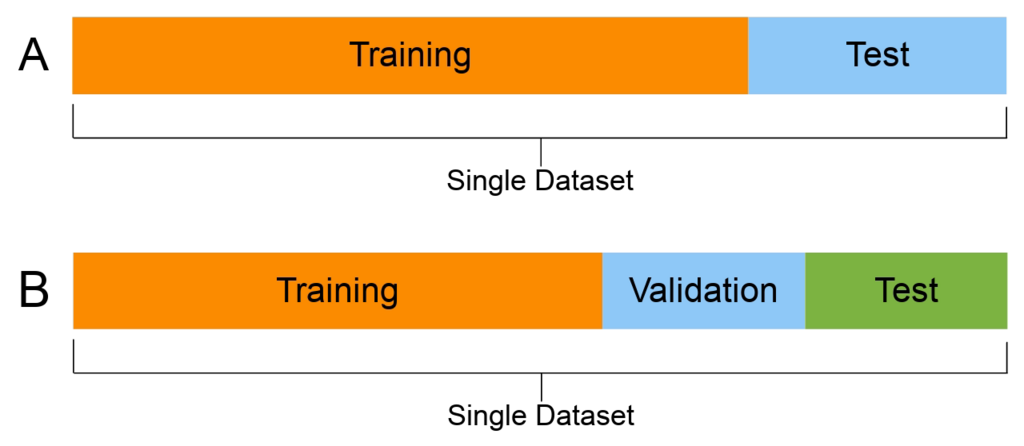
Algorithms like Principal Component Analysis (PCA) find the directions of highest variance in your data and project the data onto a lower-dimensional subspace. This forces the model to focus on the most important features, reducing noise and complexity. Another technique, t-SNE, is excellent for visualizing high-dimensional data by giving each data point a location in a 2D or 3D map, often revealing clusters you didn't know existed.
By reducing the number of features, dimensionality reduction simplifies the model, which often lowers variance and reduces the risk of overfitting.
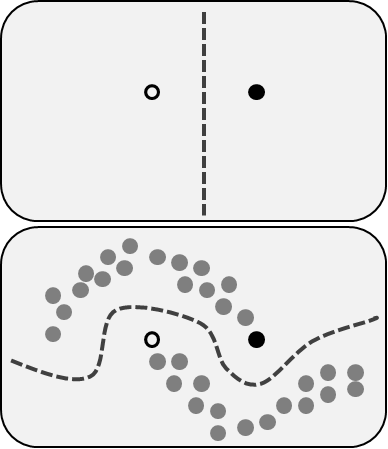
This hybrid approach bridges the gap between supervised and unsupervised paradigms. It uses unsupervised assumptions to make supervised learning more effective, especially when labeled data is scarce. By understanding the intrinsic structure of the unlabeled data, a model can create a much better decision boundary than it could with just a few labeled points alone.
This shows that the line between supervised and unsupervised learning isn't always sharp. The most effective machine learning pipelines often mix and match techniques, using unsupervised methods to clean and simplify data before feeding it into a supervised model to make predictions. The goal is always the same: create a model that generalizes well to the real world.
Ready to test your understanding of these core trade-offs?
What is the primary goal of a machine learning model in the context of generalization?
A model that is too simple and fails to capture the underlying trend in the data is said to be...
Understanding these trade-offs is what separates a novice from a professional. It's about moving beyond default settings and making informed decisions to build robust, effective models.