Applied Artificial Intelligence Foundations
Selecting Machine Learning Architectures
The Model Selection Dilemma
Choosing the right machine learning architecture feels like picking the right tool for a job. You wouldn't use a sledgehammer to hang a picture frame. Similarly, the best model depends entirely on your data, your goal, and your constraints. There's no single algorithm that reigns supreme for every problem. This core idea has a name: the in machine learning.
This principle forces us to think critically. Instead of searching for a one-size-fits-all solution, we must weigh the trade-offs. The three main considerations are the nature of the problem, the characteristics of the data, and the practical requirements of the solution, like how easy it needs to be to explain.
Lines, Trees, and Networks
At a high level, models fall into a few broad families, each with distinct strengths. The simplest are linear models, which are fast, require less data, and are highly interpretable. They assume a linear relationship between features and the target variable, making them a great starting point or baseline.
Tree-based models, like Random Forests and XGBoost, are a step up in complexity. They make decisions by splitting the data on different features, creating a tree-like structure. This allows them to capture complex, non-linear relationships that linear models would miss. They are workhorses in many business applications for structured data.
Finally, deep learning models, or neural networks, excel where the data is vast and unstructured, like images or text. They can learn intricate patterns but are computationally expensive and notoriously difficult to interpret. They are often overkill for simpler, tabular datasets.
| Model Family | Best For... | Interpretability | Computational Cost |
|---|---|---|---|
| Linear Models | Baselines, simple relationships | High | Low |
| Tree-Based | Structured data, complex interactions | Medium | Medium |
| Deep Learning | Unstructured data (images, text) | Low | High |
The Power of the Crowd
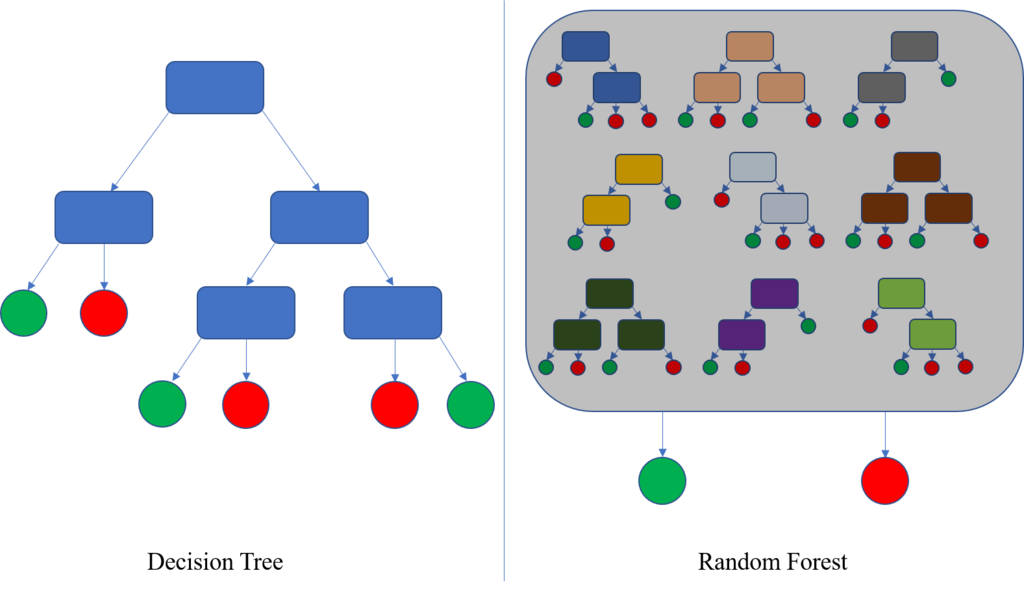
Why rely on a single expert when you can consult a whole panel? That's the logic behind ensemble methods. These techniques combine multiple individual models, often called weak learners, to produce a single, more powerful prediction. The result is almost always better than what any single model could achieve on its own.
One popular approach is bagging, short for bootstrap aggregating. It involves training many models (like decision trees) on different random subsets of the training data. are the most famous example. By averaging the predictions of all the individual trees, the final model becomes more robust and less prone to overfitting.
Another powerful technique is boosting. In boosting, models are trained sequentially. Each new model focuses on correcting the errors made by the previous ones. Algorithms like (Extreme Gradient Boosting) are famous for their performance and are a go-to for winning machine learning competitions involving structured data.
Problem First, Model Second
The most important question isn't "What model should I use?" but "What problem am I trying to solve?" The answer guides your entire approach, starting with the fundamental choice between supervised and unsupervised learning.
If you have historical data with known outcomes and want to predict that outcome for new data, you need a supervised model.
Consider a bank wanting to predict loan defaults. The business goal is to minimize financial risk. The data consists of past loans, including customer information and whether they defaulted. This is a classic supervised classification problem. You could start with a simple, interpretable Logistic Regression model to understand the key drivers of default. If performance isn't sufficient, you could then move to a more complex Random Forest or XGBoost model to capture more nuanced patterns.
If you want to discover hidden structures or groupings in your data without predefined labels, you need an unsupervised model.
Imagine a marketing team trying to understand its customer base. The business goal is to identify distinct customer segments for targeted campaigns. They have data on customer demographics and purchase behavior but no pre-existing groups. This calls for an unsupervised clustering algorithm, like or DBSCAN, to find natural groupings in the data. The output isn't a prediction, but a set of customer segments that can then inform marketing strategy.
By starting with the business problem, you can frame the technical challenge correctly and narrow down the vast field of potential models to a manageable few. A clear problem definition is the most valuable tool in your selection process.
What does the "No Free Lunch Theorem" imply in the context of machine learning?
A marketing team wants to group its customers into distinct segments based on their purchasing behavior, but they don't have any pre-existing labels for these groups. What type of machine learning problem is this?
Ultimately, selecting a machine learning architecture is an iterative process of matching the tool to the task, always guided by the practical needs of the problem you're aiming to solve.