Applied AI Frontiers
Introduction to AI
What Is Artificial Intelligence?
At its core, artificial intelligence is the science of making machines that can think and learn like humans. The goal is to create systems that can reason, solve problems, perceive the world, and understand language. Think of it less as building a robot and more as trying to replicate the process of human thought in a machine.
Artificial Intelligence
noun
A field of computer science dedicated to creating systems capable of performing tasks that typically require human intelligence, such as visual perception, speech recognition, decision-making, and translation between languages.
Instead of being explicitly programmed for every single task, some AI systems are trained on massive amounts of data. From this data, they learn to recognize patterns and make predictions on their own. This ability to learn is what makes AI so powerful and versatile.
A Quick Trip Through Time
The idea of intelligent machines has been around for centuries, but the actual field of AI research began in the 1950s. The journey has been a mix of incredible breakthroughs and periods of slow progress, often called "AI winters," when funding and interest dried up.
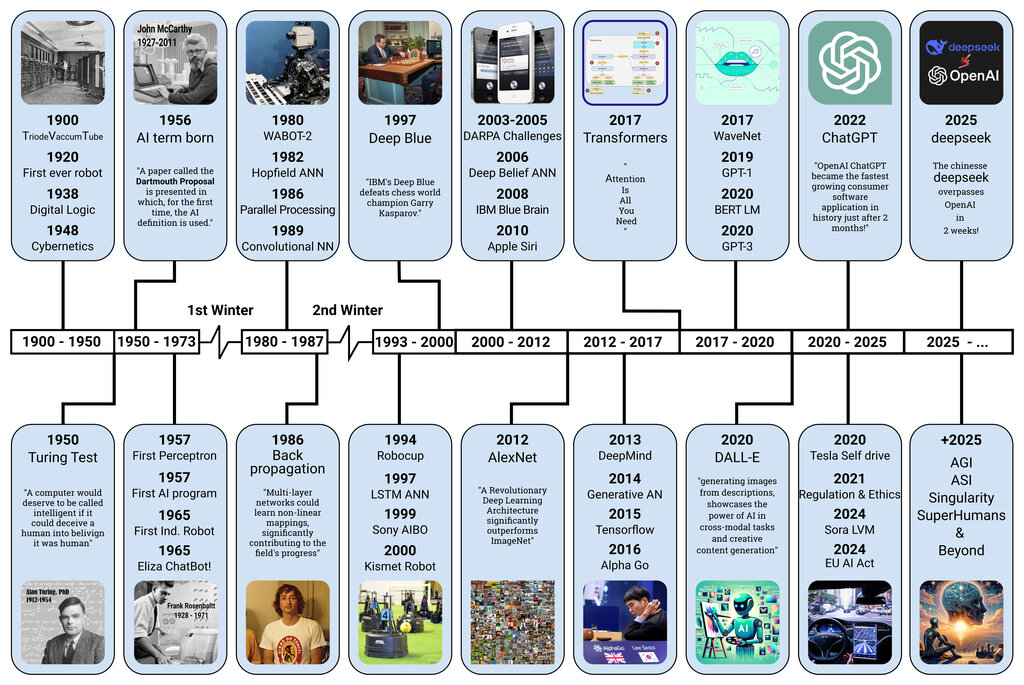
Early research focused on logic and problem-solving. A pivotal moment was the Dartmouth Workshop in 1956, where the term "artificial intelligence" was coined. In the late 1990s, IBM's Deep Blue defeated chess champion Garry Kasparov, a major milestone. The last two decades have seen an explosion of progress, thanks to more powerful computers and the availability of vast datasets, leading to the rise of deep learning and technologies like the one powering ChatGPT.
Two Kinds of AI
When we talk about AI, it's helpful to distinguish between two main types: Narrow AI and General AI. Understanding the difference is key to seeing where the technology is today and where it might be headed.
All the AI we use today is considered Narrow AI.
Artificial Narrow Intelligence (ANI), or Weak AI, is designed to perform a specific, single task. It operates within a pre-defined range and can't perform beyond its field. Your phone's virtual assistant, a spam filter for your email, or a recommendation engine on a shopping website are all examples of narrow AI. They are incredibly good at what they do, but they can't suddenly learn to do something else.
The other type is Artificial General Intelligence (AGI), or Strong AI. This is the more sci-fi version of AI—a machine with the ability to understand, learn, and apply its intelligence to solve any problem, much like a human being. AGI doesn't exist yet; it's a long-term goal for researchers. Beyond AGI is the concept of Artificial Superintelligence (ASI), an intellect that would be much smarter than the best human brains in practically every field.
Big Questions and Responsibilities
As AI becomes more integrated into our lives, it raises important questions. The data used to train AI systems can contain hidden biases related to race, gender, or age. If we're not careful, AI can perpetuate or even amplify these unfair biases in areas like hiring or loan applications.
There are also major societal impacts to consider. AI has the potential to automate many jobs, which could lead to significant economic shifts. It also brings up concerns about privacy, as companies collect vast amounts of personal data to power their AI services. On the positive side, AI is already helping to solve complex problems in medicine, climate science, and many other fields.
Developing AI responsibly means building systems that are fair, transparent, and accountable.
Because of these challenges, there's a growing global conversation about AI ethics and governance. Researchers, governments, and the public are working to create frameworks to ensure that AI is developed and used in a way that benefits everyone and minimizes harm.

Now that you have a foundational understanding of AI, let's test your knowledge.
What is the fundamental goal of artificial intelligence?
The type of AI that can perform a wide range of tasks at a human-like level of intelligence, but does not yet exist, is known as:
Understanding what AI is, where it came from, and the questions it raises is the first step in navigating our increasingly automated world.