App Development Fundamentals
Introduction to Application Development
From Idea to App
Every app on your phone started as an idea. But how does a simple concept become a functional piece of software? It’s not magic; it’s a structured process called the Software Development Lifecycle, or SDLC for short. Think of the SDLC as a roadmap that guides a team from the initial spark of an idea to a finished product in the hands of users.
The SDLC provides a clear framework, ensuring that nothing gets missed and the final product is well-built, tested, and ready for the real world.
This lifecycle is cyclical and typically involves several distinct phases. Each phase has its own goal, and completing it sets the stage for the next one.
Here's a quick breakdown of the phases:
- Planning: This is where it all begins. The team defines the project's goals, determines its feasibility, and outlines the requirements. What problem will the app solve? Who is it for?
- Design: Architects and designers create the blueprint. This includes the user interface (UI) design—what the app will look like—and the user experience (UX) design—how it will feel to use. They also map out the system architecture, the underlying structure that makes it all work.
- Development: This is the coding phase. Developers take the designs and write the actual code that brings the application to life.
- Testing: Before release, the application goes through rigorous testing. Quality Assurance (QA) engineers look for bugs, glitches, and any other issues to ensure the software is stable and meets the requirements from the planning phase.
- Deployment: Once the app is tested and ready, it's released to users. This might mean publishing it to an app store or deploying it on a web server.
- Maintenance: The work isn't over after launch. The team continues to monitor the app for issues, release updates, and add new features based on user feedback.
Choosing Your Path
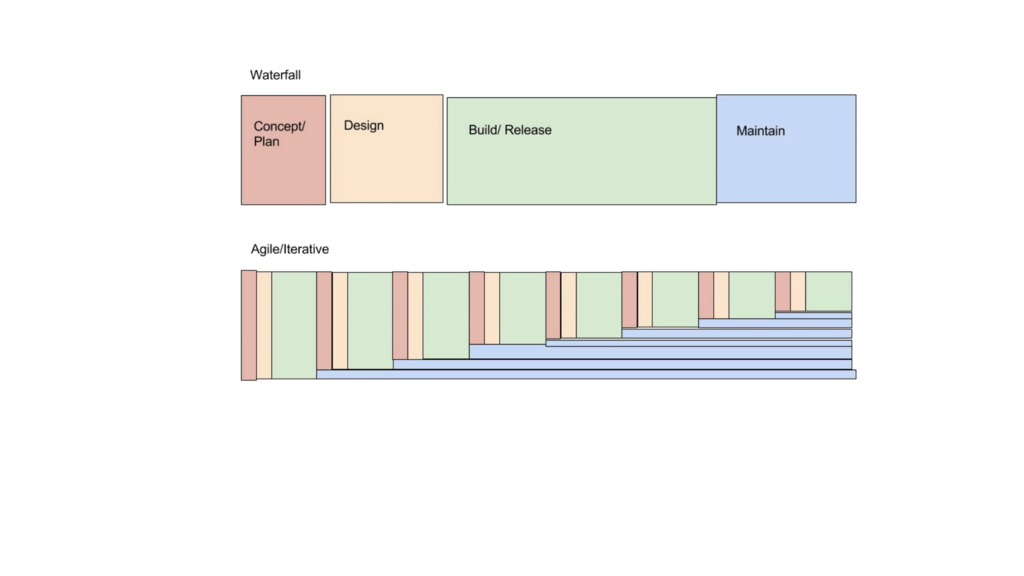
While most projects follow the SDLC phases, the way they move through them can differ. Teams use various methodologies to manage their workflow. Two of the most common are Waterfall and Agile.
The Waterfall model is a traditional, linear approach. Each phase of the SDLC must be fully completed before moving on to the next, like a waterfall cascading down a series of steps. It's rigid and structured, which works well for projects with very clear, unchanging requirements.
Agile, on the other hand, is iterative. The project is broken down into small, manageable cycles called "sprints." In each sprint, the team works through all the SDLC phases on a small piece of the project. This allows for flexibility, continuous feedback, and the ability to adapt to changes quickly. Most modern software teams use some form of Agile.
The Development Team
Building an application is a team sport. Different roles work together, each bringing a unique set of skills to the project. While roles can vary depending on the team's size and methodology, a few are fundamental.
| Role | Responsibility |
|---|---|
| Product Manager | Defines the vision for the product, prioritizes features, and represents the user's needs. They answer the 'why' and 'what.' |
| UI/UX Designer | Focuses on the user's experience. UI (User Interface) is about the look and layout, while UX (User Experience) is about the overall feel and usability. |
| Software Developer | Writes, tests, and maintains the code. They can be front-end (working on what the user sees), back-end (working on the server and database), or full-stack (both). |
| QA Engineer | Tests the application to find and report bugs or issues before it reaches the user. They ensure the software meets quality standards. |
Tools of the Trade
To build software, developers rely on a variety of languages and tools.
Programming languages are the instructions humans write for computers to follow. Some are for the front-end, which is everything the user sees and interacts with (like buttons and menus). JavaScript is the king of front-end web development. Others are for the back-end, the server-side logic that works behind the scenes to power the application. Languages like Python, Java, and Ruby are popular choices here.
Developers write code in an Integrated Development Environment (IDE), which is like a specialized text editor with helpful features like code completion and debugging tools.
Finally, to collaborate effectively, teams use version control systems like Git. Version control tracks every change made to the code, so developers can see a history of the project, revert to older versions if something breaks, and merge their work together without conflicts.
Now, let's review the key concepts we've covered.
Ready to test your knowledge?
What is the primary purpose of the Software Development Lifecycle (SDLC)?
During which phase of the SDLC is the application's blueprint, including UI/UX and system architecture, created?
Understanding these core elements—the lifecycle, methodologies, team roles, and tools—provides a solid foundation for grasping how software is made.