App Development From Scratch
Programming Languages
Choosing Your Language
The first programming language you learn is a gateway. While many concepts like loops and variables are universal, each language has its own philosophy, strengths, and community. The best choice depends on what you want to build. Let's look at a few popular options for starting your journey.
Python: The All-Rounder
Python is famous for its clean, readable syntax. It's designed to be straightforward, often reading like plain English. This simplicity allows you to focus on solving problems rather than wrestling with complex language rules. It's an interpreted language, which means you can run code line by line and see immediate results, making it great for learning.
# This prints "Hello, World!" to the console.
print("Hello, World!")
Its versatility is its biggest strength. Python is a dominant force in data science, machine learning, and AI thanks to powerful libraries like Pandas and TensorFlow. It's also widely used for web development with frameworks like Django and Flask, and for automating repetitive tasks with simple scripts.
Choose Python if you're interested in data, AI, scientific computing, or want a gentle introduction to programming fundamentals.
JavaScript: The Web's Native Tongue
If you want to build for the web, JavaScript is essential. It's the language that runs directly in your web browser, making websites interactive. It handles everything from simple animations and form validations to complex single-page applications.
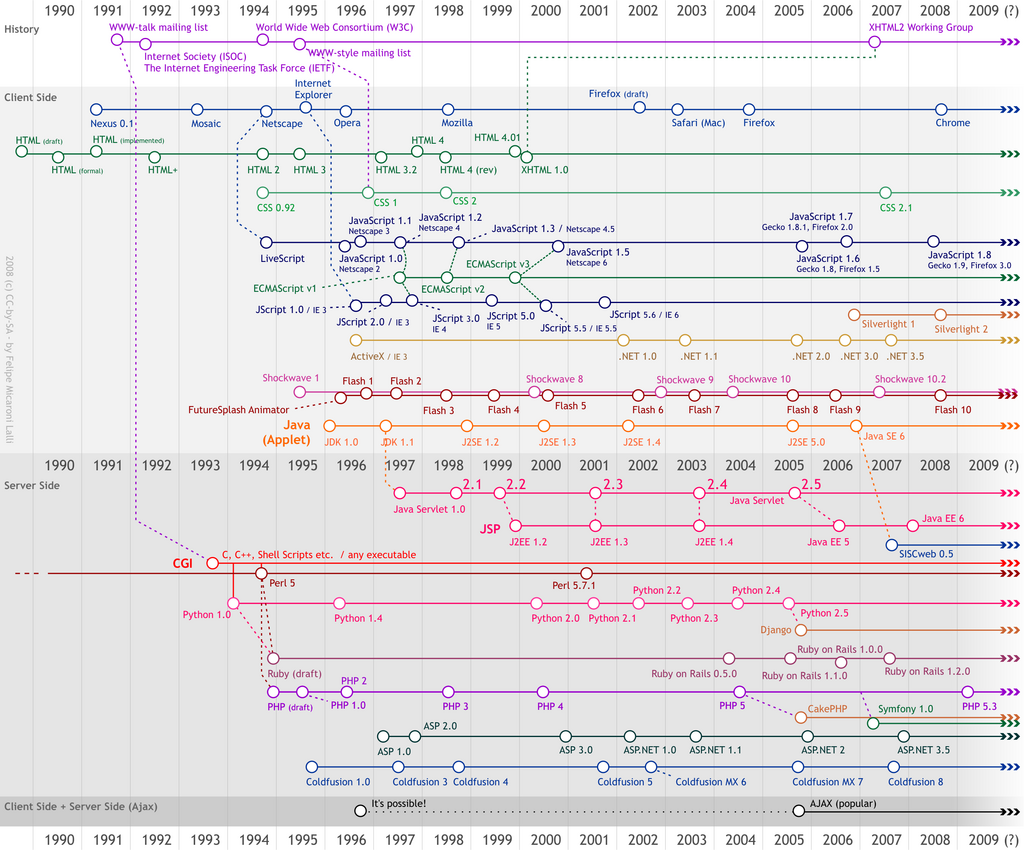
Initially a front-end language, JavaScript's role has expanded dramatically. With Node.js, it can now run on servers, allowing developers to build entire web applications using a single language. This is known as full-stack development. Its ecosystem is massive, with frameworks like React, Angular, and Vue.js for the front-end, and Express for the back-end.
// This will display a popup in a web browser.
alert("Hello, World!");
Choose JavaScript if you're passionate about web development, either for creating user interfaces or building server-side applications.
Java: The Enterprise Staple
Java is a workhorse. It was built on the principle of "Write Once, Run Anywhere" (WORA). This means Java code is compiled into an intermediate format called bytecode, which can then run on any device that has a Java Virtual Machine (JVM). This platform independence made it incredibly popular for large, cross-platform enterprise applications.
It is a statically-typed, object-oriented language. This structure makes the code more predictable and easier to manage in large, complex systems worked on by many developers. It's the primary language for native Android app development and is common in financial services, big data processing, and e-commerce backends.
public class HelloWorld {
    public static void main(String[] args) {
        System.out.println("Hello, World!");
    }
}
Choose Java if you're aiming for Android development, large-scale corporate systems, or want a deep understanding of object-oriented programming.
More Paths to Explore
Beyond these three, other languages offer unique advantages for beginners with specific goals.
| Language | Key Feature | Primary Use Case |
|---|---|---|
| C# | Integration with Microsoft's .NET framework | Game development (Unity), Windows apps, enterprise software. |
| Ruby | Focus on simplicity and developer happiness | Rapid web development with the Ruby on Rails framework. |
C# (pronounced 'C sharp') is very similar to Java in syntax and structure but is tailored for the Microsoft ecosystem. It's the language of choice for building games in the popular Unity engine.
Ruby was designed to be elegant and productive. Its most famous creation, the Ruby on Rails framework, streamlined web development by emphasizing convention over configuration, which influenced many other web frameworks.
Feeling ready to test your knowledge?
Which programming language is most renowned for its simple, readable syntax, making it an excellent choice for beginners and a powerhouse in data science?
If a developer wants to write code for both the front-end (in the browser) and the back-end (on the server) using a single language, which technology enables this for JavaScript?