Apollo 11 Mission Engineering
Saturn V Architecture
Anatomy of a Moonshot
To send astronauts to the Moon, NASA needed a vehicle of unprecedented scale. The mission wasn't just about escaping Earth's gravity; it was about propelling a heavy, complex spacecraft stack—the Command and Service Module (CSM) and the Lunar Module (LM)—all the way to the Moon. This required a carefully choreographed sequence of powerful pushes, timed perfectly. The Saturn V was the engineering answer to this monumental challenge. It was a three-stage rocket designed not just for power, but for precision and efficiency at every step of the journey.
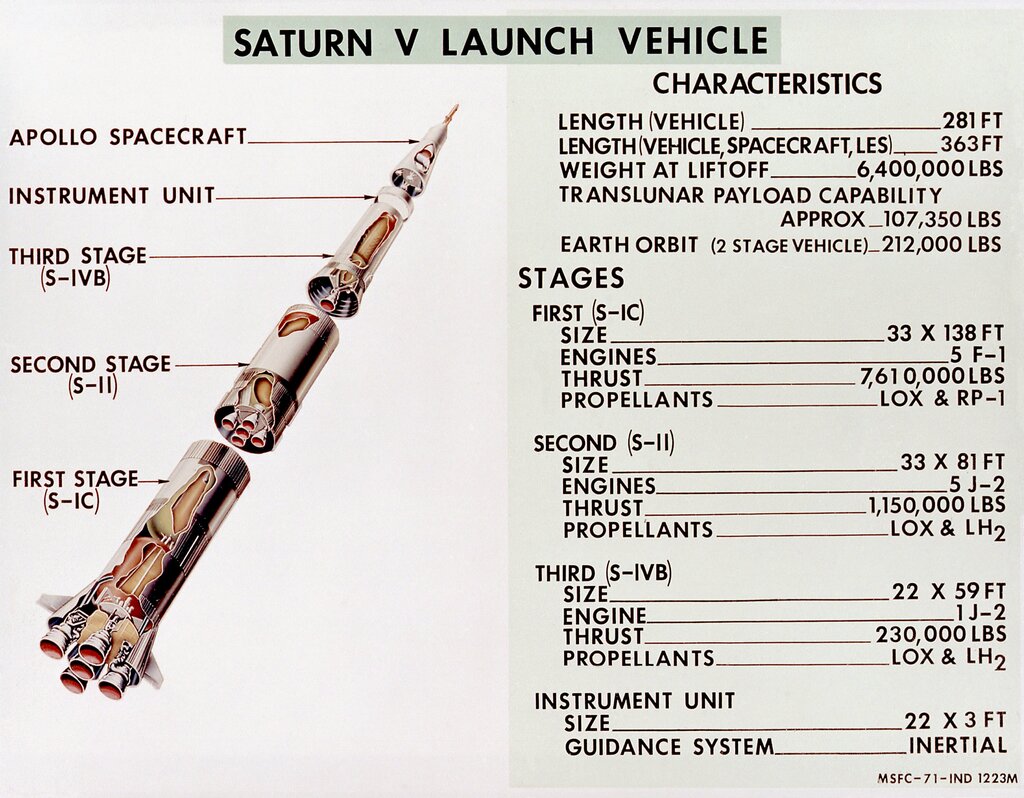
The entire rocket stood 111 metres tall and weighed over 2.8 million kilograms when fully fuelled. Its sole purpose was to accelerate its payload to a speed of nearly 11.2 kilometres per second. To achieve this, the Saturn V shed weight as it climbed, dropping massive stages once their fuel was spent. This principle of staging was critical. Each stage was a self-contained rocket, optimised for a specific phase of the ascent, from the dense lower atmosphere to the vacuum of space.
The First Stage: Brute Force
The first two-and-a-half minutes of the flight were the domain of the S-IC, the Saturn V's first stage. Its job was pure brute force: to lift the entire vehicle off the ground and through the thickest part of the atmosphere. To do this, it relied on five F-1 engines, the most powerful single-chamber liquid-fuelled rocket engines ever built. Together, they generated over 34.5 million newtons of thrust at sea level, consuming nearly 15 tonnes of propellant per second.
The S-IC used a propellant combination of Rocket Propellant-1 (RP-1), a highly refined form of kerosene, and liquid oxygen (LOX) as the oxidiser. While less efficient than the liquid hydrogen used in the upper stages, RP-1 is much denser. This meant the fuel tanks could be smaller and lighter, a crucial trade-off for the massive first stage where structural weight was a primary concern. The sheer volume of fuel required made the denser RP-1 a practical choice for generating maximum thrust at liftoff.
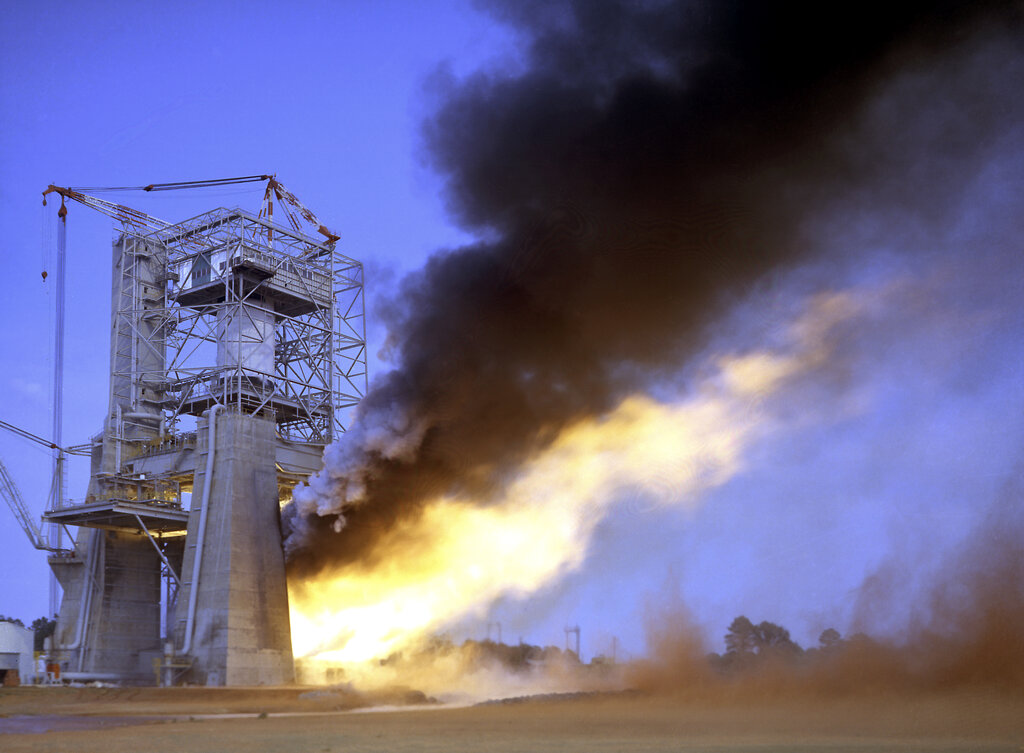
Around 70 seconds after liftoff, the rocket faced its greatest structural challenge: an event known as Max Q. This is the point of maximum dynamic pressure, where the combination of the rocket's velocity and the surrounding air density creates the most intense stress on its frame. The Saturn V's flight computers throttled the engines down slightly to ensure the vehicle wouldn't be torn apart by aerodynamic forces. After passing Max Q, the engines were throttled back up to full power. Once the S-IC's fuel was spent at an altitude of about 67 kilometres, explosive bolts fired, and eight small solid-fuelled retrorockets pushed the massive stage away from the rest of the vehicle, which continued its journey upward.
The Upper Stages: Finesse and Efficiency
With the S-IC gone, the S-II second stage took over. It was powered by five J-2 engines, which were fundamentally different from the F-1s. The J-2s burned liquid hydrogen () and liquid oxygen (), a more efficient propellant combination that provides a higher specific impulse. This means it generates more thrust for the same amount of propellant mass, making it ideal for the upper atmosphere and the vacuum of space where fuel efficiency is paramount. The challenge with liquid hydrogen is its extremely low density and cryogenic nature, requiring large, well-insulated tanks.
The S-II stage fired for about six minutes, pushing the remaining stack to an altitude of roughly 185 kilometres and a speed just shy of orbital velocity. After its burn, it too was jettisoned, and the single J-2 engine on the S-IVB third stage ignited for the first time. This initial two-and-a-half-minute burn was just enough to place the spacecraft into a stable Earth orbit.
The spacecraft would then orbit the Earth one and a half times while the crew and mission control performed final checks. Everything was building towards the most critical manoeuvre after leaving the launchpad: the Trans-Lunar Injection.
Trans-Lunar Injection (TLI) was the final push needed to escape Earth's orbit and send the Apollo spacecraft on a trajectory to the Moon.
On schedule, the S-IVB's J-2 engine was reignited. This second burn, lasting nearly six minutes, was the Trans-Lunar Injection burn. It accelerated the spacecraft from an orbital velocity of around 7.8 km/s to the required escape velocity of 11.2 km/s. This precise burn had to happen at the right moment and for the exact duration to ensure the spacecraft would arrive at the correct point in space to be captured by the Moon's gravity three days later. With the TLI burn complete, the S-IVB's job was done. The CSM and LM separated from the spent stage and continued their historic journey to the Moon.
Ready to test your knowledge on the engineering marvel that was the Saturn V?
What was the primary purpose of the Saturn V's first stage, the S-IC?
The event known as 'Max Q' is the point where the rocket experiences the greatest structural stress. What action was taken to manage this?
The Saturn V's design was a masterclass in trade-offs, balancing brute force with surgical precision to achieve one of humanity's greatest feats.