Apollo 11 Mission Analysis
Lunar Orbit Rendezvous
Choosing a Path to the Moon
Getting to the Moon wasn't just a question of building a powerful enough rocket. It was a massive strategic problem with several potential solutions, each with its own set of risks and rewards. In the early 1960s, NASA engineers debated three primary mission profiles: Direct Ascent, Earth Orbit Rendezvous (EOR), and Lunar Orbit Rendezvous (LOR).
Direct Ascent was the simplest concept: launch one enormous rocket, fly it to the Moon, land the whole thing, and then launch it off the lunar surface to come home. The problem was physics. The required rocket, dubbed "Nova," would have been gargantuan, far larger and more powerful than anything feasible to build at the time.
Earth Orbit Rendezvous was a workaround. Instead of one giant launch, NASA would use multiple smaller, more manageable Saturn V rockets to put pieces of a lunar spacecraft into Earth's orbit. Astronauts would then assemble the vehicle in space before heading to the Moon. This avoided the need for a Nova-class rocket but introduced a huge, untried risk: complex orbital rendezvous and construction.
Then there was the dark horse: Lunar Orbit Rendezvous. This plan involved sending a single spacecraft to orbit the Moon, from which a small, specialized lander would detach to go to the surface. After the lunar mission, the lander's small ascent stage would launch back into lunar orbit to dock with the main command ship for the journey home. When first proposed by a lone engineer named , many at NASA dismissed it as dangerously complex. Performing a rendezvous a quarter-million miles from home seemed reckless.
The key advantage of LOR was weight. Instead of landing a massive return vehicle on the Moon, it only required landing a stripped-down, lightweight craft. This dramatically reduced the total fuel needed for the mission.
A Modular Spacecraft
The choice of LOR fundamentally dictated the design of the Apollo spacecraft. A single, monolithic vehicle wouldn't work. Instead, a modular architecture was required, with two specialized ships that could operate independently but also function as one.
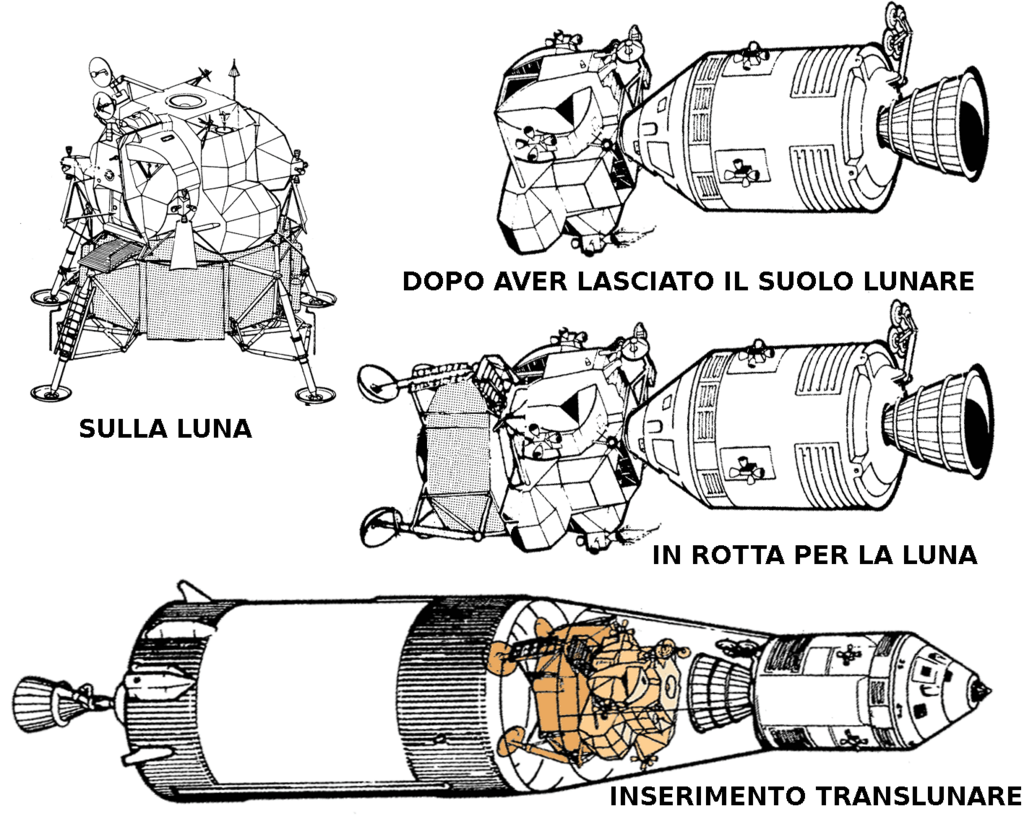
This led to the development of the Command/Service Module (CSM) and the Lunar Module (LM).
The Command/Service Module (CSM): This was the mother ship and the crew's main living quarters for the journey. The Command Module housed the crew, controls, and parachutes for reentry, while the attached Service Module contained the main engine, propellant, and life support systems.
The Lunar Module (LM): This was a marvel of purpose-built engineering, designed with a single goal: to ferry two astronauts from lunar orbit to the surface and back. It was the first crewed vehicle designed to fly only in the vacuum of space. To save every possible gram, it had no heat shield, no seats (the astronauts flew it standing up), and incredibly thin aluminum walls. Its complex maneuvers were handled by the groundbreaking , which used an innovative form of read-only memory made of woven wires.
The CSM would tow the LM to the Moon, release it, and wait in orbit. After the surface excursion, the LM's ascent stage—essentially a tiny, two-man rocket—would fire to lift off the Moon and perform the critical rendezvous and docking maneuver with the waiting CSM. Once the crew transferred back, the LM was jettisoned. This modular approach, born from the LOR strategy, was the elegant solution that made landing on the Moon possible within the decade.
Which mission profile was ultimately selected by NASA for the Apollo moon landings?
What was the primary drawback of the "Direct Ascent" mission profile?
The decision to use LOR was a pivotal moment in the space race, a calculated risk that balanced engineering reality with ambitious goals. It shaped not just the hardware, but the entire choreography of the Apollo missions.