API Hacking Financial Flows
Financial Flow Basics
The Economy's Circular Flow
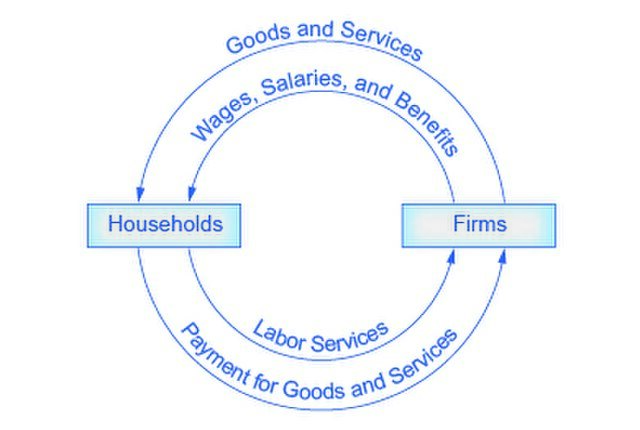
Think of an economy not as a static pile of money, but as a constantly moving river. This river of money, goods, and services flows in a continuous loop between two main groups: households (like you and your family) and firms (businesses).
Households provide firms with the essential ingredients for production: labor, land, and capital. In return, firms pay households for these resources in the form of wages, rent, and profits. This is the first part of the loop. Households now have income.
What do they do with it? They spend it on goods and services that firms produce. This spending sends the money right back to the firms. So, money flows from firms to households as income, and then flows back from households to firms as revenue. At the same time, resources flow from households to firms, and finished products flow from firms back to households.
This simple model is the bedrock of how an economy works. It's a closed loop where every dollar spent by someone is a dollar of income for someone else.
Adding More Players
Of course, the real world is a bit more complicated. We need to add a few more players to our diagram: financial institutions and the government.
Financial Institutions: Think of banks, credit unions, and investment firms. Households don't spend all their money. They save some of it. This saving is a leakage from the circular flow, because it's income that isn't immediately spent on goods. Financial institutions collect these savings and channel them back into the flow as an injection by lending money to firms for investment or to other households for major purchases.
Government: The government also plays a key role. It collects taxes from both households and firms, which is another leakage. But it injects that money back into the economy through government spending on things like infrastructure, defense, and social programs.
Leakages (savings, taxes) pull money out of the immediate spending stream. Injections (investment, government spending) push it back in. A healthy economy keeps these in balance.
Money Across Borders
Economies aren't isolated islands. They trade and invest with each other constantly. To track this global flow of money, economists use a record-keeping system called the Balance of Payments (BoP).
The BoP is a country's financial statement to the world. It records all transactions between its residents and residents of other countries over a period of time. It's broken down into two main parts.
| Account | What It Tracks | Example |
|---|---|---|
| Current Account | The flow of goods, services, and income. | A U.S. company sells software to a client in Japan. The payment is a credit on the U.S. current account. |
| Capital & Financial Account | The flow of investments. | An investor in Germany buys stock in a U.S. tech company. That's a credit on the U.S. financial account. |
Theoretically, these two accounts must balance. A country that buys more goods than it sells (a current account deficit) must finance that spending by selling assets or borrowing from abroad (a capital/financial account surplus). Every dollar flowing out for an import must be matched by a dollar flowing in as a foreign investment or loan.
The Financial Plumbing
All of these flows, both domestic and international, don't just happen on their own. They are managed by a vast network of financial institutions. Think of them as the plumbing of the economy, directing the flow of money to where it's needed.
-
Commercial Banks: These are the banks you interact with daily. They are the primary movers of money for individuals and businesses, handling deposits, payments, and loans.
-
Central Banks: Each country has a central bank (like the Federal Reserve in the U.S.) that acts as the bank for the government and commercial banks. It manages the nation's money supply and oversees the stability of the financial system.
-
Investment Banks: These institutions help companies raise money by issuing stocks and bonds. They also advise on large-scale transactions like mergers and acquisitions, facilitating major capital flows.
These institutions are the intermediaries that make the circular flow possible. They connect savers with borrowers and investors with opportunities, ensuring the river of money keeps moving.
Now let's check your understanding of these fundamental flows.
In the simplest circular flow model, what flows from households to firms?
When the government collects taxes from households and firms, this is considered a ________ from the circular flow of the economy.
Grasping how money moves through an economy is the first step to understanding finance on a larger scale. From your salary to international trade, it's all part of a single, interconnected system.