API Fundamentals Explained
API Basics
What is an API?
Imagine you're at a restaurant. You don't go into the kitchen to cook your own meal. Instead, you give your order to a waiter. The waiter acts as a messenger, taking your request to the kitchen and bringing your food back to you. You don't need to know how the kitchen works, only that you can make a request and get a result.
An API, or Application Programming Interface, works a lot like that waiter. It's a set of rules that allows different software applications to communicate with each other. It takes a request from one application, delivers it to another, and then brings back the response.
An API is a bridge that allows two software applications to talk to each other without you needing to know what’s happening behind the scenes.
This is incredibly useful. When you check the weather on your phone, the app might use an API to request weather data from a national weather service. The app doesn't need to have its own weather satellites; it just needs to know how to ask the service for information. APIs let developers build on top of existing services, saving time and creating more powerful applications.
How APIs Work
API communication follows a standard pattern called the client-server model. In this setup, you have two main players:
- The Client: The application that needs something. This could be your web browser, a mobile app, or another server.
- The Server: The application that has the data or functionality the client wants.
The client sends a request to the server, and the server sends back a response. This back-and-forth is known as the request-response cycle.
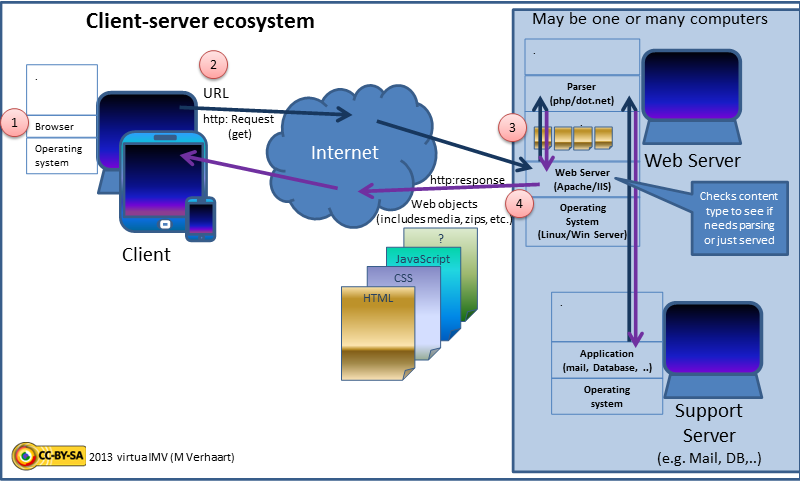
Think of browsing a website. Your web browser (the client) sends a request to the website's server asking for the contents of a page. The server finds the page and sends it back in a response, which your browser then displays.
APIs formalize this process, creating a predictable way for programs to make requests and understand the responses they receive. This structure ensures that both sides are speaking the same language.
A Key Trait Statelessness
Most modern APIs have an important characteristic: they are stateless. This means the server doesn't remember anything about the client from one request to the next. Every request is treated as a completely new interaction.
Imagine talking to someone with no short-term memory. Each time you ask a question, you have to provide the full context. You can't say, "What about the last thing I mentioned?" because they won't remember it. That's how a stateless API works.
Each API request must contain all the information the server needs to understand and process it, because the server stores no context from previous requests.
While this might sound inefficient, it's actually a huge advantage. It makes the system much simpler and more reliable. If a request fails, the client can just send it again without causing issues. It also makes it easier for companies to handle millions of requests, as any available server can process any request without needing a history of the client's past interactions.
Let's check your understanding of these core concepts.
In the restaurant analogy, what role does the API play?
In the client-server model, the application that needs data is called the ______.
Understanding these fundamentals—the role of APIs, the client-server model, and statelessness—provides a strong foundation for working with any API.