API Design Fundamentals
API Fundamentals
What Is an API?
Think of an API, or Application Programming Interface, as a waiter in a restaurant. You, the customer, don't go into the kitchen to cook your own food. Instead, you look at a menu (the interface), give your order to the waiter, and the waiter communicates it to the kitchen. The kitchen prepares your food, and the waiter brings it back to you.
In this analogy:
- You are the client application (e.g., your mobile app).
- The kitchen is the server where the data and functionality live.
- The waiter is the API, taking your request and bringing back a response.
An API is a set of rules and protocols that allows different software applications to communicate with each other. It's a contract that defines how a developer can request information or functionality from another system, without needing to know the complex details of how that system works internally.
APIs act as a bridge, allowing separate software systems to share data and features in a structured, predictable way.
This structured communication is what allows you to see Google Maps inside a ride-sharing app, or pay for an online purchase using PayPal without leaving the store's website. The ride-sharing app uses Google's Maps API, and the e-commerce site uses PayPal's payment API.
Key Types of Web APIs
While many types of APIs exist, most modern web applications use one of three major architectural styles. Think of them as different philosophies for how to design the menu and rules for communication.
SOAP
noun
A highly structured, protocol-based approach to APIs that relies on XML for its message format. It's known for its strict standards, high security, and built-in error handling.
SOAP (Simple Object Access Protocol) is the oldest of the three. It's very rigid and has a comprehensive set of rules. Because of its strict contract and built-in standards for security and transactions, it's often favored in enterprise environments, such as for financial services or telecommunications, where reliability is critical.
REST
noun
An architectural style for APIs that uses standard web protocols (like HTTP) to communicate. It treats data and functionality as resources that can be accessed via unique URLs.
REST (Representational State Transfer) is not a protocol, but a set of architectural principles. It's the most popular style for building web APIs today. RESTful APIs are lightweight, flexible, and stateless, meaning each request contains all the information needed to process it. They use standard HTTP methods you might be familiar with:
- GET: To retrieve data.
- POST: To create new data.
- PUT: To update existing data.
- DELETE: To remove data.
REST APIs typically use JSON (JavaScript Object Notation) to format data, which is easy for both humans and machines to read.
GraphQL
noun
A query language for APIs that allows clients to request exactly the data they need and nothing more. It gives the client more control over the data returned in a response.
GraphQL is the newest of the three. Developed by Facebook, it was designed to solve some of the limitations of REST. With a REST API, you might have to make multiple requests to get all the data you need (e.g., one for user info, another for their posts). Or, you might get a lot of extra data you don't need.
GraphQL solves this by letting the client specify exactly which data it wants in a single request. This is incredibly efficient, especially for mobile applications where bandwidth and speed are important.
Why Bother With APIs?
APIs are the engine of the modern internet, and they offer huge benefits for software development.
APIs are the invisible backbone of modern software development.
Efficiency and Speed: Instead of building every single feature from scratch, developers can use APIs to plug in existing functionality. Want to add payment processing? Use the Stripe API. Need to send a text message? Use the Twilio API. This saves enormous amounts of time and resources.
Innovation: APIs allow developers to build new applications on top of existing platforms. The entire ecosystem of social media management tools, for example, is built on the APIs provided by platforms like X (formerly Twitter), LinkedIn, and Facebook. This fosters creativity and allows for new services that the original platform creators never even imagined.
Specialization: APIs enable companies to focus on their core competency. A weather company can focus on building the best weather forecasting models and expose that data through an API. A mapping company can focus on creating detailed maps. Developers can then combine these specialized services to create powerful, feature-rich applications.
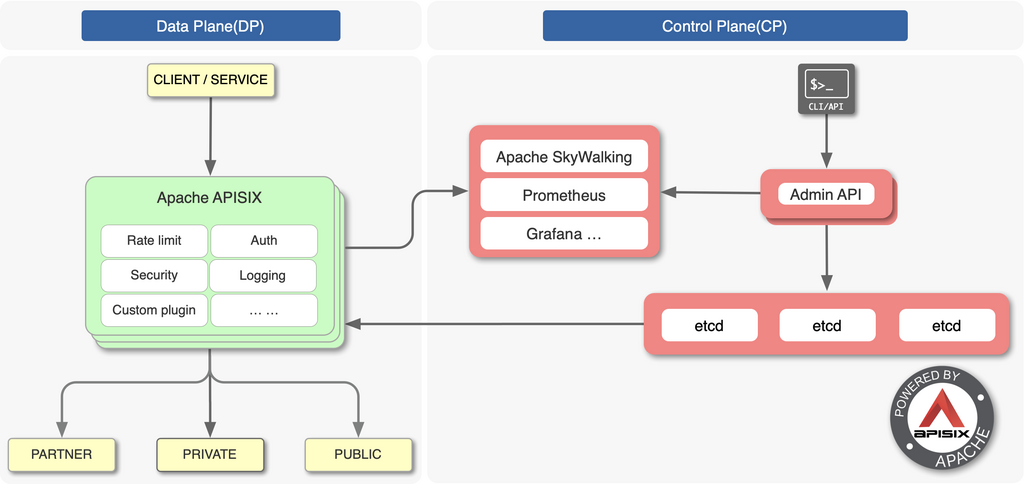
By providing a standardized way for systems to interact, APIs simplify complex processes, encourage collaboration, and allow for the rapid development of new technology.
In the common analogy of an API as a waiter in a restaurant, what does the waiter represent?
A developer is building a mobile app and wants to minimize data usage to ensure the app is fast and responsive, even on slow networks. Which API architectural style would be the most suitable choice?
Understanding these fundamental concepts is the first step toward designing, building, and using APIs effectively.