AP World History Mastery
The Global Tapestry
The World in 1200
Around the year 1200, the world was not a single, interconnected stage. Instead, it was a patchwork of vibrant civilizations, each with its own unique story. While long-distance trade existed, most societies developed in relative isolation, creating a diverse tapestry of cultures, governments, and economies. This era was a critical turning point, setting the stage for the global connections that would follow.
East Asia's Golden Age
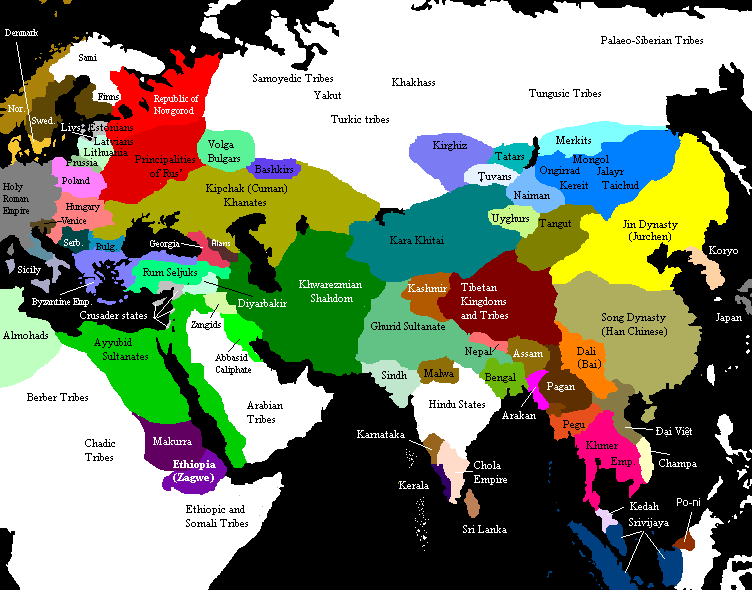
In East Asia, China's Song Dynasty was a powerhouse of innovation and prosperity. While Europe was fragmented, the Song Dynasty operated under a sophisticated, centralized government. A vast bureaucracy, staffed by officials who passed rigorous civil service exams based on Confucian principles, managed the empire. This system, known as a meritocracy, selected leaders based on ability rather than noble birth.
The Song economy was arguably the most advanced in the world. The Grand Canal, a massive man-made waterway, linked the agricultural south with the populous north, facilitating trade and feeding huge cities. The government issued the world's first paper money, making commerce more efficient. Technological breakthroughs were common, including the refinement of gunpowder, the invention of movable type printing, and the construction of massive ships called junks.
The House of Islam
From Spain to India, a vast and diverse civilization was united by the shared faith of Islam. Known as Dar al-Islam, or “the house of Islam,” this region was not a single, unified empire. The great Abbasid Caliphate, once a political titan, had fractured by 1200. New Turkic states, like the Seljuk Empire, had risen to power in the Middle East.
Despite political fragmentation, the Islamic world was a hub of intellectual and cultural life. Scholars in centers like Baghdad and Córdoba, Spain, translated and built upon the works of ancient Greek thinkers. They made groundbreaking advances in medicine, mathematics (pioneering algebra), and astronomy. A shared language of scholarship, Arabic, allowed ideas to spread rapidly across this vast region, carried by merchants along thriving trade routes.
While politically divided, the Islamic world remained a cohesive cultural and economic zone, bound by faith and commerce.
States of the Americas
Across the Atlantic, civilizations in the Americas were developing in complete isolation from the rest of the world. They built large, complex societies without the benefit of large domesticated animals like horses or oxen.
In Mesoamerica, the Maya civilization had declined, but their cultural legacy lived on. The Mexica, later known as the Aztecs, were beginning to establish themselves in what is now central Mexico. They would eventually build a powerful empire with a bustling capital city, Tenochtitlan. Further south, in the Andes Mountains, the Inca Empire was in its early stages. They would create an extensive state bound together by a sophisticated road network and a unique system of knotted strings for record-keeping called quipu.
Mesoamerican and Andean civilizations built monumental structures and managed large populations through intricate systems of tribute and labor.
A Fragmented Europe
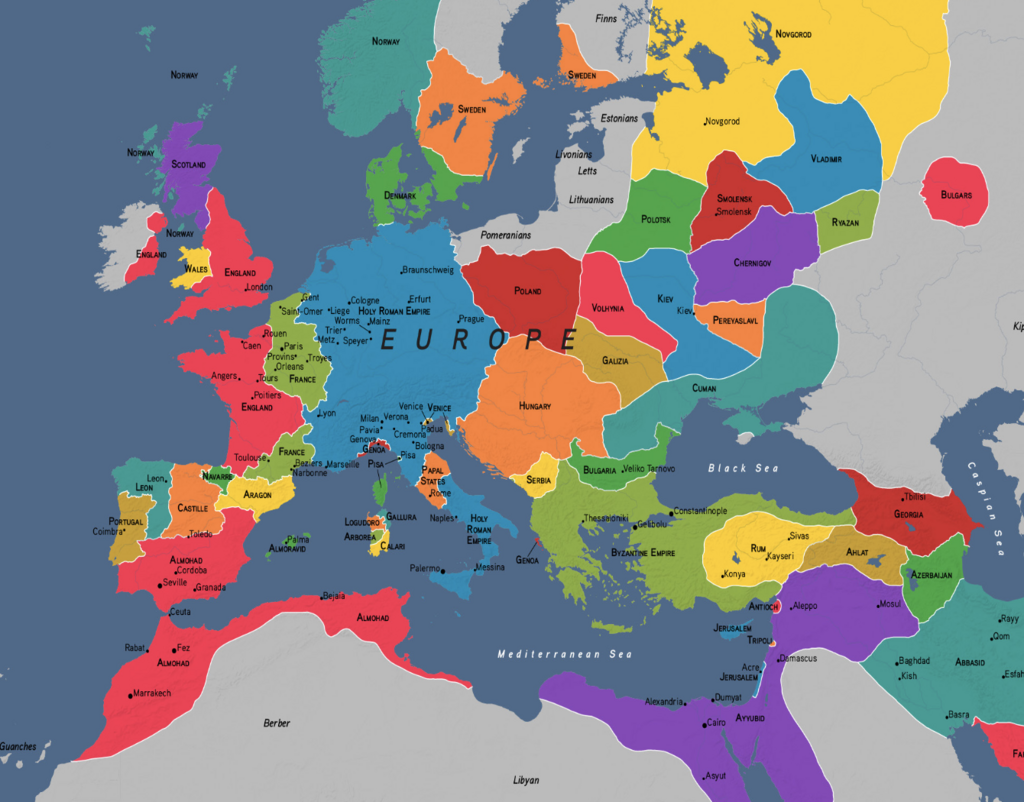
Compared to the centralized empires of China and the vibrant intellectual life of the Islamic world, Europe in 1200 was politically decentralized. The continent was a patchwork of small kingdoms and territories operating under a system called feudalism. In this structure, land was exchanged for military service and loyalty. Kings granted land to powerful lords, who in turn granted smaller parcels to knights. At the bottom of this hierarchy were the serfs, peasants who were tied to the land and worked it for the lord.
The Catholic Church was the single most powerful unifying institution in Western Europe, influencing everything from politics to daily life. While trade was reviving and cities were growing, European society remained largely rural and agricultural, lagging behind the great civilizations to its east.
Now, let's test your understanding of the world's major civilizations around 1200 CE.
How were officials selected to work in the Song Dynasty's government bureaucracy?
Which statement best describes the political and intellectual state of Dar al-Islam around 1200?
Each of these regions represented a distinct and complex world. Their interactions and developments in the centuries after 1200 would go on to shape the globalized world we know today.