AP Physics Fundamentals
Kinematics
Describing Motion
To understand the world around us, we first need a way to describe how things move. That's the job of kinematics. It’s the branch of physics that focuses purely on describing motion—without getting into the why just yet. We'll focus on the how: how fast, how far, and in what direction.
Imagine you walk from your front door, around the block, and end up exactly where you started. You've certainly walked a distance, maybe half a mile. But your displacement—your change in position from start to finish—is zero. Displacement is a straight line from your starting point to your ending point, and it includes direction.
Velocity is similar. The speedometer in a car tells you your speed, like 60 miles per hour. That's a scalar quantity—it only has magnitude. Velocity is a vector, meaning it has both magnitude and direction. 60 mph east is a velocity. This distinction is crucial. If you're driving in a circle at a constant 60 mph, your speed is constant, but your velocity is constantly changing because your direction is changing.
velocity
noun
The rate at which an object changes its position. It is a vector quantity, possessing both magnitude (speed) and direction.
And what do we call a change in velocity? Acceleration. Anytime you speed up, slow down, or change direction, you are accelerating. Like velocity, acceleration is also a vector. A car speeding up is accelerating. A car braking is also accelerating (sometimes called decelerating). A car turning a corner at a constant speed is accelerating, too, because its direction of velocity is changing.
In short: Displacement is the change in position. Velocity is the rate of change of displacement. Acceleration is the rate of change of velocity.
The Equations of Motion
Things get really interesting when acceleration is constant. This is a very common scenario—think of an object falling near the Earth's surface or a car accelerating steadily. For these situations, we have a set of simple but powerful equations that connect displacement (), initial velocity (), final velocity (), acceleration (), and time ().
First, the definition of acceleration can be rearranged to give us our first equation, which links final velocity, initial velocity, acceleration, and time.
Another key equation helps us find the displacement when we know the initial velocity, time, and acceleration. This is useful when you don't know (or need) the final velocity.
And what if you don't know the time? This next equation relates the final velocity to the initial velocity, acceleration, and displacement. It's great for problems where time isn't mentioned.
These three equations are the core of kinematics for constant acceleration. With them, you can solve a huge range of motion problems.
A Picture of Motion
Sometimes the best way to understand motion is to see it. Graphs are perfect for this. We can plot an object's position, velocity, and acceleration against time to create a visual story of its journey.
A position-time graph shows where an object is at any given moment. The slope (steepness) of the line on this graph tells you the object's velocity. A flat line means the object is stationary. A straight, sloped line means constant velocity. A curved line means the velocity is changing—in other words, it's accelerating.
A velocity-time graph is even more powerful. It shows an object's velocity at any moment. Here, the slope of the line tells you the object's acceleration. A flat line means constant velocity (zero acceleration). A straight, sloped line means constant acceleration. But there's more: the area under the line on a velocity-time graph tells you the object's displacement.
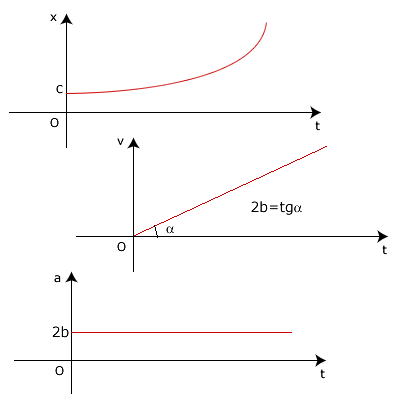
Look at the relationship between these graphs. If acceleration is a constant, non-zero value (a flat horizontal line on an a-t graph), then the velocity graph will be a straight, sloped line. In turn, the position graph will be a curve (a parabola, to be exact). Each graph is fundamentally linked to the others.
Motion in Two Dimensions
Of course, objects don't always move in a straight line. They fly through the air, curve, and turn. The classic example of motion in two dimensions is projectile motion.
There is one key element to projectile motion---and it is this: You can treat the horizontal motion (x-direction) and the vertical motion (y-direction) as two separate one-dimensional kinematics problem.
Think of a cannonball fired from a cannon. Once it's in the air, the only significant force acting on it is gravity (we'll ignore air resistance for now). Gravity only acts downwards. It has no effect on the cannonball's horizontal motion.
This means:
- The horizontal component of the velocity () is constant.
- The vertical component of the velocity () changes due to the constant downward acceleration of gravity, (about ).
By breaking a 2D problem into two separate 1D problems, we can use the same simple kinematic equations we've already learned. We use one set for the horizontal motion (with ) and another for the vertical motion (with ). The one thing that connects them is time—the projectile moves horizontally and vertically for the same amount of time.
With these tools—the definitions of displacement, velocity, and acceleration; the equations of motion; and graphical analysis—you can describe a vast range of motion, from a falling apple to a planet's orbit. You've built the foundation for understanding the mechanics of the universe.