AP Physics C Mechanics and Electromagnetism
Kinematics
The Language of Motion
Before we can understand why things move, we first need a clear way to describe how they move. This is the job of kinematics: the study of motion itself, without worrying about the forces that cause it. To do this, we need to be precise with our language and our measurements.
Displacement
noun
The change in an object's position. It is a vector quantity, meaning it has both magnitude (how far) and direction.
Displacement isn't the same as distance. In the example above, the distance you walked is 7 meters, but your displacement is only 3 meters because it measures the straight-line path from your start point to your end point. Direction matters.
Once we know how position changes, we can talk about how fast it's changing. This is velocity.
Velocity is the rate of change of displacement. Speed is just the magnitude of velocity; it doesn't include direction.
A car traveling at 60 miles per hour has a speed. A car traveling 60 miles per hour north has a velocity. Just like displacement, velocity is a vector. The average velocity is the total displacement divided by the total time.
Here, represents the change in position (displacement), and is the change in time. But what if the velocity itself is changing? That's where acceleration comes in.
Acceleration
noun
The rate of change of velocity. Like velocity, it is a vector quantity.
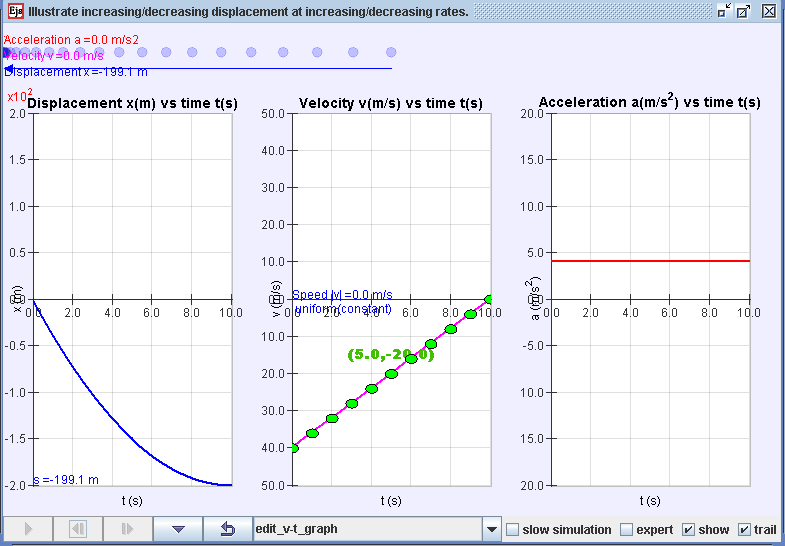
You experience acceleration when you press the gas pedal in a car (speeding up), hit the brakes (slowing down), or turn the steering wheel (changing direction). In all three cases, your velocity is changing. Average acceleration is the change in velocity over time.
Constant Acceleration
Things get much simpler when we assume acceleration is constant. This is a surprisingly useful assumption. For example, an object falling near the Earth's surface experiences a nearly constant acceleration due to gravity.
When acceleration () is constant, we can use a set of simple equations to relate displacement (), time (), initial velocity (), and final velocity ().
These are often called the kinematic equations for uniformly accelerated motion.
This first equation is just a rearrangement of the definition of acceleration.
This second one helps you find the displacement when you don't know the final velocity.
And this third one is useful when you don't know the time interval. These three equations are the essential toolkit for solving problems with constant acceleration in one dimension.
Motion in Two Dimensions
What about motion that isn't in a straight line, like a ball thrown through the air? This is projectile motion. The key insight is to break the motion into two independent parts: a horizontal component and a vertical component.
Think of it this way: gravity only pulls things down, not sideways. So, it only affects the vertical part of the motion. The horizontal part is unaffected.
Horizontal motion: Constant velocity () Vertical motion: Constant acceleration ()
We can analyze each dimension separately using the same kinematic equations we just learned. The one thing that connects them is time. The object moves horizontally and vertically for the same amount of time.
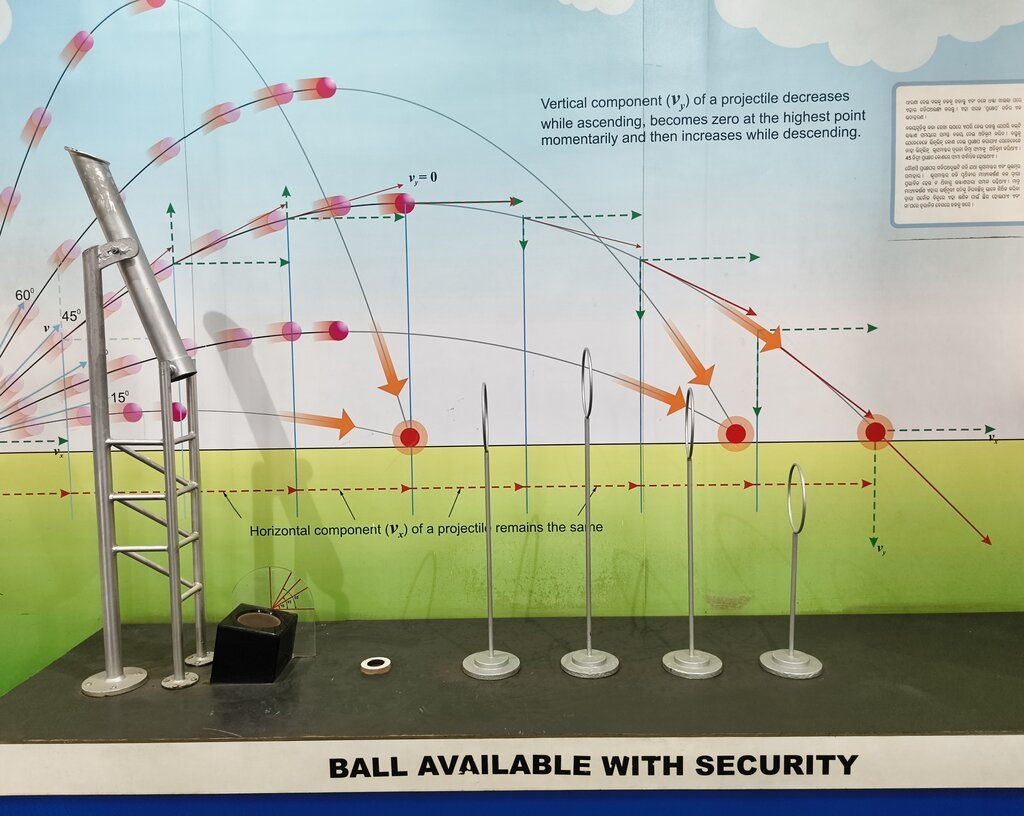
For example, to find out how far a cannonball flies, you first analyze its vertical motion to determine how long it's in the air. You'd use the vertical displacement, initial vertical velocity, and vertical acceleration (). Once you have the time of flight, you can use it to figure out the horizontal distance. Since the horizontal acceleration is zero, the calculation is simple: displacement equals horizontal velocity multiplied by time.
By splitting a complex, two-dimensional problem into two simpler, one-dimensional problems, we can describe the entire curved path of the projectile.
A runner completes one full lap around a 400-meter circular track. What are their distance traveled and their displacement?
Which of the following scenarios describes a vehicle that is accelerating?
These concepts of displacement, velocity, and acceleration form the basis for describing all motion. Whether in a straight line or along a curved path, breaking down movement into these components allows us to predict and analyze it with precision.