AP Physics 1 Essentials
Kinematics
The Language of Motion
Physics is the study of how things move and interact. Before we can understand the why of motion, we need a clear way to describe the how. This is kinematics: the language of movement.
Let’s start with where an object is. An object's position is its location relative to a reference point, or origin. If you walk 10 steps forward from your front door, your position has changed. The total path you took is the distance. But in physics, we often care more about the straight-line path from your start point to your end point. This is called displacement.
Imagine walking 5 meters east, then 5 meters west. You've walked a distance of 10 meters, but your displacement is zero because you ended up exactly where you started.
Displacement
noun
The change in position of an object. It's a vector quantity, meaning it has both magnitude (how far) and direction.
How fast you change your position is your velocity. Like displacement, velocity has a direction. The speedometer in a car shows your speed, but your velocity also includes the direction you're traveling, like "60 miles per hour east." When your velocity changes, you are accelerating. Stepping on the gas, hitting the brakes, or even just turning the steering wheel all involve acceleration because they change your velocity.
Motion on a Graph
Graphs are a powerful way to visualize motion. By plotting position, velocity, and acceleration against time, we can see the story of an object's journey.
A position-time graph shows where an object is at any given moment. The slope of this graph tells you the object's velocity. A steep slope means high velocity, a flat line means the object is stationary, and a downward slope means it's moving back toward the origin.
A velocity-time graph shows an object's velocity. The slope of this graph reveals the object's acceleration. A horizontal line means constant velocity (zero acceleration). The area under the curve of a velocity-time graph tells you the object's displacement.
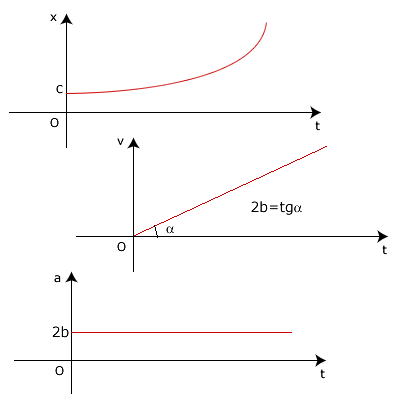
Finally, an acceleration-time graph shows how acceleration changes. For many introductory problems, we'll focus on situations where acceleration is constant, which appears as a simple horizontal line on this graph.
Equations for Constant Acceleration
When an object moves with constant acceleration, we don't always need a graph. We can use a set of powerful formulas called the kinematic equations. These equations link together displacement ( or ), initial velocity ( or ), final velocity (), acceleration (), and time ().
These equations relate displacement, initial velocity, final velocity, acceleration, and time:
Let's see them in action. A car starts from rest and accelerates at a constant . How far has it traveled after 5 seconds?
- Identify what you know: (starts from rest), , .
- Identify what you need: Displacement, .
- Choose the right equation: The second equation, , has everything we need.
- Solve: meters.
Motion in Two Dimensions
Things don't always move in a straight line. Consider a ball thrown through the air. Its motion has two parts: a horizontal part and a vertical part. This is called projectile motion.
There is one key element to projectile motion---and it is this: You can treat the horizontal motion (x-direction) and the vertical motion (y-direction) as two separate one-dimensional kinematics problem.
This insight is the key to solving these problems. The horizontal motion is simple: its velocity is constant (if we ignore air resistance). The vertical motion is also simple: it's just motion with constant downward acceleration due to gravity, . By analyzing the x and y components separately using the kinematic equations, we can predict the projectile's path, or trajectory.
Finally, motion is always described relative to an observer. If you are on a train moving at 50 km/h and you throw a ball forward at 10 km/h, the ball's speed relative to you is 10 km/h. But for someone standing on the ground, the ball is moving at 60 km/h. This idea is called relative motion, and it reminds us that the frame of reference matters.
Time to test your understanding of motion.
An athlete runs exactly one lap around a 400-meter circular track, ending precisely where they started. What is their total displacement for the lap?
On a position-time graph, what does a straight, horizontal line signify?
With this foundation in describing motion, you're ready to explore the forces that cause it.