AP Chemistry Masterclass
Stoichiometry and Gas Laws
Stoichiometry in the Real World
You already know how to use balanced chemical equations to relate the amounts of reactants and products. But real chemical reactions are rarely as perfect as they appear on paper. They often don't go to completion, and starting materials are frequently impure. Let's dig into these complexities.
First, consider a reaction where you have unequal amounts of reactants. The one that runs out first is the limiting reactant, and it dictates the maximum amount of product you can make, known as the theoretical yield. However, due to side reactions or incomplete reactions, you'll often produce less. The actual amount you make is called the actual yield.
Percent Yield
noun
The ratio of the actual yield to the theoretical yield, expressed as a percentage. It measures the efficiency of a chemical reaction.
Let's see how this works. Suppose you react 24.5 g of nitrogen gas with 5.05 g of hydrogen gas to form ammonia (NH₃). After the reaction, you collect 22.1 g of ammonia. What is the percent yield?
First, the balanced equation: .
Next, find the moles of each reactant:
- Moles of
- Moles of
To find the limiting reactant, let's see how much is needed to react with all the :
We need 2.62 mol of , but we only have 2.50 mol. So, hydrogen () is the limiting reactant. It will determine our theoretical yield.
The theoretical yield is 28.4 g. We were told the actual yield was 22.1 g.
This calculation is crucial in industrial chemistry for evaluating the efficiency of production processes.
Analyzing Mixtures
Another common scenario is working with an impure sample. Gravimetric analysis is a lab technique used to determine the amount of a substance in a sample by forming a precipitate, a solid product that can be filtered out and weighed. The mass of the precipitate tells you the quantity of the original substance.
Imagine you have a 1.45 g sample of a mixture containing magnesium chloride () and inert salt. You dissolve the mixture in water and add an excess of silver nitrate () solution. A precipitate of silver chloride () forms. After filtering, drying, and weighing, you find the mass of the is 2.55 g. What was the mass percent of in the original mixture?
The reaction is: .
The key is to work backward from the product you measured. We use the mass of to find the mass of that must have been in the sample.
So, the original 1.45 g sample contained 0.846 g of . Now we find the mass percent.
The Behavior of Gases
Stoichiometry isn't limited to solids and solutions. Many reactions involve gases, whose properties are described by the gas laws. The Ideal Gas Law combines the relationships between pressure, volume, temperature, and the amount of a gas.
We can use this law to find the molar mass of an unknown gas. If you measure the mass, volume, temperature, and pressure of a gas sample, you can calculate its number of moles () and then find its molar mass (grams/mole).
For example, if a 1.25 g sample of a gas occupies 0.750 L at 25°C (298 K) and 0.980 atm, what is its molar mass?
First, solve the Ideal Gas Law for :
Now, calculate molar mass: Molar Mass =
When gases are mixed, each gas exerts its own pressure, called a partial pressure. Dalton's Law of Partial Pressures states that the total pressure of a gas mixture is the sum of the partial pressures of each component gas.
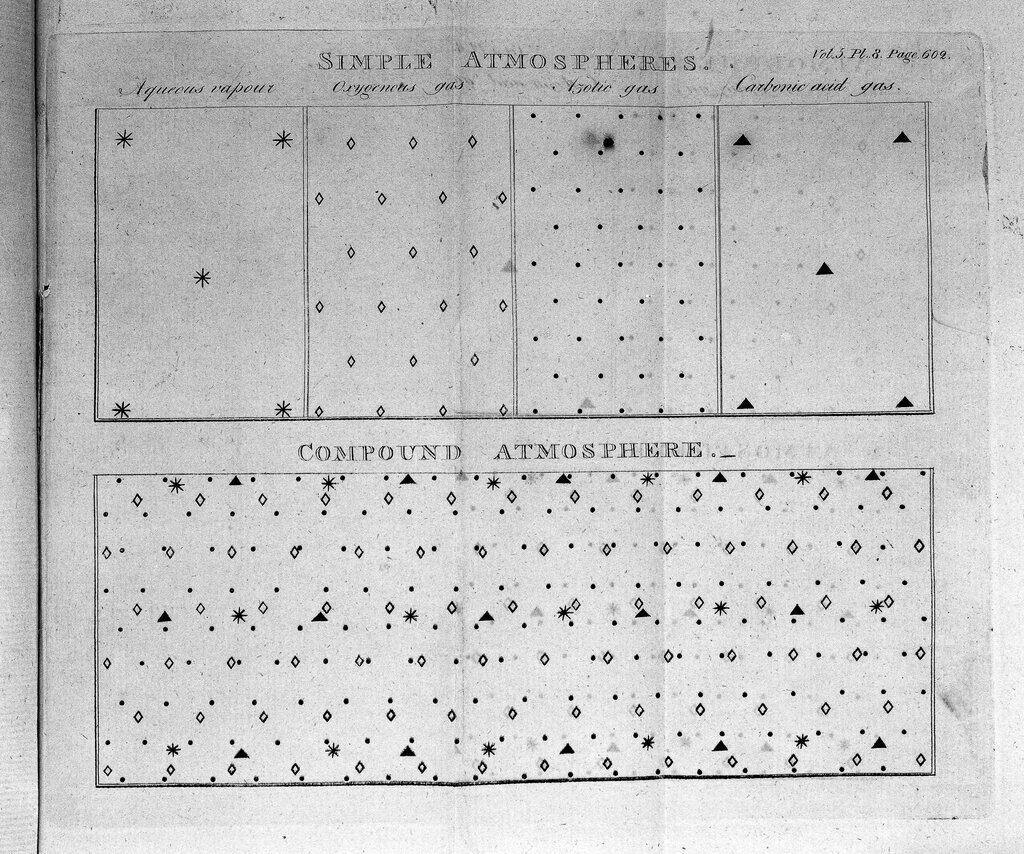
This is especially important in the lab when you collect a gas over water. The collected gas is saturated with water vapor, which contributes to the total pressure measured.
To find the pressure of just the dry gas you collected (), you must subtract the vapor pressure of water () at that temperature from the total atmospheric pressure. The vapor pressure of water is a known value that depends only on temperature.
Ideal vs. Real Gases
The Ideal Gas Law works well under many conditions, but it's based on a simplified model called the Kinetic Molecular Theory. This theory makes two key assumptions about gas particles:
- Gas particles have no volume; they are just points in space.
- Gas particles do not exert any attractive or repulsive forces on each other.
In reality, gas particles do have volume, and they do attract each other. These factors cause real gases to deviate from ideal behavior.
Real gases behave most like ideal gases at high temperatures and low pressures.
Why? At high temperatures, particles move so fast that their brief interactions are negligible. At low pressures, particles are so far apart that their individual volumes are insignificant compared to the container's volume.
Deviations become significant at low temperatures, where particles move slowly enough for intermolecular attractions to become important, and at high pressures, where particles are crowded together and their volume becomes a significant fraction of the container's volume.
Time to test your understanding of these advanced stoichiometric and gas concepts.
In a chemical reaction, the limiting reactant is the substance that:
A chemist calculates a theoretical yield of 45.0 g for a reaction but only isolates 38.7 g of product in the lab. What is the percent yield?
These principles form the quantitative backbone of chemistry, allowing us to connect macroscopic measurements in the lab to the molecular events we can't see.