Anime Production from Script to Screen
Scripting and Narrative Visuals
From Script to Screen
An animation script is a different beast from its live-action counterpart. In a live-action film, a writer can describe a character walking through a bustling market, and the director, cinematographer, and actors will fill in the countless details. In animation, every single one of those details—from a stray cat darting across the alley to the specific expression on a background character's face—must be planned and created from scratch.
This is why a script for anime isn't just a story; it's the first technical step in a long production pipeline. The goal is to write a 'board-friendly' script, a document crafted specifically to be translated into a visual sequence by a storyboard artist. The writer must think like an animator, providing a clear and executable plan for what will eventually appear on screen.
The Board-Friendly Script
A board-friendly script formats information for clarity and immediate visual translation. While it shares some DNA with standard screenplays, the emphasis on granular detail is much higher.
The core principle is simple: if it needs to be drawn, it needs to be written.
This means descriptions are paramount. Instead of writing, "Sakura is angry," a board-friendly script details the physical manifestation of that anger: "Sakura’s hands clench into fists at her sides. Her brow furrows, and her teeth grit, a low growl catching in her throat." Each phrase gives the storyboard artist a concrete action to draw.
Let's look at how this plays out in formatting:
INT. KENDO DOJO - NIGHT

Sunlight has faded. The only light comes from a single fluorescent bar overhead, casting long, sharp shadows across the wooden floor. The air is still and heavy.

KENJI (17), stands alone in the center of the dojo. He holds his shinai (bamboo sword) in a two-handed grip, but it trembles slightly.

SOUND of rain beginning to patter against the roof

His eyes are squeezed shut. Sweat beads on his forehead.

KENJI
(whispering)
I can't do it.

He lowers the shinai. Its tip clatters against the floorboards. The sound echoes in the silence.
Notice the level of detail. The lighting, the trembling sword, the sound of rain, the specific action of the sword tip hitting the floor—all are instructions for the visual and audio teams. Dialogue includes parenthetical cues that suggest timing and delivery, which directly informs the pacing of the drawn-out scene.
The E-konte Blueprint
Once the script is finalized, it moves to the next crucial stage: the (絵コンテ). This is the Japanese term for the storyboard, but its role in the anime pipeline is far more central than in many Western productions. The e-konte isn't just a guide; it is the definitive blueprint for the entire episode or film.
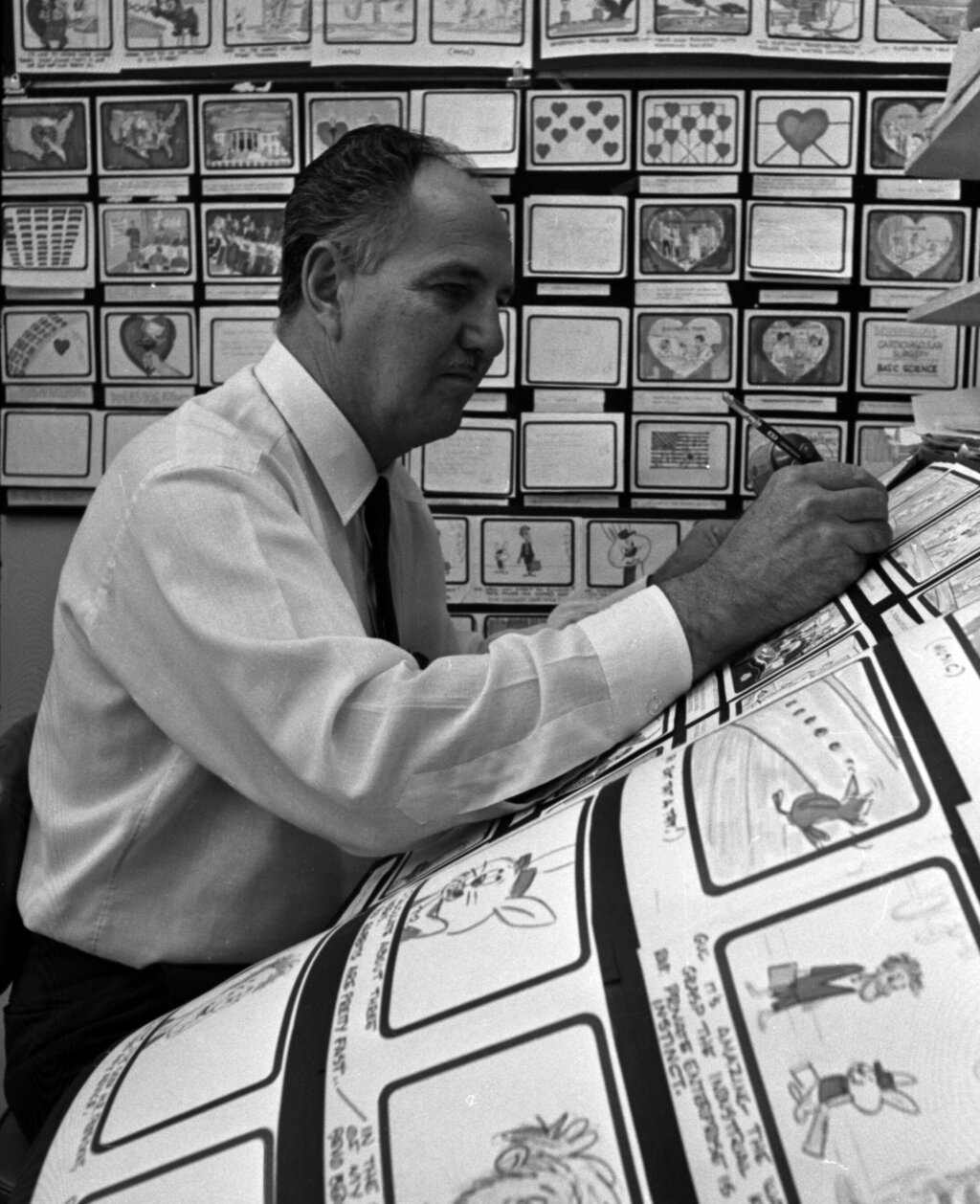
The director or a dedicated storyboard artist translates the script, shot by shot, into a series of drawings. Each panel in the e-konte represents a specific camera shot. It dictates the pacing, composition, character acting, and overall visual rhythm of the final product. Animators don't just refer to the e-konte; they follow it precisely.
A typical e-konte sheet is divided into columns:
| Column | Purpose |
|---|---|
| カット (Cut) | The shot number, in sequence. |
| 画面 (Gamen) | The panel with the drawing of the shot. |
| 内容 (Naiyō) | Action description, camera instructions (pan, tilt, zoom), and effects. |
| セリフ (Serifu) | Dialogue and character names. |
| 時間 (Jikan) | The duration of the shot in seconds and frames. |
This structure turns the narrative script into a timed, visual, and technical plan. The duration column is especially critical, as it sets the rhythm of the animation before a single final frame is drawn.
Visuals with Intent
The transition from script to e-konte is where the emotional core of the story gets its visual language. A line in the script like "He felt isolated" can be translated in countless ways. The storyboard artist makes the definitive choice. Does this mean a wide shot showing the character as a tiny figure in a vast, empty landscape? Or an extreme close-up on their face, with the background out of focus?
These choices are not arbitrary. They are deliberate techniques to guide the audience's emotional response. A can create a sense of unease or disorientation. A low-angle shot makes a character seem powerful and imposing, while a high-angle shot can make them appear vulnerable or small. The storyboard artist uses this cinematic vocabulary to translate the script's subtext into explicit visual cues.
This is the conceptual leap: from the what of the script (the events and dialogue) to the how of the e-konte (how the audience will see and experience those events). A well-executed e-konte ensures that the story's emotional beats are not just told, but felt, creating a seamless flow that carries the viewer through the narrative.
Time to review what we've covered.
Let's test your understanding of the pre-production pipeline.
What is the primary purpose of writing a 'board-friendly' script for animation?
In the context of an anime production pipeline, what is the e-konte (絵コンテ)?