Animal Tissue Structure and Function
Epithelial Structure
The Body's Gatekeepers
Epithelial tissue is the ultimate multitasker. It forms the protective outer layer of your skin, lines your organs, and covers the surfaces of internal passageways. Think of it as a tightly-packed sheet of cells standing shoulder-to-shoulder, creating a selective barrier between different environments.
Unlike other tissue types where cells might be scattered within a matrix, epithelial cells are defined by their close contact.
This tissue has a distinct sense of direction, a property called polarity. Every epithelial cell has an apical surface, which faces an open space like the inside of your gut or the outside world. The opposite side is the basal surface, which is anchored to the underlying connective tissue. This anchoring is done via a thin, non-cellular layer called the basement membrane, a sort of molecular glue and scaffolding that holds the epithelium in place.
Shape, Layers, and Function
Epithelia are classified based on two features: the number of cell layers and the shape of the cells. This classification isn't just for organization; it directly relates to the tissue's job.
Layers:
- Simple: A single layer of cells. Ideal for absorption, secretion, or filtration because of its thinness.
- Stratified: Two or more layers of cells. Common in high-abrasion areas where protection is key, like the skin.
- Pseudostratified: Looks stratified but is actually a single layer of cells of different heights.
Shapes:
- Squamous: Flat and scale-like. The thinness is perfect for rapid diffusion of materials.
- Cuboidal: Boxy, like dice. Active in secretion and absorption.
- Columnar: Tall and column-shaped. Also specializes in secretion and absorption.
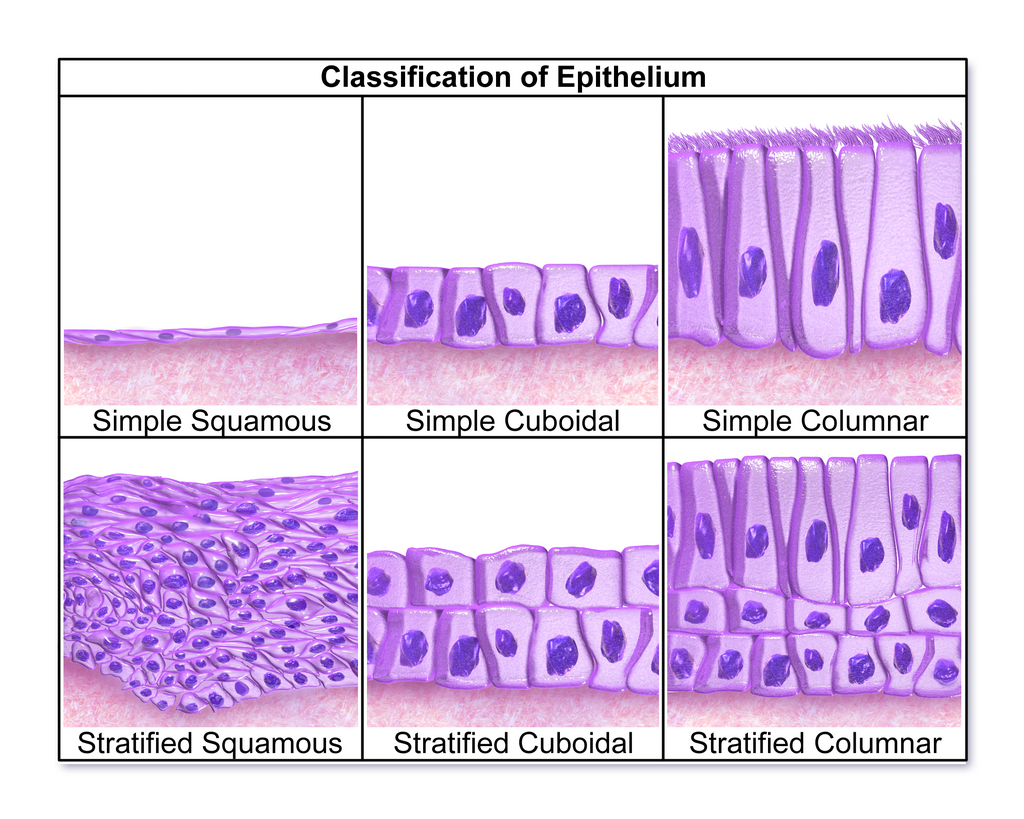
Combining these gives us names like simple squamous epithelium, a single layer of flat cells found in the air sacs of lungs, or stratified squamous epithelium, the multiple layers of flat cells that make up the outer part of your skin.
Holding It All Together
To form an effective barrier, epithelial cells must be linked together tightly. This is achieved by specialized cell-to-cell junctions.
Tight junctions are like the sealant between tiles. They form a nearly impermeable barrier that prevents molecules from passing between the cells. This is crucial in places like the small intestine, forcing nutrients to pass through the cells to be absorbed, rather than leaking between them.
Desmosomes, on the other hand, act like rivets or spot welds. They anchor cells together, providing immense mechanical strength. You find many in tissues that experience a lot of stress and stretching, like the skin and cardiac muscle. They ensure the cells don't pull apart when the tissue is under strain.
Specializations and Glands
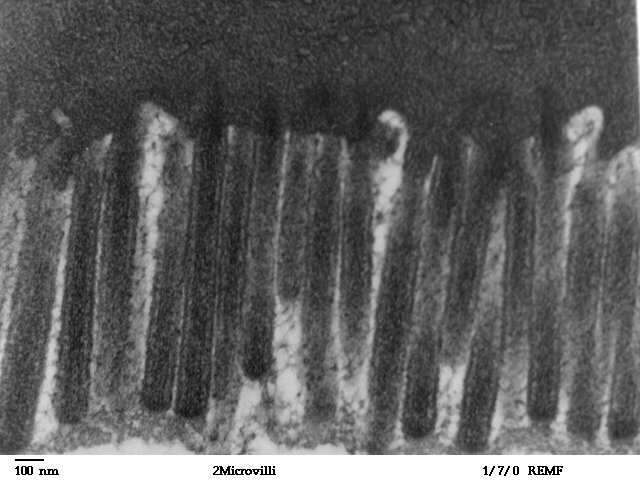
The apical surface of epithelial cells can have special features. Microvilli are microscopic finger-like projections that dramatically increase the cell's surface area. They are abundant on the simple columnar epithelium of the small intestine, maximizing its ability to absorb nutrients.
Cilia are longer, hair-like structures that beat in a coordinated rhythm to move substances across the cell's surface. The pseudostratified columnar epithelium lining your respiratory tract uses cilia to sweep mucus, dust, and other debris up and out of your airways.
Finally, some epithelial cells are modified to produce and secrete substances. These form glandular epithelium.
- Exocrine glands secrete their products onto a surface or into a cavity through a duct. Sweat glands, salivary glands, and oil glands are all examples.
- Endocrine glands are ductless. They release their products, called hormones, directly into the bloodstream or surrounding fluid. The thyroid and adrenal glands are endocrine glands.
Now, let's test your understanding of epithelial structures.
What type of epithelial tissue is best suited for rapid diffusion and is found in the air sacs of the lungs?
An epithelial cell has a distinct polarity. The surface that faces an open space, like the inside of the intestine, is called the ______ surface.
Understanding how epithelial cells are shaped, layered, and connected is key to appreciating how they protect our bodies, control absorption, and produce essential secretions.