Ancient Pyramid Construction
Stoneworking Tools
Mastering the Old Kingdom Toolkit
Think it took magic or lost technology to shape the pyramids? Think again. By combining copper chisels and saws with simple quartz sand as an abrasive, ancient builders achieved astonishing precision. This chapter will uncover the mechanics behind these tools, showing you how durability and material constraints shaped the logistics of massive construction sites. By the end, you will understand exactly how ancient innovation turned soft copper into an engine for monumental architecture.
The Secret Power of Soft Metal
At first glance, copper seems like a terrible choice for carving stone. On the Mohs scale of mineral hardness, copper sits at about a 3, while the it was meant to cut is similar, and granite is a staggering 6 or 7. If you tried to hack at a granite block with a pure copper blade, the metal would simply deform and dull almost instantly. It would be like trying to cut a steak with a stick of butter.
However, the Egyptians were not using the copper as a blade in the modern sense. Instead, they used it as a delivery system. The true cutting was done by , which acted as an abrasive. By placing sand between the copper tool and the stone, the soft metal would trap the hard quartz crystals, pressing them against the rock.
As the worker moved the tool back and forth, those tiny, sharp crystals ground away the stone surface bit by bit. It is the exact same principle as modern sandpaper or a grinding paste used in precision machining. The copper did not need to be harder than the stone; it only needed to be tough enough to hold the grit in place while the sand did the heavy lifting.
Being the innovators they were, the Egyptians learned if they used sand or powdered rock as an abrasive, their copper tools would be able to cut through the limestone.
Drills Saws and Trade Offs
To harness this abrasive power, the Egyptians developed two primary tools: the bow drill and the copper saw. The used a rotating copper tube or bit, powered by the back and forth motion of a bow string. By feeding sand and water into the hole, workers could core into the hardest granite, leaving behind the circular grooves still visible in many ancient artifacts today.
The copper saw was a long, toothless strip of metal. It required two men to pull it across a block, constantly feeding more sand into the cut. But this power came with a high price in maintenance. Copper is highly ductile, meaning it wears down significantly during the grinding process. For every inch of stone cut, a measurable amount of copper was lost as dust or thin shavings. This created a massive logistical hurdle: the tools were essentially disposable.
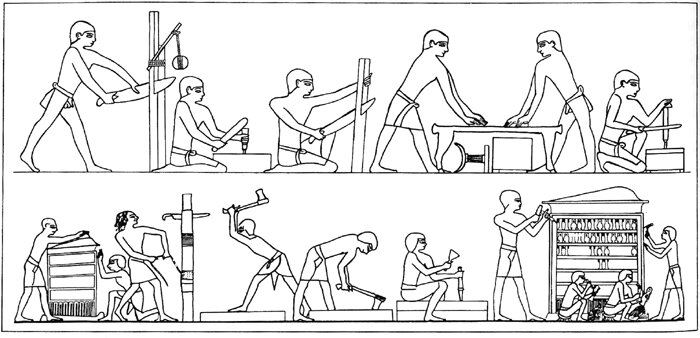
A System of Constant Recycling
Because the tools wore out so quickly, the construction site was more than just a place of masonry; it was a massive metal recycling center. A project like the Great Pyramid required a small army of stationed right on the Giza plateau. Their sole job was to take dulled, shortened saws and bent chisels, melt them down, and cast them into new tools.
This cycle of use, wear, and rebirth meant that copper was treated as a revolving resource. The limited lifespan of the tools dictated the organization of labor. You could not simply give a mason a chisel and expect it to last the week. Instead, you needed a constant flow of metal moving between the quarry face and the furnace. This logistics chain ensured that even though the tools were technically weak, the building process never stopped.
Understanding this relationship between the tool and the abrasive changes how we view ancient engineering. It wasn't about the strength of the metal, but the intelligence of the system. By viewing copper as a carrier for sand and maintaining a rigorous recycling loop, the Egyptians turned a seemingly weak material into the foundation of a civilization.