Anatta The Buddhist Concept of No-Self
Introduction to Anatta
The Idea of Non-Self
In many belief systems, the idea of a soul, or a permanent, unchanging self, is central. Buddhism takes a radically different view with its doctrine of anatta, often translated as 'non-self' or 'no-soul'. This isn't a claim that you don't exist. Rather, it's the idea that there is no permanent, unchanging essence that you can point to and call 'me'.
This teaching challenges us to look at ourselves not as a solid, static entity, but as a dynamic process. The concept of anatta is one of the Three Marks of Existence, which are considered the fundamental characteristics of all conditioned things in the universe.
| Mark (Pali) | Translation | Meaning |
|---|---|---|
| Anicca | Impermanence | Everything is in a constant state of flux. |
| Dukkha | Suffering | Unsatisfactoriness and stress are inherent in life. |
| Anatta | Non-Self | There is no permanent, independent self or soul. |
To fully grasp anatta, it's helpful to compare it with the concept of the self that was prevalent in India during the Buddha's time. Hinduism, which shares roots with Buddhism, has a very different perspective.
To Hindus, every person has an essential self, or atman (aht mun).
The atman is seen as an eternal, unchanging soul that is part of the universal spirit. The Buddha directly countered this idea. He taught that clinging to the notion of a permanent self is a primary source of suffering.
Buddhism, however, teaches the doctrine of Anatta (non-self), which denies the existence of a permanent self or soul and emphasises the impermanent nature of all things.
What Makes a 'Self'?
If there's no permanent self, what are we? According to Buddhist thought, what we call the 'self' is a temporary combination of five shifting components, known as the Five Skandhas or aggregates.
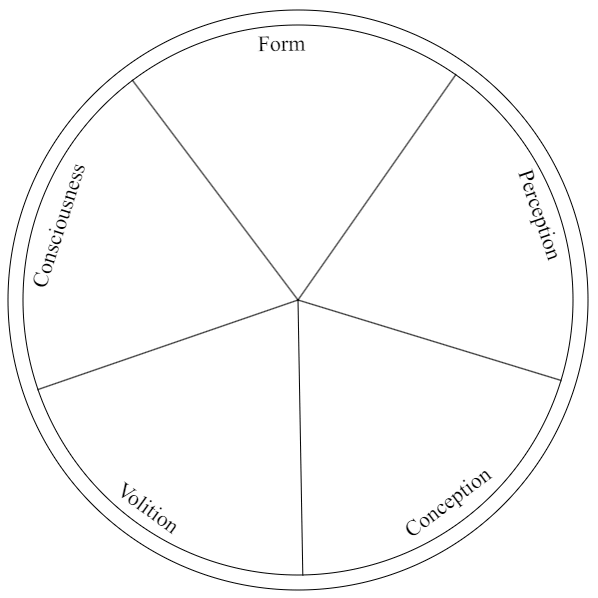
These five aggregates work together to create the illusion of a single, stable identity. They are:
- Form: The physical body and the material world.
- Sensation: The feelings that arise from our contact with the world, whether pleasant, unpleasant, or neutral.
- Perception: The process of recognizing and labeling our sensations. This is how we distinguish a 'tree' from a 'rock'.
- Mental Formations: Our thoughts, attitudes, opinions, and intentions. This includes everything from a passing whim to a deeply held belief.
- Consciousness: The basic awareness that allows us to experience the other four aggregates.
None of these components are permanent, and none of them, alone or combined, constitute a 'self'. They are constantly changing, like a river that appears to be a single thing but is actually a continuous flow of new water.
Understanding anatta isn't about denying your own experience. It's about seeing that the 'you' who is reading this sentence is a dynamic combination of physical and mental processes, not a fixed soul. By letting go of attachment to this constructed self, Buddhists believe one can reduce ego-driven craving and, ultimately, alleviate suffering.