Anatomy of the Posterior Triangle
Triangle Boundaries
Defining the Posterior Triangle
The side of your neck is a busy neighbourhood of muscles, nerves, and blood vessels. To navigate it, anatomists divide it into smaller, more manageable regions. One of the most important is the posterior triangle, a large, triangular space on the lateral aspect of the neck.
Imagine you're drawing a triangle on the side of your neck. Each side of this triangle is formed by a distinct anatomical landmark. It's not an abstract shape but a real space defined by powerful muscles.
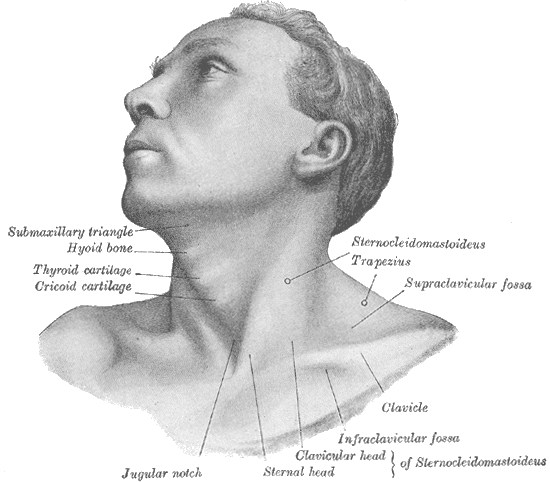
The anterior (front) boundary of this triangle is the posterior edge of a prominent muscle called the Sternocleidomastoid (SCM). You can feel this rope-like muscle when you turn your head to one side and tilt it down. It runs diagonally from behind your ear down to your collarbone and sternum.
The posterior (back) boundary is the anterior edge of the large, flat muscle. This is the muscle that shrugs your shoulders and extends from the base of your skull down your upper back. Its front border forms the back side of our triangle.
The base of the triangle, its inferior (bottom) border, is formed by the middle one-third of the clavicle, or collarbone. This bone provides a solid floor for the region.
Apex and Roof
The three borders meet at specific points. The SCM and Trapezius muscles come together at the top, forming the apex (or peak) of the triangle. This meeting point is on the superior nuchal line of the occipital bone, which is a bony ridge at the back of your skull.
Finally, every structure needs a roof. The roof of the posterior triangle is formed by the a sheet of connective tissue that encases the neck muscles like a supportive stocking. Just above this fascia lies the superficial fascia, fat, and skin.
Summary of Boundaries
| Boundary | Structure |
|---|---|
| Anterior | Posterior border of the Sternocleidomastoid muscle |
| Posterior | Anterior border of the Trapezius muscle |
| Inferior (Base) | Middle third of the clavicle |
| Apex | Junction of Sternocleidomastoid and Trapezius at the superior nuchal line |
| Roof | Investing layer of deep cervical fascia |
Knowing these boundaries is the first step in understanding the contents of the posterior triangle, which include crucial nerves and vessels that supply the arm and parts of the head and neck. By defining this space, we create a map for exploring its complex anatomy.
Let's check your understanding of these key anatomical borders.
Which muscle forms the anterior boundary of the posterior triangle of the neck?
The inferior border, or base, of the posterior triangle is formed by the middle one-third of the clavicle.