Anatomy Basics
Anatomical Terminology
A Universal Starting Point
To talk about the body, we need a shared starting point. Imagine trying to give directions in a city where no one agrees on which way is north. It would be chaos. Anatomy has the same problem. Is the heart "above" the stomach? It depends if you're standing up or lying down. To avoid confusion, anatomists use a standard reference posture called the anatomical position.
The anatomical position is a person standing upright, with feet parallel and flat on the floor. The head is level, and the eyes are looking forward. The arms are at the sides, with palms facing forward.
Every description of the body assumes this position, regardless of how the body is actually oriented. It’s the universal map that ensures everyone is speaking the same language.
Navigating the Body
With the anatomical position as our reference, we can use directional terms to describe where one body part is in relation to another. These terms always come in pairs of opposites.
| Term | Meaning | Example |
|---|---|---|
| Anterior (or Ventral) | Toward the front | The sternum is anterior to the heart. |
| Posterior (or Dorsal) | Toward the back | The spine is posterior to the stomach. |
| Superior (or Cranial) | Toward the head | The nose is superior to the mouth. |
| Inferior (or Caudal) | Toward the feet | The stomach is inferior to the lungs. |
| Medial | Toward the midline | The heart is medial to the lungs. |
| Lateral | Away from the midline | The ears are lateral to the nose. |
| Proximal | Closer to the trunk | The elbow is proximal to the wrist. |
| Distal | Farther from the trunk | The fingers are distal to the elbow. |
| Superficial | Toward the surface | The skin is superficial to the muscles. |
| Deep | Away from the surface | The bones are deep to the muscles. |
Notice that proximal and distal are used mostly for limbs, describing positions along the arm or leg relative to where it attaches to the main body.
Slicing through the Body
To see inside the body, we often imagine it cut along flat surfaces called planes. Think of them as invisible slices that help us view internal structures from different angles. There are three main anatomical planes.
- Sagittal Plane: Divides the body vertically into left and right sections. If the plane runs exactly down the middle, it's called a midsagittal plane.
- Coronal Plane (or Frontal Plane): Divides the body vertically into anterior (front) and posterior (back) sections.
- Transverse Plane (or Axial Plane): Divides the body horizontally into superior (upper) and inferior (lower) sections.
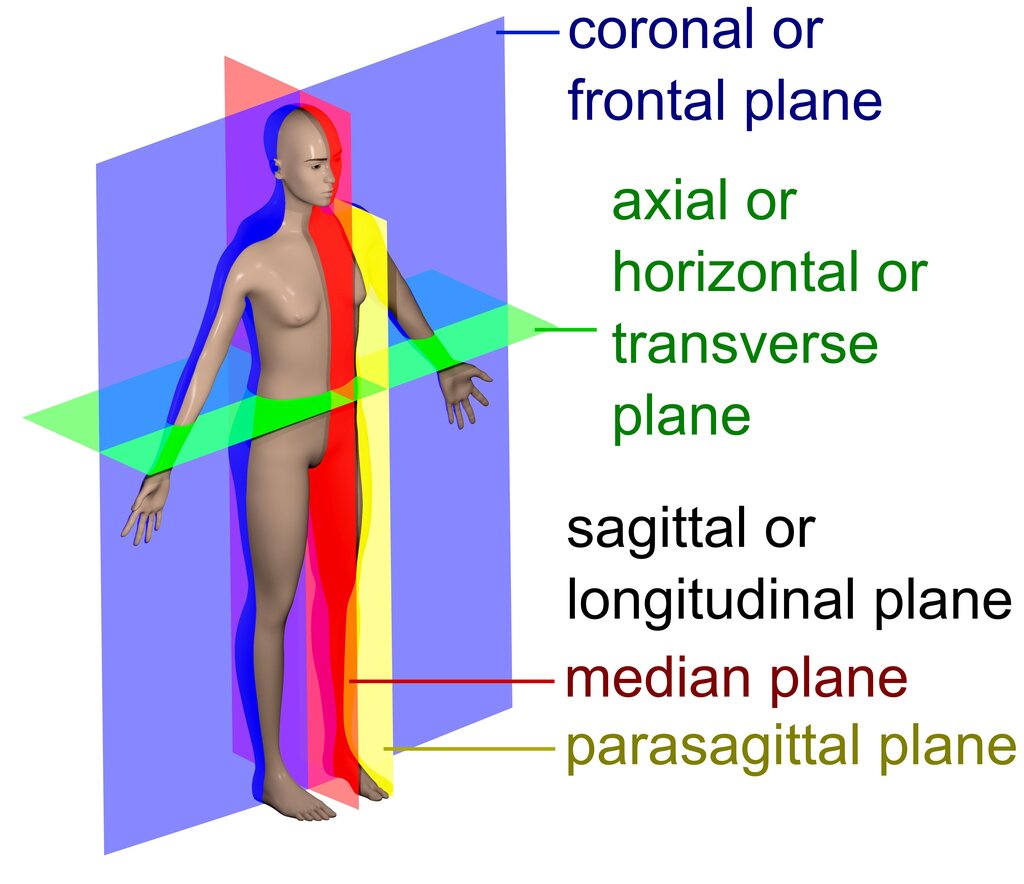
Medical imaging techniques, like MRI or CT scans, often present views of the body along these planes.
The Body's Compartments
The body's organs aren't just floating around inside. They are housed within specific compartments called cavities, which protect them and allow them to change shape and size. The two main cavities are the dorsal (back) and ventral (front) cavities.
The Dorsal Cavity, located along the back of the body, is subdivided into:
- The Cranial Cavity, which encases the brain.
- The Vertebral Cavity (or spinal canal), which encloses the spinal cord.
The Ventral Cavity is the larger cavity at the front of the body. It's separated by the diaphragm into:
- The Thoracic Cavity, which contains the heart and lungs.
- The Abdominopelvic Cavity, which is further divided. The upper Abdominal Cavity holds the stomach, liver, and intestines, while the lower Pelvic Cavity contains the bladder and reproductive organs.
This framework of position, direction, planes, and cavities provides the essential language for studying anatomy.
What is the primary purpose of the anatomical position in the study of the human body?
The elbow is ______ to the wrist.