Anatomy and Origin of the GameCube Controller
Design Philosophy and Origins
The Disappearing Controller
When Nintendo set out to design the controller for their new console, the GameCube, they had a single, guiding principle: create a controller that 'disappears' in the player's hands. The goal was an input device so comfortable and intuitive that the player would forget it was there, allowing for complete immersion in the game. This was a direct evolution from the experimental design of the Nintendo 64 controller.
The N64's three-pronged controller was a bold attempt to bridge the gap between 2D and 3D gaming, but it often forced players into awkward hand positions. For the GameCube, the team abandoned this transitional form factor. They committed fully to a dual-handle design, focusing entirely on ergonomics and the demands of increasingly complex 3D worlds.
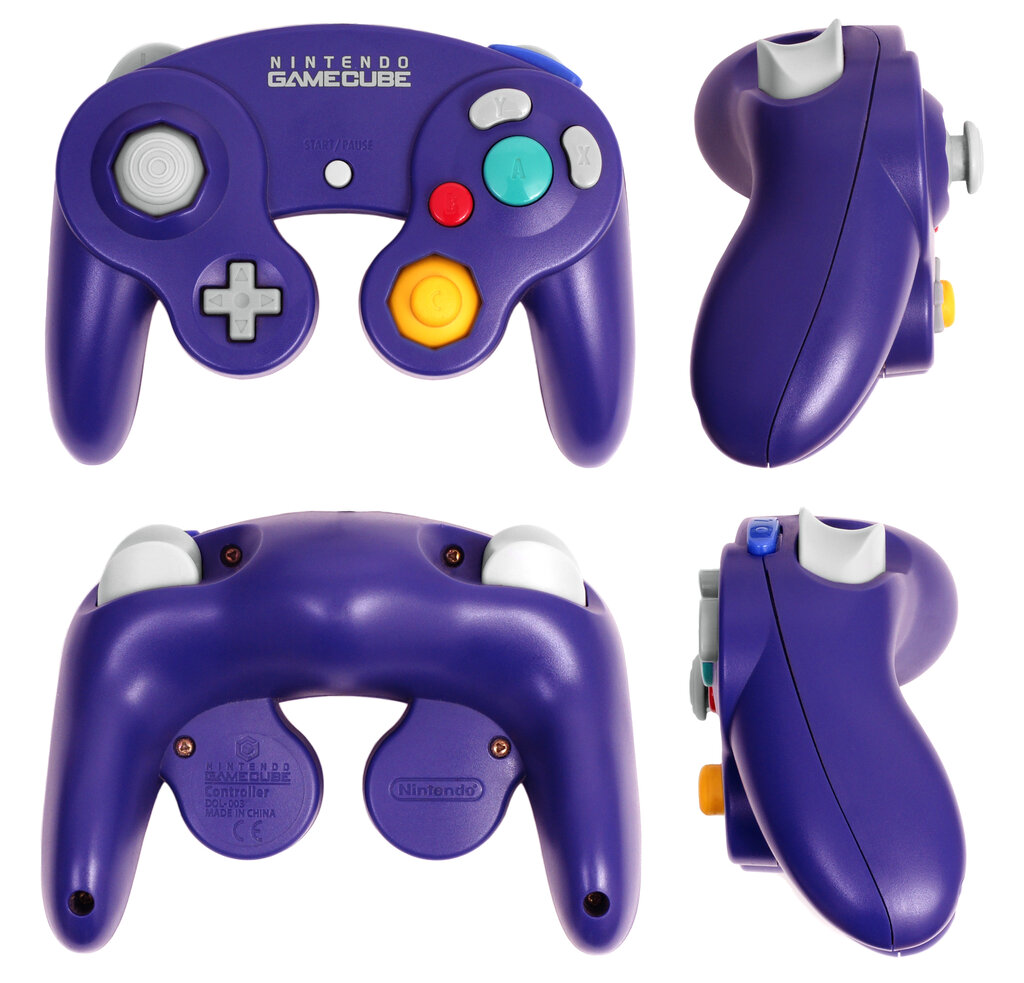
A New Philosophy
The design philosophy for the DOL-003, as the controller was officially known, was heavily influenced by writer and game designer and spearheaded by Nintendo's legendary hardware designer, of the Integrated Research & Development (IRD) division. Itoi, known for his work on the EarthBound/Mother series, wasn't a typical hardware engineer. His input was focused on the user's emotional and physical experience. He championed the idea that the controller should feel like a well-worn tool, perfectly molded to the user's grip.
Takeda's IRD team translated this vision into a physical product. They understood that the analog stick, introduced with the N64, was the future of 3D navigation. The challenge was to build a controller around it that felt natural for everyone, not just seasoned gamers. The result was a device with a distinct asymmetrical button layout and two handles designed to fit snugly in the palms.
Purposeful Design
Every curve and button on the GameCube controller was intentional. The large, green 'A' button sits centrally, acting as the home base for the player's thumb. The smaller, red 'B' button is nestled beside it, easy to find without looking. The kidney-bean-shaped 'X' and 'Y' buttons curve around the 'A' button, their unique shapes providing tactile feedback.
This layout created a clear hierarchy of actions. The primary action button was biggest and easiest to press, while secondary actions were physically distinct, helping players build muscle memory quickly.
The dual-handle form factor was a significant ergonomic leap from the N64's three-pronged approach. Holding the N64 controller often required the player to choose which handle to prioritize, leaving the D-pad or the analog stick in an awkward position. The GameCube's design provided a stable, comfortable grip that kept all primary inputs within easy reach of the thumbs.
This commitment to a comfortable, logical layout was the key to making the controller 'disappear.' By removing the physical and mental awkwardness of the previous generation's design, Nintendo allowed players to focus entirely on the game world, making 3D navigation feel less like a task and more like a natural extension of thought.
What was the central design philosophy guiding the creation of the GameCube controller?
Who was the writer and game designer, known for the EarthBound series, who contributed to the controller's design by focusing on the user's experience?