Anatomy and Function of the Male Reproductive System
Systemic Architecture
An External Arrangement
The male reproductive system's design is a fascinating solution to a biological problem. Unlike most organs, which are safely housed within the body cavity, the primary male gonads, the testes, are located outside in a sac called the scrotum. This isn't an accident of evolution; it's a critical feature for function.
The story starts during fetal development, when the testes form inside the abdominal cavity, near the kidneys. Before birth, they undertake a journey, descending through the inguinal canal to settle in the scrotum. This migration creates a vital lifeline: the spermatic cord.
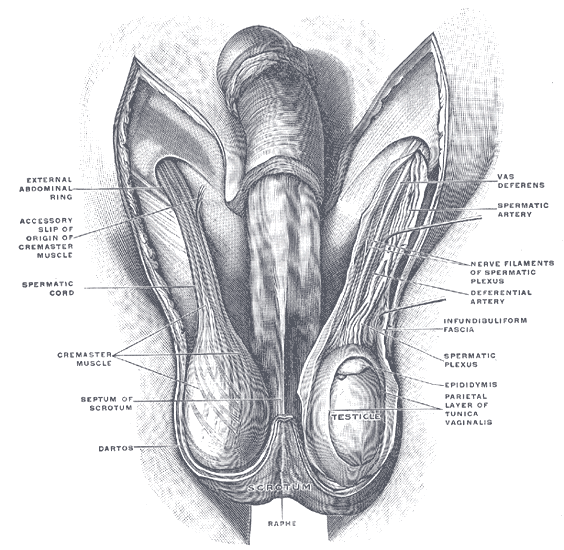
The spermatic cord is more than just a tether. It's a bundled conduit containing the vas deferens (the tube that carries sperm), blood vessels, nerves, and lymphatic vessels that service each testis. Think of it as a utility cable running from the main building (the pelvic cavity) to an external facility (the testis). This arrangement connects the external production site with the internal network required for transport and hormonal signaling.
A Precise Climate Control System
Why go to all this trouble? The primary reason is temperature. Spermatogenesis, the process of creating sperm, is highly sensitive to heat. It functions optimally at about 2–3°C below the core body temperature of 37°C. The scrotum is essentially a sophisticated climate control unit designed to maintain this ideal environment.
Two sets of muscles manage the testes' position relative to the body. The dartos muscle is a layer of smooth muscle in the scrotal wall. When it contracts, it wrinkles the scrotal skin, reducing the surface area available for heat loss. The , an extension of the internal oblique muscle of the abdominal wall, actively raises and lowers the testes. When it's cold, both muscles contract to pull the testes closer to the body for warmth. When it's hot, they relax, allowing the testes to hang lower, away from body heat.
But positional adjustment is only half the story. The blood arriving from the aorta is at core body temperature, far too warm for sperm production. To solve this, the spermatic cord employs a brilliant piece of biological engineering called the pampiniform plexus—a dense network of veins that surround the testicular artery.
This arrangement creates a counter-current heat exchanger. Warm arterial blood flowing down to the testis transfers its heat to the cooler venous blood returning to the body.
By the time the arterial blood reaches the testis, it has been pre-cooled to the ideal temperature. This passive, efficient system ensures the testes are constantly supplied with blood that won't disrupt spermatogenesis. It's a perfect example of how anatomical structure directly serves physiological function.
Now let's review these key thermoregulatory structures.
Ready to test your understanding of this system?
What is the primary reason the testes are located in the scrotum, outside the main body cavity?
Which structure acts as a counter-current heat exchanger, cooling arterial blood before it reaches the testes?
This intricate system of muscles and blood vessels highlights how evolution has solved the complex problem of producing viable sperm by creating a unique anatomical arrangement outside the main body cavity.