An Introduction to Western Philosophy
Ancient Greek Philosophy
The First Questions
Western philosophy began with a simple but profound shift in thinking. Before the 6th century BCE, the ancient Greeks explained the world through myths. Thunder was a sign of Zeus's anger, and the changing seasons were tied to the story of Persephone. A group of thinkers in the coastal city of Miletus started asking different kinds of questions. Instead of asking who was responsible for natural events, they asked what was responsible.
These were the Pre-Socratic philosophers, the first scientists of a sort. They looked for a single, underlying substance, or archē, that made up everything. Thales, often called the first philosopher, proposed that everything was made of water. It was a reasonable guess. Water can be liquid, solid (ice), or gas (steam), and all life seems to depend on it. Others followed with their own theories. Anaximander suggested an indefinite, boundless substance he called the apeiron. Heraclitus argued that the fundamental principle wasn't a substance at all, but change itself, famously stating, "You cannot step into the same river twice."
The Pre-Socratics moved away from mythological explanations and toward rational, naturalistic ones. They were looking for the basic stuff of the universe.
The Turn Inward
While the Pre-Socratics looked at the cosmos, Socrates turned his attention to human life. He roamed the streets of Athens, not lecturing, but asking questions. He didn't claim to have answers. In fact, he famously claimed that the only thing he knew was that he knew nothing. His goal was to expose the ignorance of those who thought they were wise.
This method of persistent, probing questions is now called the Socratic method. He would approach a respected statesman or poet and ask, "What is justice?" or "What is courage?" Through a series of follow-up questions, he would reveal contradictions in their beliefs, showing that their confident certainty was built on a shaky foundation. For Socrates, philosophy wasn't about finding a single element like water or fire. It was about examining one's own life and beliefs to pursue virtue and moral truth. This focus on ethics and self-examination was a radical departure and set the stage for everything that followed.
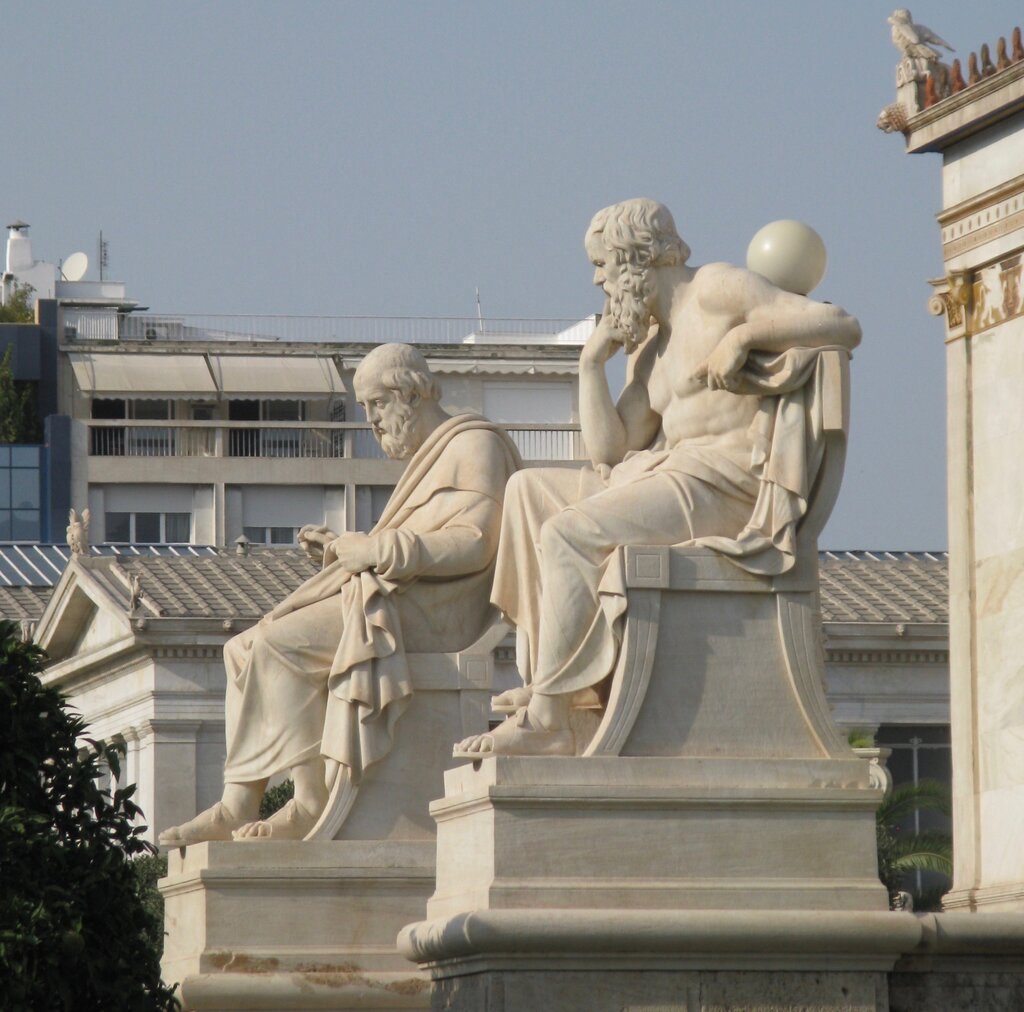
Plato's World of Ideas
Socrates never wrote anything down. What we know of him comes mostly from his brilliant student, Plato. Deeply affected by Socrates's trial and execution, Plato dedicated his life to philosophy, founding a school called the Academy.
Plato took Socrates's search for perfect definitions of concepts like 'justice' and developed a groundbreaking idea: the Theory of Forms. He argued that the physical world we perceive with our senses is not the real world. It's a world of imperfect, changing copies. The real world is a realm of perfect, eternal, and unchanging ideas, or Forms. There is a perfect Form of a Circle, a perfect Form of a Tree, and, most importantly, a perfect Form of the Good. Everything we see is just a shadow of these perfect Forms.
Plato's most famous work, The Republic, uses this theory to explore justice and outline an ideal state. He argued that just as the philosopher must escape the cave of ignorance to see the true Forms, the ideal city should be ruled by "philosopher-kings"—those who have grasped the Form of the Good and can lead society with true wisdom.
Aristotle's Empirical World
Plato's most famous student was Aristotle, but he took a very different path. While Plato looked to an abstract world of Forms for truth, Aristotle looked to the world around him. He was a keen observer of nature, a biologist, and a physicist. For him, reality was right here, in the physical objects we can see and touch.
Aristotle's philosophy is vast, but his core contributions are in logic, metaphysics, and ethics. He invented formal logic, creating a system of deduction called the syllogism to arrive at certain conclusions. For example: All men are mortal. Socrates is a man. Therefore, Socrates is mortal.
In ethics, he rejected Plato's abstract Form of the Good. Instead, he argued that the good life is about achieving eudaimonia, often translated as "flourishing" or "living well." We achieve this by cultivating virtues, which he described as a "golden mean" between two extremes. Courage, for instance, is the mean between cowardice and recklessness.
| Philosopher | Key Idea | Approach |
|---|---|---|
| Socrates | The unexamined life is not worth living | Questioning, Dialogue, Ethics |
| Plato | Theory of Forms | Abstract, Rationalist |
| Aristotle | The Golden Mean | Empirical, Observational |
These three thinkers, Socrates, Plato, and Aristotle, form the foundation of Western philosophy. Their questions about knowledge, reality, and the good life have been debated and reinterpreted for over two thousand years.
Ready to test your knowledge?
What fundamental shift in thinking characterized the Pre-Socratic philosophers?
According to Plato's Theory of Forms, the physical world we perceive is...
The inquiries of these early Greek thinkers kicked off a conversation that continues to this day, shaping how we think about science, politics, and our own purpose in the world.