An Introduction to Cats
Feline Evolution
The Cat Family Tree
The story of the domestic cat, Felis catus, begins long before the first human settlements. All cats, from the roaring lion to the purring tabby, belong to the family Felidae. This group emerged roughly 25 million years ago, descending from a common carnivorous ancestor. Over millennia, this family tree branched into distinct lineages.
One of the most significant splits separated the roaring big cats (subfamily Pantherinae) from the smaller, purring cats (subfamily Felinae). The lineage that would eventually lead to our pets falls squarely within the Felinae group. This is where we find the genus Felis, a group of small wildcats spread across the Old World.
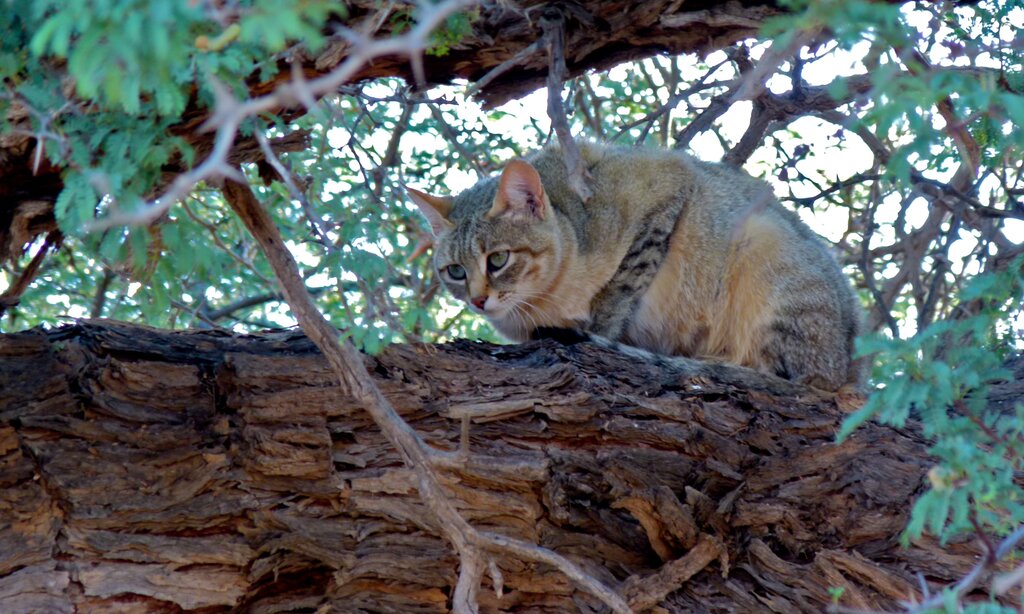
The key species in our story is Felis silvestris, the wildcat. Genetic studies confirm that all domestic cats descend from one of its subspecies, the Near Eastern or African wildcat, Felis silvestris lybica. These wild ancestors look remarkably similar to modern tabby cats, just a bit leaner and leggier.
A Self-Made Companion
Unlike dogs, which were actively domesticated by humans for hunting and protection, cats likely domesticated themselves. The process wasn't driven by human needs but by feline opportunity. It began around 10,000 years ago in the Fertile Crescent, the same region where humans first developed agriculture.
The theme is that cats domesticated themselves.
Early agricultural settlements created a perfect new ecosystem for wildcats. Farmers stored surplus grain, which attracted hordes of rodents. For the local wildcats, these granaries were an all-you-can-eat buffet. Natural selection then played its part. The cats that were less fearful of humans and more tolerant of living in close quarters got better access to this reliable food source. Over generations, this favored temperament became more common, paving the way for a unique partnership between our two species.
Archaeological evidence supports this timeline. A significant discovery in Cyprus revealed a cat intentionally buried with a human nearly 9,500 years ago. Since cats are not native to the island, it implies that humans brought them there, suggesting a special relationship was already forming.
The Genetics of Domestication
For thousands of years, domestic cats remained genetically very similar to their wild cousins. The major changes that define today's pet cats are surprisingly recent, mostly occurring within the last few hundred years with the rise of formal cat breeding.
The most significant genetic shifts relate to behavior. Scientists have identified genes involved in memory, fear conditioning, and stimulus-reward learning that differ between domestic cats and wildcats. These changes likely underpin the increased docility and sociability that allow cats to thrive in human households.
Another key area of genetic adaptation is coat color and pattern. While the ancestral wildcat has a striped tabby coat for camouflage, domestication relaxed this selective pressure. This allowed for a wide array of mutations to persist and spread. Genes responsible for traits like solid black fur, white spotting (piebaldism), and the blotched tabby pattern became much more common in domestic populations.
Interestingly, the genes that control coat color are sometimes linked to other traits. For example, the same neural crest cells that determine coat pigmentation during development also influence parts of the nervous system. This link may help explain why changes in appearance sometimes coincided with changes in temperament, a phenomenon known as the 'domestication syndrome'.
Now, let's test your understanding of the cat's evolutionary journey.
What is the specific wildcat subspecies from which all domestic cats descend?
How did the process of cat domestication primarily differ from that of dogs?
From a wild hunter to a household companion, the cat's evolution is a story of adaptation and a unique, self-directed partnership with humanity.