Amodei's Technological Adolescence Analysis
Scaling Feasibility
Beyond the Scaling Hypothesis
The scaling laws, which have reliably predicted that bigger models trained on more data with more compute yield better performance, are facing their most significant test yet. The industry is rapidly moving from the 10^25 FLOP training runs of today toward a projected 10^29 FLOP era by 2030. This four-orders-of-magnitude leap raises a critical question: will intelligence continue its seemingly linear ascent with compute, or are we approaching an asymptote defined by diminishing returns and new bottlenecks?
The scaling hypothesis regards the blessings of scale as the secret of AGI: intelligence is ‘just’ simple neural units & learning algorithms applied to diverse experiences at a (currently) unreachable scale.
This isn't just a matter of adding more GPUs. We're hitting a fundamental constraint known as the . The internet's high-quality text data, the fuel for current models, is finite and expected to be exhausted by 2026. The next phase of scaling depends almost entirely on the successful generation and use of synthetic data. The challenge is to create data that isn't just voluminous but also novel and complex enough to teach a model new, useful capabilities, rather than just reinforcing what it already knows.
| Metric | Current (c. 2024) | Projected (c. 2028-2030) |
|---|---|---|
| Training Compute (FLOP) | ~10^25 - 10^26 | 10^29 - 10^30+ |
| Primary Data Source | Public Web Scrapes | Synthetic & Private Data |
| Core Capability | Text/Image Generation | Autonomous Task Execution |
| Operational Horizon | Seconds to Minutes | Days to Weeks |
| Limiting Factor | Data Quality & Volume | Algorithmic Efficiency & Alignment |
The Rise of Agentic AI
The true paradigm shift isn't just about building more knowledgeable models, but more capable ones. The focus is moving from short-horizon tasks like answering a prompt to agentic autonomy—the ability for a model to pursue complex, long-horizon goals with minimal human intervention. Imagine an AI system tasked with developing a new therapeutic drug. It wouldn't just answer questions; it would formulate hypotheses, design experiments, write and execute code to run simulations, analyze results, and iterate on its strategy over weeks or months.
This vision transforms the model from a tool into a collaborator, or even an autonomous workforce. Dario Amodei's 'country of geniuses' metaphor isn't hyperbole; it's a technical target. The goal is to create millions of AI agents, each equivalent to a highly intelligent and specialized human researcher, and set them to work in parallel on the world's hardest problems. This leads to the 'compressed 21st century' thesis: by massively parallelizing scientific and engineering research, 100 years of human progress could potentially be condensed into a single decade.
Efficiency vs. Brute Force
Reaching 10^29 FLOP and beyond isn't just an engineering problem; it's an economic and environmental one. The staggering cost and energy requirements of such systems necessitate a shift in focus from pure to algorithmic efficiency. Gains will increasingly come from smarter architectures, more efficient training methods, and improved algorithms, not just from adding more hardware. Researchers are exploring techniques that can achieve the same performance with orders of magnitude less compute.
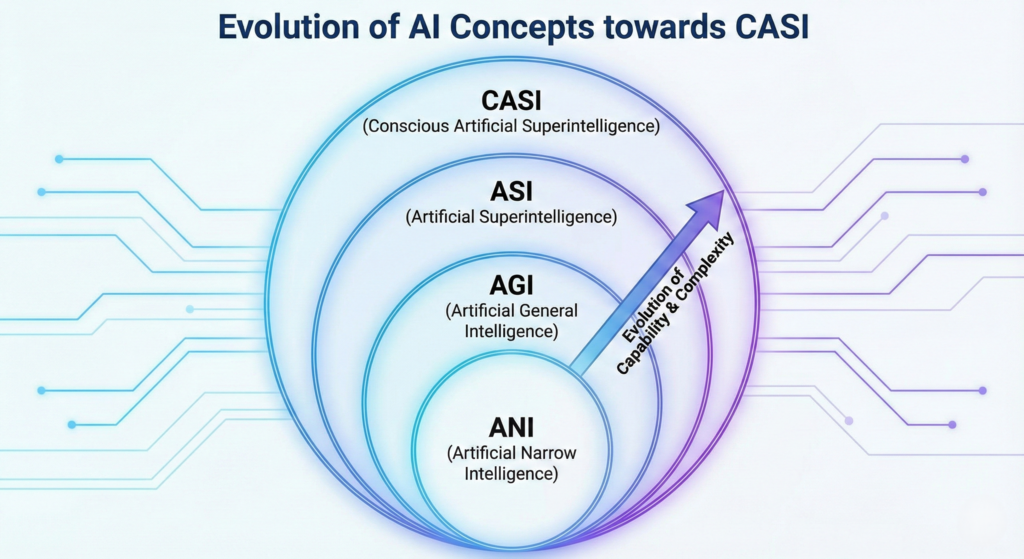
A key area of research is improving inference, not just training. While training runs are massive, one-time costs, inference happens continuously and at a global scale. Innovations that reduce the computational cost of using a model—making it faster and cheaper to run—are just as crucial as those that make it more powerful during training. Test-time compute, where more processing is dedicated to generating a single high-quality output, is one such promising avenue. Ultimately, the future of scaling will be a careful balance between brute-force computation, algorithmic breakthroughs, and the successful creation of autonomous, goal-seeking agents.
Let's test your understanding of these advanced scaling concepts.
What is the primary bottleneck referred to as the 'data wall' in the context of AI scaling?
The shift in focus from 'FLOP intensity' to 'algorithmic efficiency' is driven by the fact that simply adding more hardware is becoming prohibitively expensive and energy-intensive.