American Political Giants Clay Calhoun Webster
Political Landscape 1800s
The First Political Divide
After the Revolution, Americans had to figure out how to run their new country. Almost immediately, two competing visions emerged, leading to the nation's first political parties: the Federalists and the Democratic-Republicans. This wasn't just a friendly disagreement; it was a fundamental clash over the future of the United States.
The Federalists, led by figures like Alexander Hamilton, believed in a strong central government. They envisioned an America that was a powerhouse of industry and trade, with a national bank and a robust federal system to manage the economy. They thought a powerful government was necessary to command respect on the world stage and ensure stability at home. Their support was strongest in the cities and commercial centers of the North.
On the other side were the Democratic-Republicans, championed by Thomas Jefferson. They feared that a strong central government would become tyrannical, just like the British monarchy they had fought to escape. They imagined a nation of independent farmers, with power resting firmly in the hands of the states. To them, the ideal government was one that governed least. Their strength lay in the rural South and among small farmers and artisans.
The Power Struggle
This party division wasn't just about different preferences. It was rooted in a deep, unresolved question from the Constitutional Convention: Where does the ultimate power lie? Does it rest with the federal government in Washington, or with the individual states?
The core debate was federal authority versus states' rights. It was a tug-of-war that would define American politics for decades.
Advocates for federal authority argued that a unified, central government was essential for the nation's survival. How could the United States negotiate treaties, regulate trade between states, or defend itself without a strong national government making the final call?
Supporters of states' rights, however, were wary. They believed that the states, being closer to the people, could better understand and protect their citizens' interests. They feared a distant federal government would ignore local needs and trample on individual liberties. This belief led to the controversial idea of nullification, where a state could supposedly void a federal law it considered unconstitutional.
Money, Land, and People
Economic issues poured fuel on this fire. The Federalists' plan for a national bank was a major point of contention. They saw it as a way to stabilize the nation's finances and promote business. Democratic-Republicans saw it as an unconstitutional overreach of federal power that would benefit wealthy urban elites at the expense of rural farmers.
Tariffs, or taxes on imported goods, were another battleground. Northern manufacturers wanted high tariffs to protect their young industries from cheaper British competition. But Southerners, who exported crops like cotton and imported many goods, hated tariffs. They saw them as a tax that raised the cost of things they needed while unfairly benefiting the North.
Finally, the institution of slavery cast a long and dark shadow over every political debate. While not always the stated topic, it was the unspoken issue beneath the surface of arguments about states' rights, economic policy, and westward expansion. Southern politicians fiercely defended slavery as essential to their economy and way of life, viewing any federal interference as a direct threat. This social and moral issue was deeply entangled with the political and economic conflicts of the time, creating divisions that would ultimately prove impossible to resolve through debate alone.
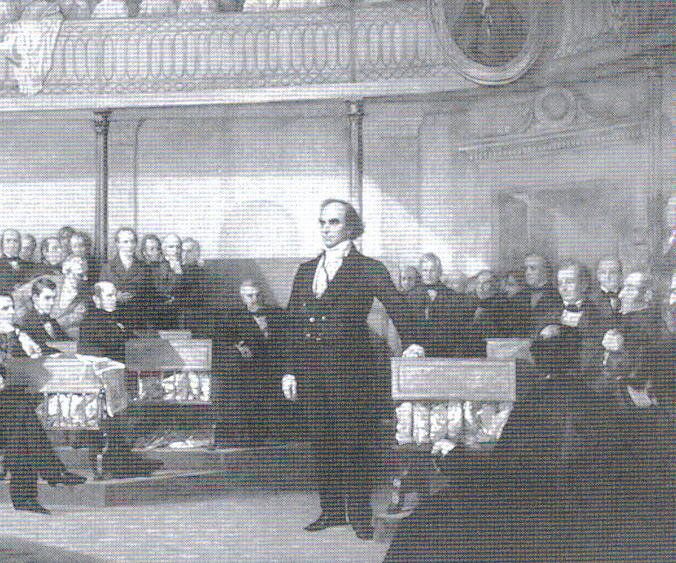
This was the complex and divided world that a new generation of leaders, including Henry Clay, John C. Calhoun, and Daniel Webster, entered. They would spend their careers navigating these explosive issues, trying to hold a young, fragile nation together.