American History: Founders to Empire
Enlightenment and Governance
From Reason to Republic
The American Revolution won independence, but the peace that followed was chaotic. The Articles of Confederation, the first governing document, created a weak central government that couldn't effectively manage the new nation's debts or quell internal uprisings. It was clear a new blueprint was needed. This need coincided with the peak of the Enlightenment, a European intellectual movement that championed reason, logic, and individual rights. Think of it as a societal operating system upgrade.
Just as Neoclassical art and architecture of the era rejected the ornate excess of the Baroque for clean lines and rational order, America's founders sought to build a government based on logical principles rather than inherited power. They looked to thinkers who had tried to design a perfect society on paper. English philosopher John Locke argued for natural rights to life, liberty, and property. French thinker proposed separating a government's powers to prevent any one branch from becoming too dominant.
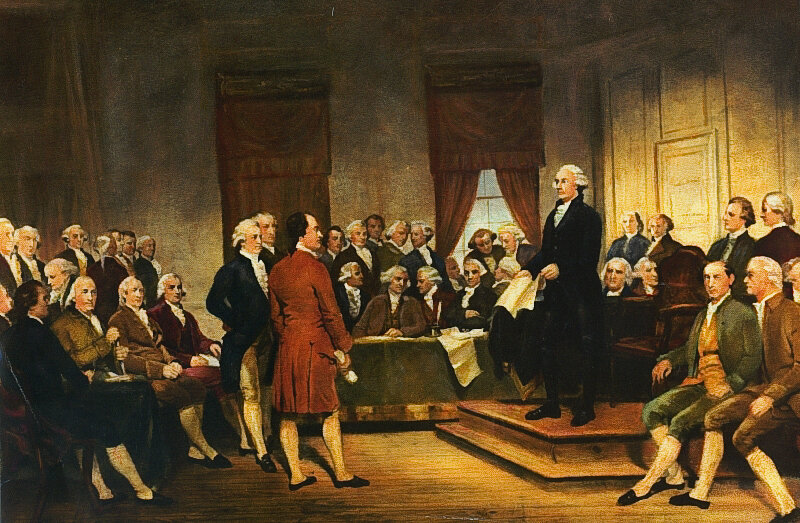
These weren't just abstract ideas. They were practical solutions to a real problem: how to create a strong, stable government that didn't trample the very liberties it was supposed to protect. The delegates at the 1787 Constitutional Convention in Philadelphia were engineers as much as they were politicians, tasked with building a machine of governance.
The Great Debate
Not everyone agreed on the design. The debate over the new Constitution quickly split the nation's leaders into two camps: the Federalists and the Anti-Federalists. This wasn't just a squabble; it was a fundamental disagreement about the nature of power and the future of the republic.
The Federalists, led by figures like Alexander Hamilton and James Madison, argued for a strong national government. They believed a central authority was necessary for defense, commerce, and national unity. To make their case, they published a series of 85 essays known as , which remain one of the most important works of American political philosophy.
The Anti-Federalists, including Patrick Henry and George Mason, feared that a powerful central government would replicate the British tyranny they had just overthrown. They championed states' rights and demanded a bill of rights to protect individual liberties from federal encroachment. Their arguments weren't just based on fear; they stemmed from a deep-seated belief that power was safest when kept close to the people.
| Stance | Federalists | Anti-Federalists |
|---|---|---|
| Central Government | Favored a strong national government. | Favored strong state governments. |
| Key Supporters | Alexander Hamilton, James Madison, John Jay. | Patrick Henry, George Mason, Samuel Adams. |
| Core Argument | A strong central government is needed for order, stability, and defense. | A strong central government threatens individual liberty and state sovereignty. |
| Bill of Rights | Initially argued it was unnecessary, as the Constitution itself was a bill of rights. | Demanded its inclusion as a condition for ratification. |
The compromise was ratification of the Constitution, but with the promise of immediately adding a Bill of Rights. This addressed the Anti-Federalists' primary concern and secured the new government's foundation.
A Machine Built to Last
The final document was a masterpiece of political engineering, built on the principle of separating powers. This wasn't about creating an efficient government; it was about creating a safe one. The framers intentionally introduced friction into the system to prevent any single person or group from accumulating too much control. They divided power both horizontally and vertically.
Horizontal separation created the three branches of government: Legislative (Congress), Executive (President), and Judicial (Supreme Court). Vertical separation, known as federalism, divided power between the national government and the state governments.
This structure tackles the fundamental question of sovereignty: where does ultimate authority lie? In a monarchy, it's the king. Under the Articles of Confederation, it was effectively the states. The Constitution's radical answer was that sovereignty resides with "We the People." The people delegate specific, limited powers to the government through the Constitution, while retaining all other rights and powers for themselves or their states.
sovereignty
noun
The supreme authority within a territory. In political theory, it determines the ultimate source of law and power.
This framework wasn't perfect, and it has been amended 27 times over 200 years. Yet, its core design, inspired by Enlightenment ideals of reason and a healthy skepticism of power, has proven remarkably resilient.
Now, let's test your understanding of these foundational concepts.
What was the primary weakness of the Articles of Confederation that led to the Constitutional Convention?
The U.S. Constitution was heavily influenced by Enlightenment ideas. Which thinker is most associated with the principle of the separation of powers?
The Constitution created a new form of government, but its influence came from centuries of political thought. The document balanced competing ideas about power, liberty, and order, setting the stage for the modern American state.