American Constitutional Mechanics and Legal Evolution
Federalism and Sovereignty
A Tale of Two Sovereigns
In the United States government, power isn't a single pie held by one entity. It's deliberately divided. This system, known as federalism, creates a dynamic tension between two sovereigns: the national (federal) government and the individual state governments. Each has its own sphere of authority, and the line between them has been a source of debate since the country's founding.
The foundation for states' rights is baked directly into the Constitution. The Tenth Amendment is straightforward: any powers not explicitly given to the federal government, nor prohibited to the states, are reserved for the states themselves or for the people. This creates a baseline of state authority over many aspects of daily life, often referred to as their police power — the inherent authority to regulate health, safety, and public welfare.
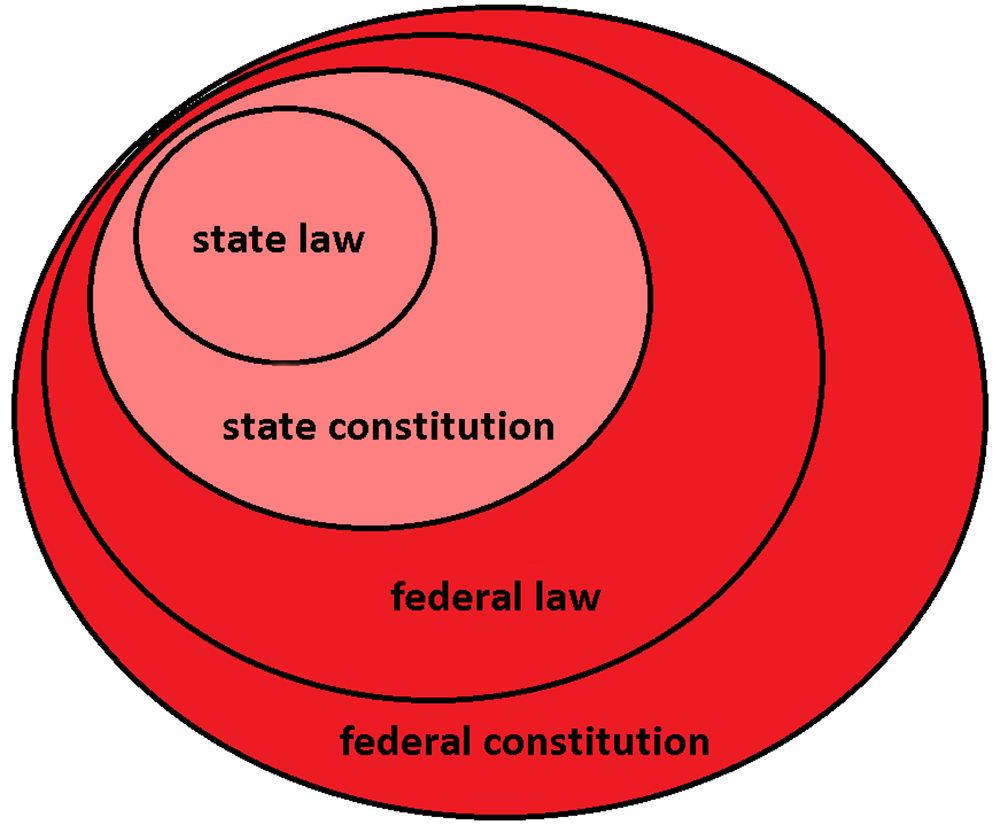
The Federal Toolkit
If the Tenth Amendment puts a fence around state power, Article I, Section 8 of the Constitution hands the federal government a toolkit of enumerated powers. These are specific responsibilities like coining money, raising an army, and establishing post offices.
But two clauses in this section provide the real muscle for federal authority. The first is the which gives Congress the power to make all laws “necessary and proper” for carrying out its other listed powers. It’s not a blank check; rather, it’s a way to ensure the government has the practical means to do its job.
The second, and arguably most influential, is the Commerce Clause. This grants Congress the power to regulate commerce with foreign nations, among the several states, and with Native American tribes. Originally, its main purpose was to stop states from setting up protectionist trade barriers against each other, creating a single, unified economic market across the country.
The Court Weighs In
The theoretical boundaries of federalism are constantly tested in the real world, and the Supreme Court often acts as the referee. Two landmark cases show how the interpretation of federal power has both expanded and contracted over time.
The first major showdown was (1819). The federal government established a national bank, and the state of Maryland tried to tax it out of existence. The Court, led by Chief Justice John Marshall, sided with the federal government. Marshall argued that while the power to create a bank isn't explicitly listed in the Constitution, it was a 'necessary and proper' way for Congress to carry out its fiscal duties. Furthermore, he established that states could not tax federal institutions, famously declaring that “the power to tax involves the power to destroy.” This ruling dramatically strengthened federal authority.
For over a century, especially during the New Deal era, the Court interpreted the Commerce Clause so broadly that Congress could regulate almost any activity that had an indirect effect on interstate commerce. This changed with United States v. Lopez (1995).
In this case, the Court struck down the Gun-Free School Zones Act, a federal law that banned possessing a gun in a school zone. The government argued that gun violence in schools hurt the economy, thus affecting interstate commerce. For the first time in nearly 60 years, the Court said no. It ruled that carrying a gun in a local school zone was not an economic activity that had a substantial effect on interstate commerce. The link was too remote. Lopez signaled a limit to the federal government's reach under the Commerce Clause, reaffirming that some powers, like policing local schools, belong firmly to the states.
The tension between the Necessary and Proper Clause and the Tenth Amendment creates a 'dual sovereignty' framework where federal and state powers are in constant negotiation.
Time for a quick check on these foundational concepts.
Which constitutional amendment serves as the foundation for the powers reserved to the states, often referred to as their 'police power'?
What was the central argument used by the Supreme Court in McCulloch v. Maryland (1819) to uphold the creation of a national bank?
These cases highlight the ongoing tug-of-war. Federalism is not a static list of rules but a constantly evolving balance between the need for national standards and the value of local control.