Amazon Mainframe Technology
Introduction to Mainframe Computers
The Unseen Giants
Imagine a computer that never crashes. A machine designed to run for decades without a single reboot, processing thousands of transactions every second with absolute precision. This isn't science fiction; it's the world of mainframe computers. While smartphones and laptops grab the headlines, these powerful systems are the unsung heroes of the digital world, quietly running the core operations of banks, airlines, insurance companies, and governments.
Welcome to the hidden world of mainframe computers: the digital workhorses processing billions of transactions every day while remaining completely invisible to the people whose lives they run.
So, what exactly is a mainframe? It's a large, powerful computer built for reliability, security, and massive transaction processing. Instead of handling a wide variety of tasks like a personal computer, mainframes are specialists. They excel at running the same critical programs over and over, handling enormous volumes of input and output without breaking a sweat. This focus on high-volume, simultaneous processing is a key characteristic that sets them apart.
A Brief History
Mainframes were the first commercial computers. Born in the 1950s, giants like the IBM System/360 revolutionized business by automating tasks that were previously done by hand. These early machines filled entire rooms and required teams of specialists to operate. Over the decades, they've shrunk in size while growing exponentially in power, but their core purpose has remained the same: to be the ultra-reliable backbone for mission-critical operations.
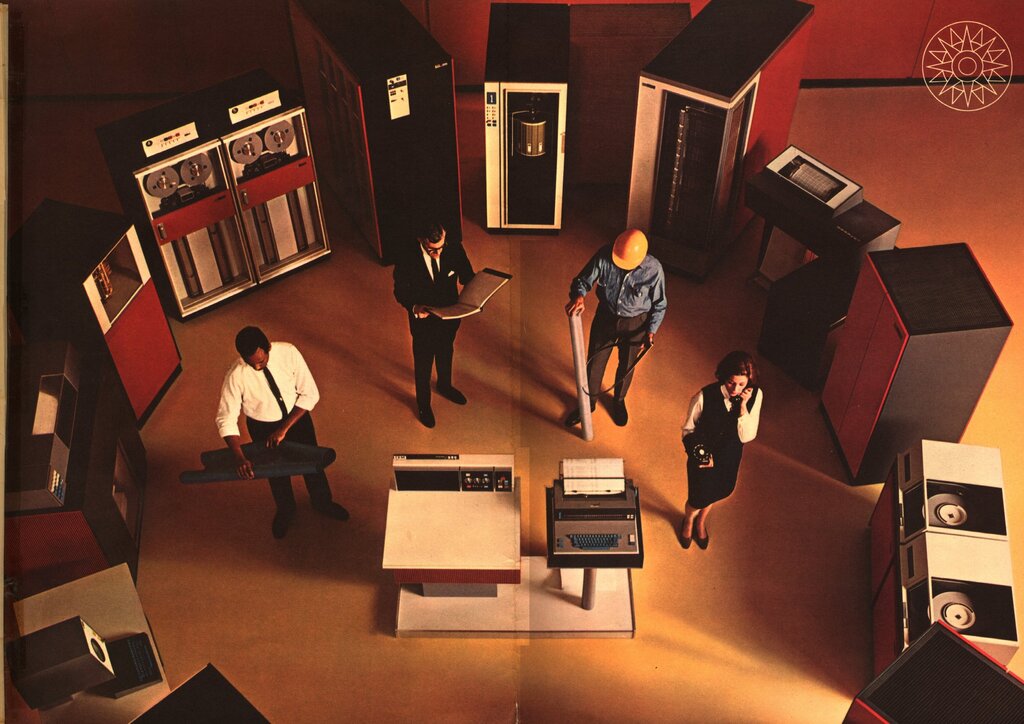
Think of the first mainframes as massive calculators for big businesses. They were instrumental in everything from the US census to the Apollo space missions. While technology has evolved, the principles of reliability and massive throughput established by these early systems continue in modern mainframes.
Inside the Mainframe
A mainframe's architecture is built around redundancy and efficiency. Unlike a typical computer where the CPU does most of the work, a mainframe offloads many tasks to specialized processors and channels. This allows the central processors to focus purely on executing application logic at incredible speeds.
Key components include:
- Central Processors (CPs): These are the main engines that run the operating system and execute user instructions.
- System Assist Processors (SAPs): These specialized processors handle all the input/output (I/O) operations, freeing up the CPs.
- Channels: High-speed pathways that connect the processors to peripheral devices like disk drives and printers. They manage data transfer independently.
- Memory: Mainframes have large amounts of highly reliable memory with built-in error correction.
This division of labor is crucial. It means the system doesn't slow down even when it's communicating with thousands of devices at once.
Not All Big Computers Are the Same
It's easy to confuse mainframes with other large computing systems like servers or supercomputers. While they might look similar in a data center, their jobs are fundamentally different.
A server is designed for flexibility, a supercomputer for raw calculation speed, and a mainframe for relentless reliability and massive I/O.
| Feature | Mainframe | Server | Supercomputer |
|---|---|---|---|
| Primary Goal | High reliability, massive transaction I/O | General purpose, client-server tasks | Complex numerical computation |
| Workload | Thousands of concurrent simple transactions | A few to hundreds of users/tasks | One or a few massive, complex problems |
| Architecture | I/O-centric, specialized processors | CPU-centric, standardized components | Highly parallel, thousands of cores |
| Example | Processing millions of credit card swipes | Hosting a company website | Simulating weather patterns or nuclear physics |
Think of it this way: a supercomputer is a Formula 1 race car, built for one thing: extreme speed on a specific track. A server is like a delivery van, versatile and able to handle many different types of cargo. A mainframe is like a freight train, not necessarily the fastest, but capable of moving an enormous amount of goods across the country, 24/7, without fail.
Time for a quick check on what we've covered.
What is the primary design focus of a mainframe computer?
In a mainframe's architecture, what is the primary role of System Assist Processors (SAPs)?
Mainframes are a testament to specialized engineering. By focusing on reliability and high-volume transaction processing, they've carved out an essential role in the global economy that remains vital today.