Amazon DynamoDB Essentials
Introduction to NoSQL Databases
Beyond Tables and Rows
For decades, relational databases, which organize data into neat tables with rows and columns, have been the standard. Think of a spreadsheet for a company's employees: each row is an employee, and each column is a specific piece of information like 'Name,' 'ID Number,' or 'Hire Date.' This structure is rigid and predictable, which is often a good thing.
But what if your data doesn't fit neatly into a table? What if you're dealing with social media posts, product catalogs with varying attributes, or sensor data from thousands of devices? For these situations, a different approach was needed. This led to the rise of NoSQL databases.
NoSQL databases offer a more flexible, schema-less approach to storing data.
NoSQL stands for "Not Only SQL." It's an umbrella term for databases that store data in formats other than relational tables. The key characteristics of NoSQL databases are flexibility, scalability, and the ability to handle large volumes of unstructured or semi-structured data. Unlike relational databases that require you to define your data structure upfront (a "schema-on-write"), many NoSQL databases let you add data first and figure out the structure later (a "schema-on-read").
SQL vs. NoSQL
The fundamental difference between SQL (Relational) and NoSQL databases lies in how they handle data structure and scaling. Relational databases scale vertically, meaning you increase power by adding more CPU or RAM to a single server. NoSQL databases are designed to scale horizontally, allowing you to add more servers to your database cluster. This makes them ideal for handling massive, rapidly growing datasets.
| Feature | Relational (SQL) | NoSQL |
|---|---|---|
| Data Structure | Tables with rows and columns | Varies: Documents, key-value pairs, graphs, etc. |
| Schema | Fixed, predefined schema | Dynamic or flexible schema |
| Scalability | Vertical (scale-up) | Horizontal (scale-out) |
| Data Type | Structured | Structured, semi-structured, and unstructured |
The Four Main Types
NoSQL isn't just one thing; it's a category of different database models. Each is optimized for specific types of data and use cases.
1. Document Stores These databases store data in documents, which are similar to JSON objects. Each document contains fields and values, and the values can be a variety of types, including strings, numbers, booleans, arrays, or even other nested objects. This is a very popular model because it maps naturally to objects in programming languages.
{
  "userId": "user123",
  "username": "alex_wilson",
  "email": "alex@example.com",
  "interests": ["hiking", "photography", "cooking"],
  "profile": {
    "firstName": "Alex",
    "lastName": "Wilson",
    "joinDate": "2023-01-15"
  }
}
This flexible structure is perfect for things like user profiles, content management systems, and e-commerce product catalogs, where each item might have a different set of attributes.
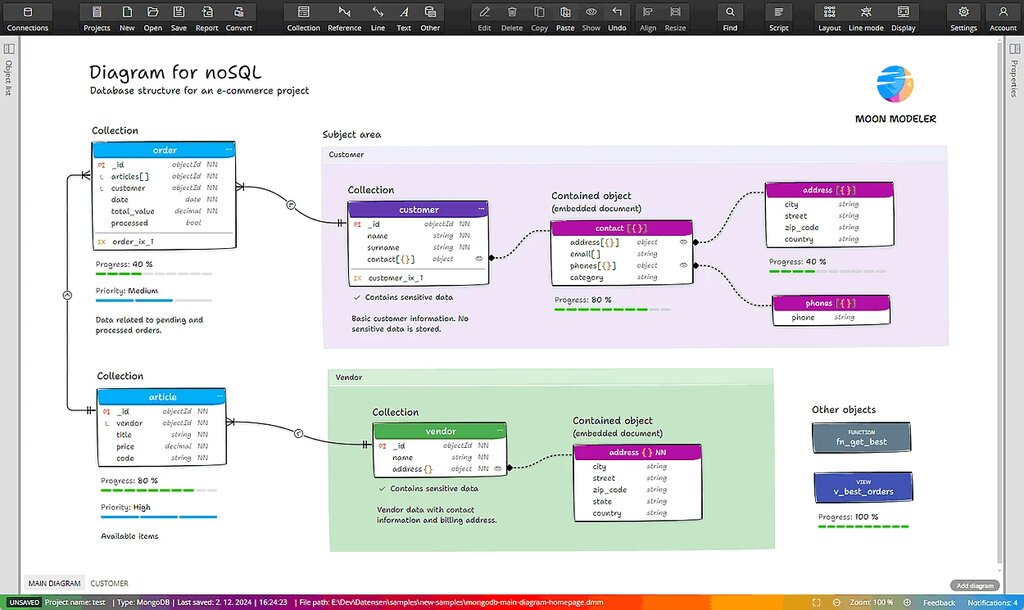
2. Key-Value Stores This is the simplest type of NoSQL database. Every item is stored as a key (a unique identifier) paired with a value. The value can be anything from a simple string to a complex object. Think of it like a giant dictionary or hash table.
Key-value stores are incredibly fast for retrieving data when you know the key. They are commonly used for caching, storing user session information, and real-time applications where quick lookups are critical.
3. Column-Family Stores While relational databases store data in rows, column-family (or wide-column) stores organize data into columns. Data for a single row is still grouped together, but you can have a massive number of columns, and you don't need to define them all upfront. This model is highly optimized for queries that aggregate data over specific columns.
This makes them excellent for analytics, logging systems, and any application that handles large-scale data processing.
4. Graph Databases Graph databases are built to store and navigate relationships. They use nodes (to store data entities) and edges (to represent the connections between those entities). If your data is highly interconnected, a graph database is often the best choice.
They excel at tasks like building social networks, fraud detection systems, and recommendation engines, where understanding the relationships between data points is key.
Why Choose NoSQL?
NoSQL databases shine in scenarios where traditional relational databases might struggle. They are built for the scale and complexity of modern applications.
- Big Data: They can handle vast amounts of data distributed across many servers.
- Flexibility: Evolving applications with changing data requirements benefit from a dynamic schema.
- High Performance: They are designed for simple, fast read/write operations at scale, making them ideal for real-time web applications.
By choosing the right NoSQL model, developers can build highly scalable, resilient, and performant systems. As we move forward, we'll see how Amazon DynamoDB, a key-value and document database, puts these principles into practice.
Which statement best describes the primary difference in how relational (SQL) and NoSQL databases scale?
A developer needs to build a recommendation engine that analyzes relationships between users and products. Which type of NoSQL database would be the most suitable for this task?