Amazing Animal Facts Interactive
Animal Classification
Ordering the Animal World
Our planet is home to millions of animal species, from tiny insects to massive blue whales. To make sense of this incredible diversity, scientists use a system called taxonomy. It's like a giant, detailed filing system for all living things.
Taxonomy
noun
The science of naming, defining, and classifying groups of biological organisms based on shared characteristics.
This system organizes animals into groups, and those groups into larger groups, creating a hierarchy. Think of it like your home address. You live in a house (species), on a street (genus), in a neighborhood (family), in a city (order), and so on. Each step up becomes more general.
The Taxonomic Ladder
The classification system has several major ranks. The highest rank is the most inclusive, and each rank below it becomes more specific. The main ranks are:
| Rank | Description |
|---|---|
| Kingdom | The highest level. For example, Animalia (all animals). |
| Phylum | Groups animals based on fundamental body plan. Ex: Chordata (animals with a backbone). |
| Class | A more specific grouping. Ex: Mammalia (mammals). |
| Order | Divides classes into smaller groups. Ex: Carnivora (carnivores). |
| Family | A group of related genera. Ex: Felidae (cats). |
| Genus | A group of closely related species. Ex: Felis (small cats). |
| Species | The most specific rank, identifying a single type of organism. |
A helpful mnemonic to remember this order is: King Philip Came Over For Good Soup. At the species level, we find a unique group of animals that can naturally reproduce with each other and create fertile offspring.
Species
noun
A group of living organisms consisting of similar individuals capable of exchanging genes or interbreeding.
Putting It All Together
Let's see how this works with a familiar animal: the house cat. By following its classification, we can see its relationship to other animals. The scientific name of a species is always written in italics and combines the genus and species: Felis catus.
| Rank | House Cat Classification | What it means |
|---|---|---|
| Kingdom | Animalia | It's an animal. |
| Phylum | Chordata | It has a backbone. |
| Class | Mammalia | It's a mammal (has fur, produces milk). |
| Order | Carnivora | It belongs to the carnivore group. |
| Family | Felidae | It's in the cat family. |
| Genus | Felis | It's a small cat. |
| Species | catus | It's a domestic house cat. |
This system shows us that a house cat is distantly related to all animals with a backbone, more closely related to all mammals, and very closely related to other members of the Felidae family, like lions and tigers. This branching tree of life is called a phylogenetic tree.
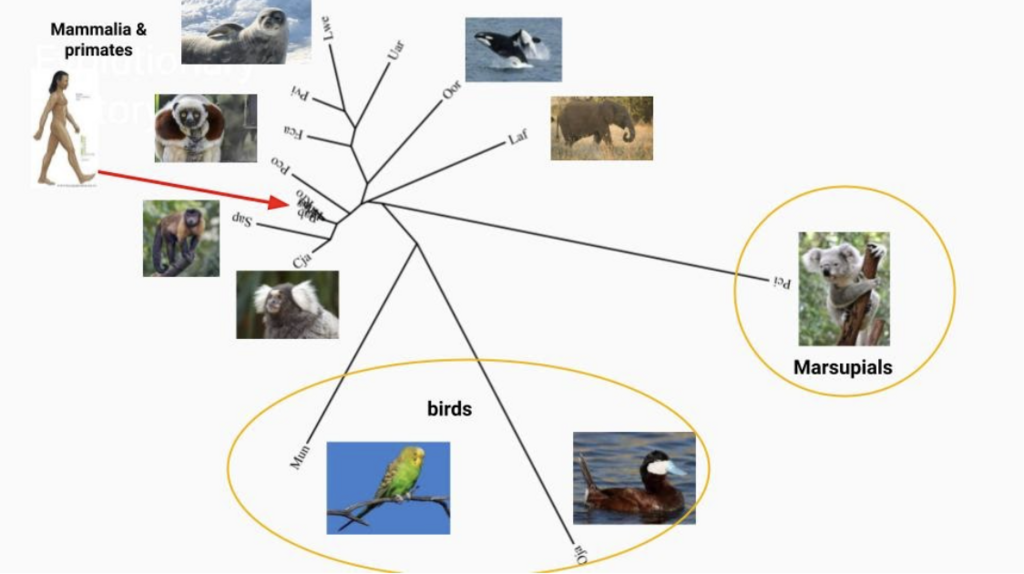
Classification isn't just about putting animals in boxes. It reflects their evolutionary history. Animals in the same genus share a very recent common ancestor. Animals that only share the same Kingdom, like a jellyfish and a wolf, have a common ancestor that lived hundreds of millions of years ago.
Now, let's test your knowledge of how this system works.
Which of the following lists the taxonomic ranks in the correct order, from most inclusive to least inclusive?
What is the primary characteristic that defines a group of animals as a single species?
Understanding this hierarchy is the first step to exploring the vast and fascinating world of animal life.