Alzheimer's Disease Explained
Understanding Alzheimer's Disease
What is Alzheimer's Disease?
Alzheimer's disease is a brain disorder that slowly destroys memory and thinking skills. Over time, it affects the ability to carry out even the simplest tasks. It's the most common cause of dementia, a general term for a decline in mental ability severe enough to interfere with daily life.
Alzheimer's disease is the biological process that begins with the appearance of a buildup of proteins in the form of amyloid plaques and neurofibrillary tangles in the brain.
The disease is progressive, meaning symptoms develop gradually and become more severe. It's not a normal part of aging, though the greatest known risk factor is increasing age.
Inside the Brain
To understand Alzheimer's, we need to look at what's happening on a microscopic level. The disease is characterized by two main culprits: amyloid plaques and neurofibrillary tangles. These two abnormal protein structures disrupt the work of neurons, the specialized cells that process and transmit information.
Plaque
noun
A sticky buildup of beta-amyloid protein that accumulates outside of neurons in the brain.
Beta-amyloid is a protein fragment that, in a healthy brain, is broken down and eliminated. In Alzheimer's, these fragments clump together to form hard, insoluble plaques between the neurons. These plaques can block cell-to-cell signaling at synapses, and they may also trigger inflammation.
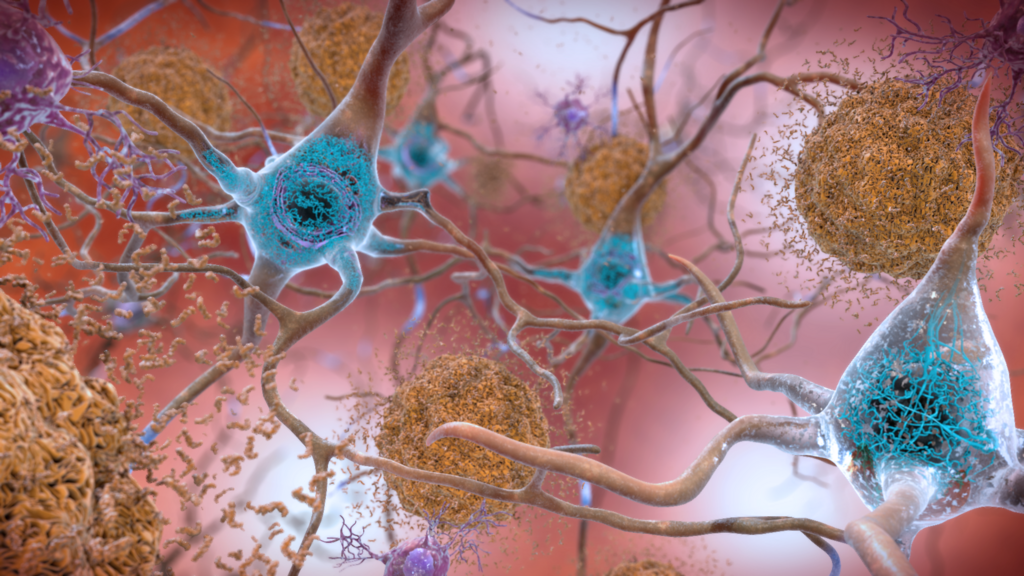
The other culprit is neurofibrillary tangles. These are abnormal accumulations of a protein called tau that collect inside neurons. In a healthy brain, tau helps stabilize microtubules, which are like tiny railway tracks that transport nutrients and other essential materials throughout the cell.
In Alzheimer's, tau proteins change shape and organize themselves into twisted strands, or tangles. These tangles disrupt the transport system and are toxic to the cells, eventually leading to neuron death. As neurons die, the brain begins to shrink, a process called brain atrophy.
Who Is Affected?
Alzheimer's primarily affects older adults. In the United States, about 6.9 million people aged 65 and older are living with Alzheimer's dementia. The prevalence increases significantly with age; more than 70% of those with the disease are 75 years old or older.
Recognizing Early Signs
The initial symptoms of Alzheimer's can be subtle. One of the most common early signs is difficulty remembering new information. This is because the disease often begins by damaging the parts of the brain involved in learning and memory.
Early symptoms of Alzheimer's disease include forgetting recent events or conversations.
As the disease progresses, other symptoms appear. These can include:
- Challenges in planning or solving problems: Some people may experience changes in their ability to develop and follow a plan or work with numbers. They might have trouble following a familiar recipe or keeping track of monthly bills.
- Difficulty with familiar tasks: Everyday tasks can become challenging. A person might have trouble driving to a familiar location or remembering the rules of a favorite game.
- Confusion with time or place: People with Alzheimer's can lose track of dates, seasons, and the passage of time. They may sometimes forget where they are or how they got there.
Memory loss that disrupts daily life is more than just typical age-related forgetfulness, like misplacing keys. It's about forgetting important dates or events and repeatedly asking for the same information.
Now, let's test your understanding of these fundamental concepts.
Alzheimer's disease is best described as:
What are the two hallmark protein structures that build up in the brain in Alzheimer's disease?
Recognizing the biological basis and early signs of Alzheimer's is the first step in understanding this complex condition.